Tsutomu Watanabe, Professor Emeritus at the University of Tokyo and a former Bank of Japan economist, along with others, has expressed strong concerns regarding the economic policies centered on the “responsible proactive fiscal policy” advocated by the Takaichi administration. They warn that policy management that relies on growth expectations and lacks alternative plans carries the risk of triggering further depreciation of the yen, rising interest rates, and soaring prices, thereby squeezing the livelihoods of citizens.
- Key points of the events and an overview of the warnings issued by former BOJ academics and others
- The Philosophy of Responsible Proactive Fiscal Policy and Initial Market Reactions
- The Trap of Relying on Growth Expectations Without a Plan B
- The Erosion of Fiscal Discipline and Upward Pressure on Government Bond Markets and Interest Rates
- Financial strain on daily life due to the depreciation of the yen and cost-push inflation
- Future Outlook and Key Points
Key points of the events and an overview of the warnings issued by former BOJ academics and others
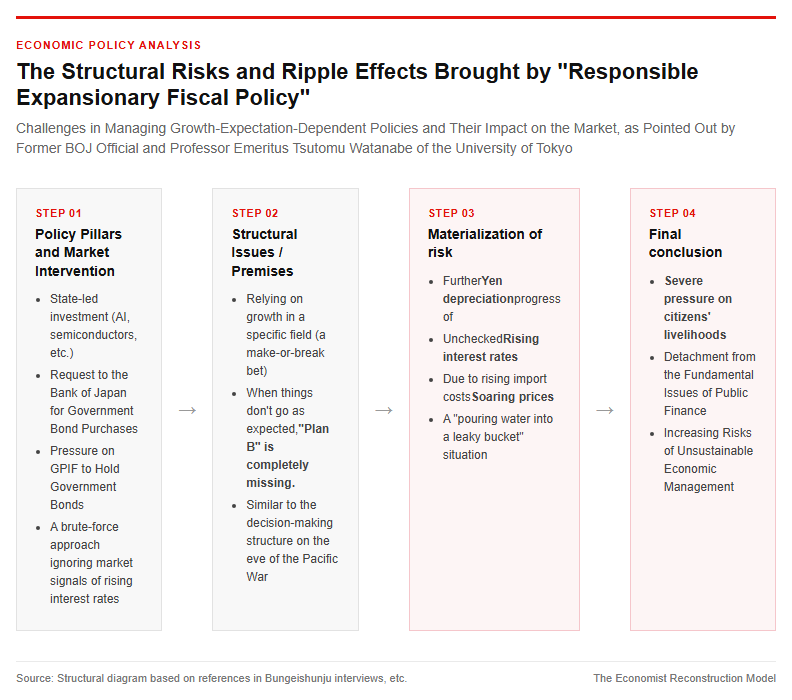
The Takaichi administration, which was inaugurated in October 2025, advocates a “responsible proactive fiscal policy” centered on state-led investment and increased spending. In response, Tsutomu Watanabe, professor emeritus at the University of Tokyo and an economist formerly with the Bank of Japan, and hedge fund manager Naofumi Tsukaguchi have successively sounded the alarm in dialogues such as those in Bungeishunju. Watanabe and others sharply point out that this is a make-or-break policy management that assumes growth investments in specific fields such as artificial intelligence and semiconductors will succeed, completely lacking a risk management strategy—namely, a Plan B—in the event that economic growth fails to materialize as expected. They also express concern that the attitude of pushing through policies based on such wishful thinking bears a resemblance to the decision-making structure on the eve of the outbreak of the Pacific War. Furthermore, they criticize requests for the Bank of Japan to purchase government bonds and pressure on the Government Pension Investment Fund to hold government bonds as brute-force tactics akin to pouring water into a leaking bucket while ignoring market signals of rising interest rates, turning a blind eye to fundamental fiscal challenges. Please refer to the figure below.
The Philosophy of Responsible Proactive Fiscal Policy and Initial Market Reactions
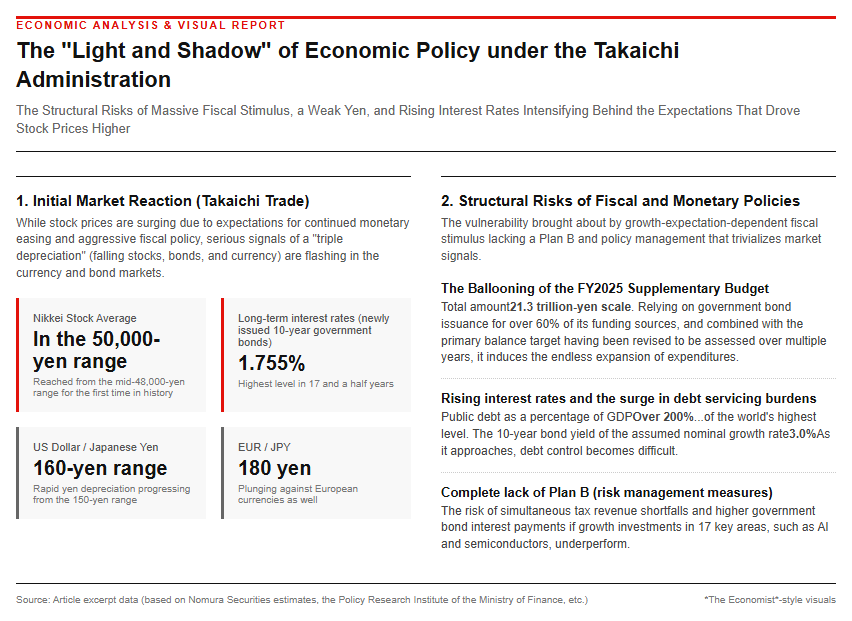
Immediately after the inauguration of the Takaichi administration, stock prices temporarily surged in the stock market due to expectations of aggressive fiscal policy and the continuation of monetary easing, with the Nikkei Stock Average seeing phases where it moved from the 48,000-yen range to reach the 50,000-yen range for the first time in history. In the market, this movement was dubbed the “Takaichi trade.” However, behind this, deep-seated concerns also spread regarding the government’s massive fiscal stimulus and the expansion of the supplementary budget. The FY2025 supplementary budget reached a total scale of 21.3 trillion yen, adopting a structure that depended on government bond issuance for over 60% of its funding sources. Prompted by this fiscal expansion stance, government bonds were sold in the bond market, and long-term interest rates (newly issued 10-year government bond yields) rose to 1.755%, the highest level in 17 and a half years. In the foreign exchange market as well, yen selling accelerated, with the US dollar-yen exchange rate depreciating from the 150-yen range to temporarily surpass 160 yen per US dollar, and the euro-yen exchange rate also plunging to 180 yen per euro. Thus, behind the rising stock prices, a severe chain reaction of a weaker yen and falling bond prices occurred.
Structural Risks and Concerns Facing Fiscal and Monetary Policy
The Trap of Relying on Growth Expectations Without a Plan B
What is emphasized most in the points raised by Watanabe and others is the uncertainty of the growth strategy and the absence of risk management. The Takaichi administration has adopted a strategy of making growth investments in 17 fields such as AI and semiconductors, increasing tax revenues by boosting nominal GDP, and aiming to reduce debt relative to GDP. However, in the high-tech industry where global competition is intensifying, there is no guarantee that Japan’s state-led investments will reliably achieve the targeted high growth rates. If the expected growth fails to materialize and only expenditures expand, a shortage of tax revenues and an increase in government bond interest payments will hit simultaneously, leading to a continuous deterioration of the fiscal balance. There are also concerns that the politically driven withdrawal of the single-year primary balance surplus target and its revision to multi-year verification will lead to the endless expansion of expenditures without a brake.
The Erosion of Fiscal Discipline and Upward Pressure on Government Bond Markets and Interest Rates
Japan’s public debt outstanding exceeds 200% of GDP, the highest level in the world, and faces a structural vulnerability where interest payment burdens on government bonds would surge in a rising interest rate environment. According to an analysis by the Policy Research Institute of the Ministry of Finance, even for domestically denominated government bonds, if undisciplined fiscal financing and market support become normalized, there is a warning that it could trigger a loss of confidence in the currency and runaway inflation. Nomura Securities estimates that while the market has already priced in to a certain extent an expansion of the fiscal deficit exceeding 10 trillion yen per year and an increase in government bond issuance, if the 10-year bond yield approaches the assumed nominal growth rate of 3.0%, curbing the debt-to-GDP ratio will become difficult. If the government fails to consider the market and attempts to force or suppress low interest rates, it risks instead triggering a sell-off of government bonds and rapid capital flight. Please refer to the figure below.
Impact on Household Budgets and Future Outlook
Financial strain on daily life due to the depreciation of the yen and cost-push inflation
The depreciation of the yen, driven by a combination of expansionary fiscal policy and political pressure on the Bank of Japan to refrain from raising interest rates, is significantly driving up import prices for food, energy, and other goods. As real wages have continued to fall below the previous year’s levels for an extended period, the situation where the inflation rate exceeds wage growth is functioning as an “inflation tax” that erodes households’ real income. Takahide Kiuchi, Executive Economist at Nomura Research Institute, points out that if political intervention to curb interest rate hikes by the Bank of Japan intensifies, it will further fuel the depreciation of the yen and high prices, creating the contradiction of directly pressing down on the livelihoods of citizens, particularly low-income earners. While rising stock prices and real estate values benefit a handful of the wealthy and large corporations, the burden on assetless working households is increasing, and the expansion of nominal figures without improvements in the real economy is widening social disparities.
Future Outlook and Key Points
The most critical point in forecasting the future of the Japanese economy is whether the Takaichi administration can correct its excessively expansionary fiscal stance and maintain market confidence. The appointment of Satsuki Katayama as Minister of Finance, who has expressed concern over the impact of a weak yen on households and shown flexibility in respecting a certain degree of fiscal discipline and the BOJ’s independence, has served to curb extreme market volatility. Moving forward, questions will be raised about the securing of permanent funding sources for specific measures such as consumption tax cuts and cash handouts, as well as the effectiveness of the mid-term fiscal plan accompanying the review of the primary balance target. Additionally, whether the BOJ can fend off political pressure and implement interest rate hikes toward a neutral interest rate level in a timely and appropriate manner will determine the stability of the foreign exchange and government bond markets. The ultimate focus will be on whether it can avoid a loss of market confidence and achieve sustained real wage growth that outpaces inflation.
Reference Page
- [The Takaichi Administration’s Economic Policy: “Plunging ahead based on wishful thinking is just like the last war”—Former BOJ Economist and Skilled Fund Manager Sound the Alarm] https://bunshun.jp/articles/-/92782
[#TakaichiAdministration #Sanaenomics #AggressiveFiscalPolicy #JapaneseEconomy #Inflation]


コメント