With the Bank of Japan raising its policy interest rate to around 1.25% on September 18, 2026, the bond market has grown increasingly focused on the “terminal rate,” the ultimate peak of the rate-hike cycle. Behind this lies a rise in inflation concerns driven by supply constraints associated with labor shortages and expansionary fiscal policies, alongside moves to improve market functionality accompanying the reduction in the BOJ’s Japanese government bond purchases.
- Key points of the event: September rate hike and awareness of the “terminal rate”
- Behind Accelerated Rate Hikes: Intensifying Supply Constraints and Entrenched Inflation
- Fiscal Policy and Risk Premiums: Market Warnings and the “Bad Rise in Interest Rates”
- Structural Changes in the Government Bond Market: BOJ Bond Purchase Reductions and Investor Response
- Spillover to Economic Entities: Disparities in Interest Rate Resilience Among Households, Corporations, and Governments
- Future Outlook and Points to Watch: Exploring the Neutral Interest Rate and Dialogue with the Market
Key points of the event: September rate hike and awareness of the “terminal rate”
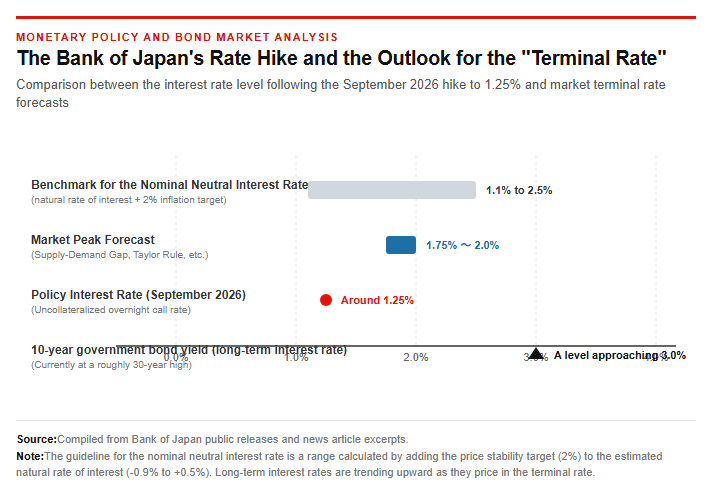
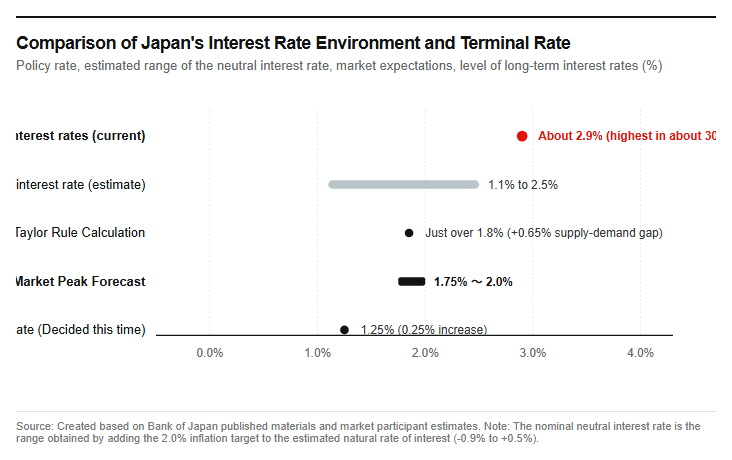
At the Monetary Policy Meeting held on September 17 and 18, 2026, the Bank of Japan decided to raise the policy interest rate (the uncollateralized overnight call rate) by 0.25 percentage points to around 1.25%. Since lifting the negative interest rate policy in March 2024, phased rate hikes have been implemented, but this latest decision has shortened the interval between hikes compared to before, and the market perceives this as a transition toward a standard pace of rate hikes even from an international perspective. Along with rising interest rates, bond market participants’ attention is rapidly shifting toward the specific level and timing of the “terminal rate,” which is the ultimate destination of the rate hikes. Adding the 2% inflation target to the Bank of Japan’s published estimates for the natural rate of interest—ranging from minus 0.9% to plus 0.5%—results in a broad estimated range for the nominal neutral interest rate of approximately 1.1% to 2.5%. Among market participants, views are spreading that the endpoint of the current rate hike cycle will be around 1.75% to 2.0%, based on calculations derived from the transition of the output gap to positive territory and the Taylor rule. Consequently, long-term interest rates, such as 10-year government bond yields, have followed an upward trend to price in this terminal point, and are currently hovering near 3%, marking their highest level in about 30 years.
Behind Accelerated Rate Hikes: Intensifying Supply Constraints and Entrenched Inflation
The Bank of Japan’s continued stance on interest rate hikes is driven by intensifying structural supply constraints in the domestic economy and the accompanying entrenchment of underlying inflationary pressure. In particular, the increase in unit labor costs caused by labor shortages and the accelerating speed of price-passing by companies are acting as major factors pushing up prices. Since entering the 2020s, the medium- to long-term expected inflation rate of businesses and households has shown a consistent upward trend, and amidst the prolonged high prices, people’s views on prices themselves are shifting to an “inflation-premised” mindset. Furthermore, proactive fiscal policies—such as the government’s proposed investments in 17 strategic fields (on a scale of about 10 trillion yen annually) and a reduction in the consumption tax on food—are expected to be implemented, which will likely tighten the domestic supply-demand gap further and create a state of excess demand. With the supply-demand gap being upwardly revised to around plus 0.65%, the appropriate policy interest rate level when applying a standard Taylor rule is calculated to be a little over 1.8%, strengthening the necessity to raise the policy interest rate to a level equal to or higher than the neutral interest rate in order to achieve the 2% inflation target. Such changes in the macroeconomic environment are a strong factor making market participants confident in a higher “goal” for interest rate hikes.
Expansionary Fiscal Policy, Changes in the Supply-Demand Structure, and the Risk of Rising Interest Rates
Fiscal Policy and Risk Premiums: Market Warnings and the “Bad Rise in Interest Rates”
Breaking down the rise in long-term interest rates (10-year Japanese government bond yields) into their constituent factors, we can see that in addition to upward revisions in expectations for future short-term interest rates, the expansion of the term premium (compensation for risk) has contributed significantly. The recent rise in the premium reflects market concerns over the Japanese government’s aggressive fiscal policies, amounting to a scale of 15 trillion yen annually, and the continuation of structural primary balance deficits. The rise in real long-term interest rates and inflation-indexed bond yields not only represents a “good rise in interest rates” driven by heightened growth expectations, but also carries the aspect of a warning bell reflecting concerns over fiscal deterioration and market distrust in monetary policy. Triggered by reports regarding the draft Basic Policy on Economic and Fiscal Management and Reform published in July 2026 (the so-called “Basic Policy shock”), the political stance of keeping rate hikes in check evoked risks of falling “behind the curve,” which also led to a sell-off of government bonds and a sharp spike in interest rates. There are growing concerns that if a “bad rise in interest rates” driven by the premium—caused by a decline in fiscal credibility and worsening supply and demand without any accompanying improvement in growth rates—becomes entrenched, it would significantly drive up the government’s borrowing costs and pose the risk of destabilizing the entire financial market.
Structural Changes in the Government Bond Market: BOJ Bond Purchase Reductions and Investor Response
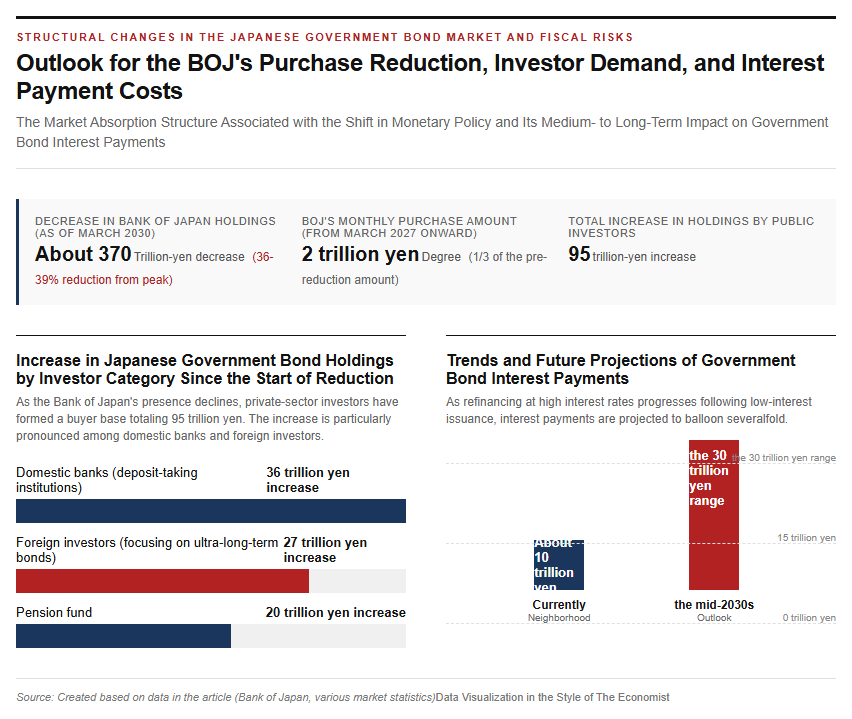
The supply and demand structure in the bond market is also reaching a major turning point. Based on the Japanese government bond purchase reduction plan decided in July 2024, the Bank of Japan is proceeding with a policy to gradually reduce its monthly purchase amount, shrinking it to about 2 trillion yen per month (one-third of the level prior to the start of reductions) by March 2027. While the decision in June 2026 indicated a halt to purchase reductions from April 2027 onward and the maintenance of about 2 trillion yen per month, the BOJ’s holdings as of March 2030 are expected to decrease by about 36% to 39% compared to the peak level (a reduction on a scale of approximately 370 trillion yen). As the BOJ’s market presence declines, improvements in price discovery functions are progressing—such as increased government bond market trading volume and the resolution of yield curve distortions—while securing alternative buyers for government bonds to take the place of the BOJ remains a challenge. Since the start of the reductions, commercial investors’ government bond holdings have increased by 95 trillion yen, with domestic banks (deposit-taking institutions) increasing their holdings by 36 trillion yen, pension funds by 20 trillion yen, and foreign investors by 27 trillion yen, respectively. In particular, foreign investors have been actively purchasing super-long-term bonds due to the attractiveness of hedged yields, but the rising ownership share of foreign investors could also become a factor that increases market volatility.
Impact on Economic Entities and Future Policy Outlook
Spillover to Economic Entities: Disparities in Interest Rate Resilience Among Households, Corporations, and Governments
Rising interest rates are exerting asymmetric effects on the various economic agents of households, businesses, and the government. Looking at the private sector as a whole, its resilience to interest rates is relatively high because abundant cash and deposits and an increase in interest income offset the heavier burden of interest payments, and it is estimated that the downward pressure on real GDP from a 1 percentage point increase in the policy rate remains at around 0.3%. However, positive and negative impacts are heavily skewed among households: while the elderly demographic holding financial assets benefits from interest income, young and child-rearing households with a high ratio of variable-rate mortgages face increased monthly repayment burdens. Similarly, in the corporate sector, while resilience remains strong for large enterprises and cash-rich sectors, the negative impact on business performance is pronounced in industries with a high dependence on interest-bearing debt, such as real estate, as well as low-margin small and medium-sized enterprises (SMEs). The impact is most severe in the government sector, where the refinancing of government bonds issued under past low interest rates with high-rate bonds will cause government bond interest payments to balloon from the current level of around 10 trillion yen to the 30 trillion-yen range by the mid-2030s. To maintain fiscal sustainability, shifting the expenditure structure by revising interest rate assumptions has become an urgent priority.
Future Outlook and Points to Watch: Exploring the Neutral Interest Rate and Dialogue with the Market
The single biggest point of focus in the outlook for future monetary policy and the bond market is balancing the Bank of Japan’s targeted terminal policy rate with the pace of rate hikes. In the baseline scenario, the BOJ is expected to raise rates by 25 basis points at a standard pace of roughly once a quarter (every three months), reaching a policy rate of around 2.0% by mid-2027 to complete the rate-hike cycle. However, the market is also debating the BOJ’s own financial risks associated with rate hikes, including the emergence of a negative spread due to increased interest payments on current accounts and the widening of deficits (on a scale of 4 trillion to 5 trillion yen annually) once the policy rate reaches 2%. Furthermore, policymakers must keep a close eye on overseas risk factors, such as the possibility that long-term interest rates might price in the terminal rate early and peak out, trends in the U.S. economy, and higher crude oil prices driven by Middle Eastern tensions. The Bank of Japan is expected to maintain careful communication with the market as it explores the neutral rate while preserving liquidity in the Japanese government bond market. For the government, the paramount challenge will be to maintain market confidence by going beyond mere economic stimulus and consistently demonstrating a commitment to spurring private investment for enhanced growth potential and securing permanent revenue sources.
Reference page
- 【Bank of Japan】 The Impact of the Bank of Japan’s Reduction in Government Bond Purchases on the Government Bond Market (Bank of Japan Review) https://www.boj.or.jp
- [Tokyo Foundation] Two Risks Associated with the Normalization of the Bank of Japan’s Monetary Policy https://www.tkfd.or.jp/research/detail.php?id=4669
- [Sumitomo Mitsui DS Asset Management] Decoding the BOJ’s Interest Rate Hike Stance (Part 1) [suspicious link removed]
- [Nomura Securities] Bank of Japan Moving to a “Normal” Pace of Rate Hikes https://www.nomura.co.jp/wealthstyle/
- [Nomura Research Institute] Rise in Long-Term Interest Rates Due to Basic Policies Shock Is a Market Warning to Fiscal Policy https://www.nri.com/jp/media/column/kiuchi/20260708.html
【#BankOfJapan #RateHike #BondMarket #TerminalRate #LongTermInterestRates #EconomicPolicy #FiscalRisk】

コメント