Major digital pen manufacturer Wacom, in partnership with investment fund MBK Partners, has announced a management buyout (MBO) to take the company private. The backdrop includes struggles in its brand business due to the rise of Chinese competitors, the desire to escape short-term stock market pressures, and the need to accelerate medium- to long-term upfront investments.
- TOB scheme featuring an acquisition price of 1,030 yen and a total of approximately 136.6 billion yen
- Samsung’s Re-investment and the Complex Capital Structure of Major Shareholders
- Struggles in the Branded Product Business and the Relentless Pursuit by Chinese Competitors and iPad
- Short-Term Performance Constraints and Structural Challenges in Listed Companies
- Liberation from Quarterly Pressures and Promotion of Fundamental Management Reforms and M&A
- Delisting Procedures and Medium-to-Long-Term Outlook for the Pen Tablet Market
TOB scheme featuring an acquisition price of 1,030 yen and a total of approximately 136.6 billion yen
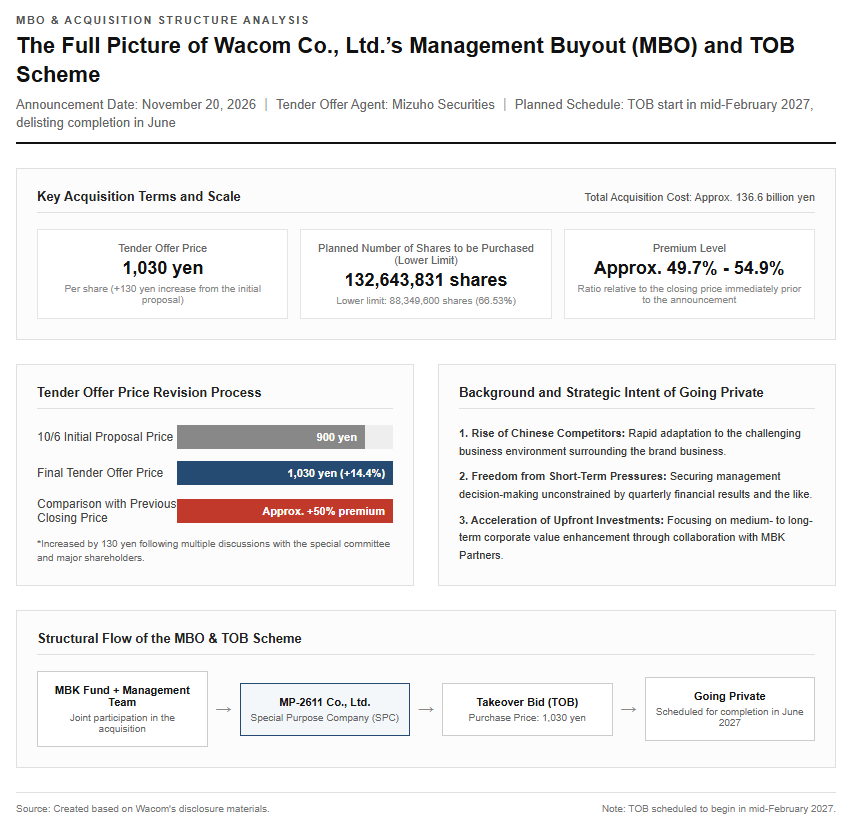
On November 20, 2026, digital pen system major Wacom (6727), listed on the Tokyo Stock Exchange Prime Market, announced plans for a management buyout (MBO) and a tender offer (TOB) to take the company private. The tender offeror is “MP-2611 Co., Ltd.,” a special purpose company (SPC) under a fund serviced by the Asian investment fund MBK Partners, and Wacom Representative Director, President, and CEO Nobutaka Ide is also participating in the acquisition.
The tender offer price was set at 1,030 yen per common share. In determining this acquisition price, it was raised by 130 yen (approximately 14.4%) from the initial proposal of 900 yen per share on October 6, following multiple rounds of discussions with Wacom’s independent special committee and major shareholders. The price of 1,030 yen represents a high premium of approximately 49.7% to 54.9% over the closing price on the Tokyo Stock Exchange Prime Market immediately prior to the announcement.
The planned number of shares to be purchased is 132,643,831 shares, with the lower limit set at 88,349,600 shares, which corresponds to an ownership ratio of 66.53%, making it a large-scale deal with a total acquisition cost of approximately 136.6 billion yen (roughly the 140 billion yen scale). Following regulatory approval procedures under domestic and international competition laws and investment regulations, the TOB is scheduled to start around mid-February 2027, aiming to complete the delisting by June 2027. Mizuho Securities is scheduled to act as the tender offer agent. The flow of this acquisition overview and structural scheme is outlined in the configuration below.
Samsung’s Re-investment and the Complex Capital Structure of Major Shareholders
This MBO scheme goes beyond a simple fund-led acquisition, featuring a complex re-investment and tendering structure involving existing major shareholders, management, and major shareholder funds.
One of the most notable developments is the move by Wacom’s second-largest shareholder, Samsung Electronics Singapore Pte. Ltd. (SESP) of South Korea’s Samsung Group, which owns 6.32% of the issued shares (8,398,400 shares). SESP has signed an agreement to tender all of its held shares in this TOB, and plans to make a re-investment into the acquirer’s parent company (MP-2610) within five business days following the completion of the TOB settlement, thereby securing and maintaining a voting rights ratio of approximately 6.3% on a fully diluted basis. Wacom and Samsung have had a capital and business alliance since January 2013, with a clear intent to continue and develop a long-term, stable partnership, including the supply of core S Pen technology for the smartphone “Galaxy” series.
At the same time, Wacom President Nobutaka Ide has solidified his policy not to tender his personally held 155,953 shares (0.12% ownership ratio) to the TOB, but instead to re-invest in the acquiring parent company after the go-private transaction, and to continue leading management post-acquisition. Meanwhile, British investment fund Asset Value Investors (AVI, 20.16% stake) and US-based Kaname Capital (5.38% stake), which had been demanding management improvements from Wacom, have agreed to tender their entire holdings to the TOB. Ultimately, the acquiring company will absorb and merge Wacom, creating a structure where the three parties—funds under MBK Partners, President Ide, and SESP—will support management as shareholders of the surviving company.
The Operating Environment and Background Behind the Decision to Go Private
Struggles in the Branded Product Business and the Relentless Pursuit by Chinese Competitors and iPad
The backdrop to Wacom’s decision to undertake an MBO accompanied by a delisting lies in dramatic changes in the market environment and sluggish business performance confronting its branded product business, one of the company’s two major business pillars.
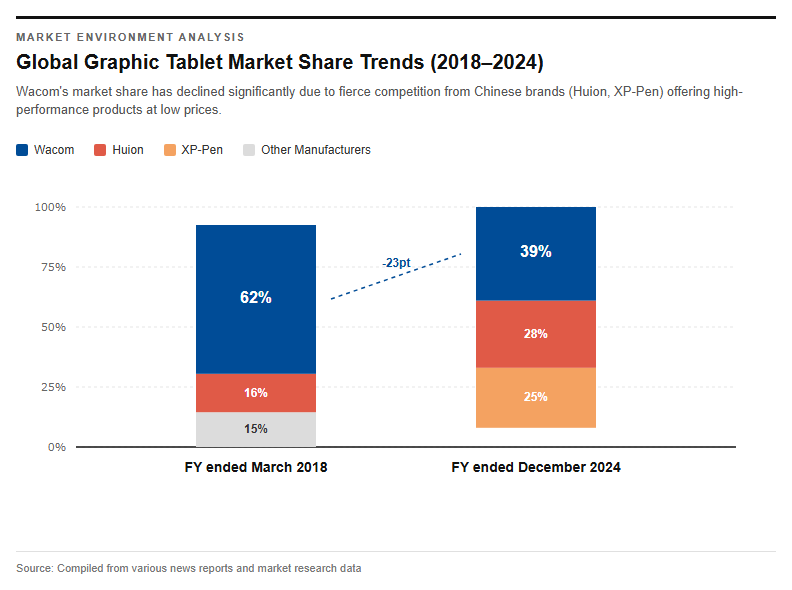
Wacom has long boasted an overwhelming global share in the pen tablets and interactive pen displays market for professional creators in film production and graphic design. In recent years, however, emerging manufacturers such as Huion and XP-Pen from China have successively introduced high-cost-performance, mid-to-low-priced products equipped with equivalent features, showing a rapid surge in the market. In the global graphic tablet market share, Wacom saw its share drop significantly from 62% for the fiscal year ended March 2018 to 39% for the fiscal year ended December 2024. Over the same period, Huion rapidly expanded its share from 16% to 28% and XP-Pen from 15% to 25%, eroding Wacom’s solid foundation in the entry and middle zones.
Furthermore, the technological evolution of general-purpose tablets—most notably the iPad Pro, which comes standard with the Apple Pencil—has also been a major factor preventing entry-level illustrators and digital art beginners from entering the market. In the fiscal year ending March 2026, the brand business successfully returned to profitability thanks to the new introduction of the portable creative category, including the “Wacom MovinkPad,” and business structural reforms (fixed cost reductions) totaling approximately 2.9 billion yen. However, there was an urgent need for fundamental medium-to-long-term countermeasures against intense price competition. A conceptual diagram of market share changes among major manufacturers and product classifications is shown below.
Short-Term Performance Constraints and Structural Challenges in Listed Companies
On the other hand, the “Technology Solution Business,” which supplies digital pen technology (EMR and AES technologies) to OEM finished product manufacturers of smartphones, notebook PCs, and other devices, is the largest revenue source, generating approximately 70% of the company’s consolidated net sales (71.5% for the fiscal year ended March 2026, and 70.2% for the fiscal year ended March 30, 2026).
However, this Technology Solution Business faces structural challenges where overall performance is easily swayed by the shipping trends of major OEM customers and economic environments such as the Chinese market. Additionally, as a listed company, it has been necessary to maintain quarterly financial disclosures and shareholder return policies, such as a consolidated total return ratio of 50% or higher and a principle of progressive dividends. As a result, short-term demands from the stock market and considerations for the stock price were prioritized, placing constraints on the allocation of funds for flexible research and development investments, the launch of new businesses, and accelerating product development cycles from a medium-to-long-term perspective.
Amid the simultaneous onslaught of rapid advancements in AI technology, soaring component prices, and intensifying competition from Chinese players, the company concluded that establishing a management foundation with a high degree of freedom through going private is indispensable for aggressively promoting full-scale entry into growth areas such as education, medical care, and business DX, as well as proactive M&A. Note that contingent upon the successful completion of this TOB, Wacom has resolved to revise its year-end dividend forecast for the fiscal year ending March 2027 from the conventional 12 yen per share to 0 yen (no dividend).
Business Strategy and Medium-to-Long-Term Outlook After Going Private
Liberation from Quarterly Pressures and Promotion of Fundamental Management Reforms and M&A
Following the completion of the tender offer and the series of going-private procedures, Wacom will be completely freed from stock market pressures such as quarterly financial results and short-term stock price fluctuations. This will make it possible to dynamically promote fundamental business structure restructuring and strategic investments from a medium-to-long-term perspective.
Key initiatives following the going private include refreshing the product portfolio to counter price competition from Chinese competing manufacturers, and developing highly specialized business-focused solutions such as education, healthcare, and retail delivery DX. Furthermore, by leveraging the abundant financial resources, management know-how, and global network held by MBK Partners—its co-acquisition partner—the company plans to significantly accelerate M&A (mergers and acquisitions) aimed at acquiring new technologies in the digital pen and digital ink fields, as well as the recruitment of top-tier IT talent.
In its medium-term management plan “Wacom Chapter 4,” Wacom has set ambitious numerical targets of 150 billion yen in net sales and 15 billion yen in operating income for the final fiscal year ending March 2029. Moving forward, the company plans to redefine the digital pen as “the optimal interface for humans to master AI,” strongly promoting a shift from a mere hardware one-off sales model to a “hardware sales + various services” or SaaS-type business model.
Delisting Procedures and Medium-to-Long-Term Outlook for the Pen Tablet Market
If the TOB, scheduled to start around mid-February 2027, is successfully completed, Wacom will undergo prescribed squeeze-out procedures (such as a share consolidation procedure from minority shareholders) and be delisted from the Tokyo Stock Exchange Prime Market, where it has long been familiar. General individual investors and existing shareholders will have the choice to tender their shares through a designated agent securities company during the TOB period or sell their shares on the market.
Whether Wacom, having transitioned to a private company, can improve its development speed and rebuild its brand power under a strong alliance with MBK Partners and Samsung will have a profound impact on the overall power balance of the global digital art and pen tablet market.
According to market research reports, the global pen tablet market size is projected to grow from approximately $1.8 billion in 2026 to $4.9 billion in 2035, showing a steady expansion with a compound annual growth rate (CAGR) of 11.6%. The extent to which Wacom can develop new growth markets such as education, healthcare, and office DX while maintaining the overwhelming product quality and reliability in the professional market will be the primary focal point that determines Wacom’s medium-to-long-term revitalization and growth after going private.
Reference Page
- [Wacom Co., Ltd. Official IR Information] https://investors.wacom.com/ja-jp/
[#Wacom #MBO #MBKPartners #TOB #PenTablets #GoingPrivate #Samsung #Acquisition]


コメント