The number of Japanese stocks indirectly held by the Bank of Japan (BOJ) through exchange-traded funds (ETFs) is expected to decrease significantly. This is driven by the structural reform of the Tokyo Stock Price Index (TOPIX) being promoted by Japan Exchange Group (JPX), as the narrowing down of constituent stocks will also bring about major changes to the actual composition of the BOJ’s portfolio.
- [Key Takeaways] Changes in the composition of the Bank of Japan’s stock holdings associated with the TOPIX reform
- [Background and Mechanism] The Reason Why “Indirectly Held Companies” Are Decreasing, Rather Than the Number of ETF Products
- [Market Impact] Phased Adjustment Rules and Direct Impact on Stock Supply and Demand
- [Management and Governance] Addressing Buyer Failure and Incentives for Enhancing Corporate Value
- [Future Outlook and Key Points] Re-evaluations and Medium-to-Long-Term Scenarios Investors Should Watch Closely
[Key Takeaways] Changes in the composition of the Bank of Japan’s stock holdings associated with the TOPIX reform
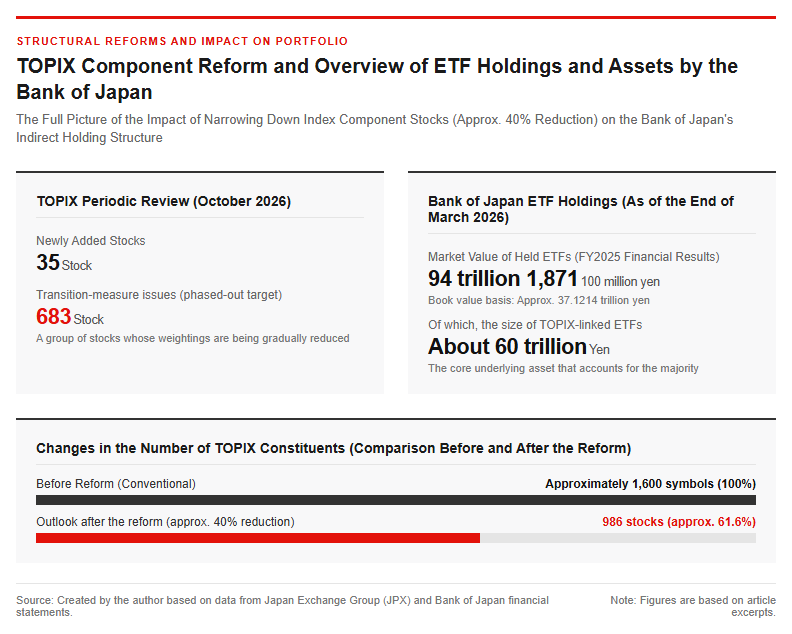
On October 7, 2026, Japan Exchange Group (JPX) announced the selection results for the first periodic review of the Tokyo Stock Price Index (TOPIX). In this review, 35 stocks were newly added, while 683 stocks were designated as transition-measure stocks subject to a phased reduction in their weighting. As a result, the number of TOPIX constituent stocks is expected to decrease by about 40%, dropping from approximately 1,600 to 986.
This index reform will also have a direct impact on the portfolio of the Bank of Japan, which holds a massive amount of TOPIX-linked ETFs. According to the BOJ’s financial results for fiscal 2025 (as of the end of March 2026) released by the bank, the market value of the ETFs held by the BOJ has reached approximately 94.1871 trillion yen (about 37.1214 trillion yen on a book value basis). Of this total, TOPIX-linked ETFs account for the vast majority at approximately 60 trillion yen. As ETF management companies reallocate their holdings in conjunction with the reshuffling of index constituent stocks, the number of companies indirectly held by the BOJ will be significantly reduced.
The following figure shows the trends in the market value and book value of ETFs held by the Bank of Japan, as well as an overview of the changes in the number of constituent stocks resulting from the current TOPIX reform.
For investors, we have reached a phase where it is essential to closely examine a new supply-and-demand factor—namely, the skew in capital allocation caused by index rule changes—in addition to the Bank of Japan’s selling process in its monetary easing exit policy.
[Background and Mechanism] The Reason Why “Indirectly Held Companies” Are Decreasing, Rather Than the Number of ETF Products
What is easily misunderstood in this announcement is that the variety of “financial products known as ETFs (exchange-traded funds)” held by the Bank of Japan is not what is decreasing. What is actually decreasing significantly is the “number of individual company stock issues underlying them” that are internally incorporated by the ETF asset management companies.
The Bank of Japan itself does not buy and sell stocks by evaluating the growth potential or financial performance of individual companies. TOPIX-linked ETFs are designed so that asset management companies buy and hold physical stocks matching the constituent issues and their weightings in order to track the price movements of the index. Due to the recent TOPIX reform, when the index weightings of companies designated as transition-measure issues are lowered, asset management companies mechanically sell the corresponding stocks and reallocate funds to continuously included issues and newly added issues. As a result, the lineup of companies indirectly held by the Bank of Japan through ETFs will be narrowed down.
Moreover, TOPIX is an index that calculates its constituent ratios based on free-float market capitalization rather than weighting each company with an equal monetary amount. Therefore, the fact that the number of stocks will decrease by about 40% does not mean that the BOJ’s ETF holdings themselves will decrease by 40%. Because the capital recovered from the excluded stocks will be reinvested into the major companies remaining in the index, the structure is designed to heighten the concentration of funds into specific large-cap and highly liquid stocks.
[Market Impact] Phased Adjustment Rules and Direct Impact on Stock Supply and Demand
To cushion the market against sudden supply-and-demand shocks, Japan Exchange Group (JPX) has implemented measures to reduce the weight of transitional issues in phases rather than all at once. Specifically, the plan is to reduce their component ratio toward zero in a total of eight quarterly stages over a period of approximately two years from the end of October 2026 to the end of July 2028. Furthermore, a re-evaluation of transitional issues is scheduled for October 2027, and a mechanism is also in place to halt weight reductions for companies that meet the criteria for liquidity and free-float market capitalization.
Assets under management linked to the TOPIX, including public pension trusts and private investment trusts, amount to approximately 160 trillion yen. Because this massive pool of capital will be gradually reallocated, stocks designated for transitional measures will face sustained selling pressure, while the 35 stocks slated for continued or new inclusion will generate buying demand.
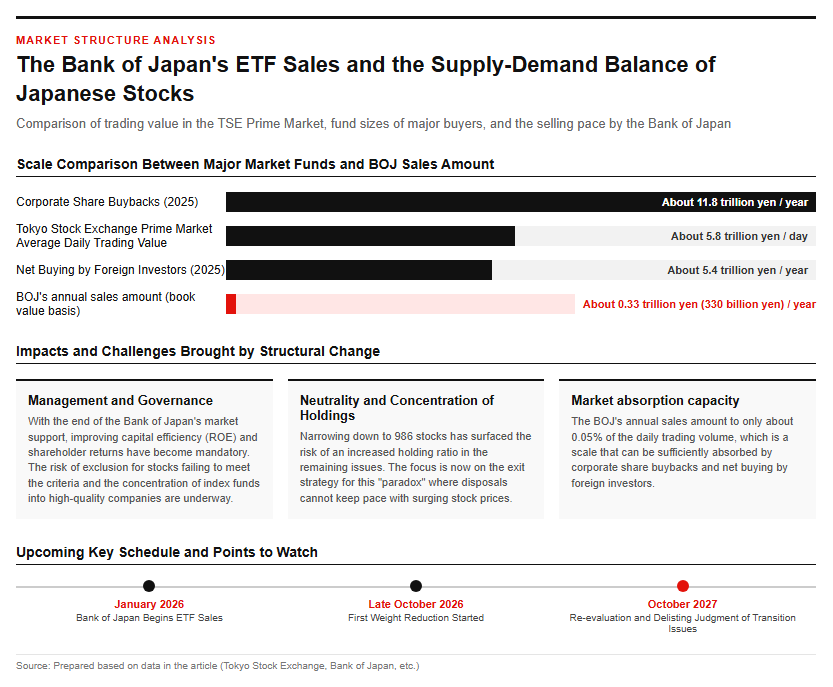
However, looking at the trends in the Bank of Japan’s own asset holdings, the BOJ announced a policy in September 2025 to sell ETFs at an extremely gradual pace of 330 billion yen per year in book value (approximately 620 billion yen on a market value basis), and began sales in January 2026. With the average daily trading value on the Tokyo Stock Exchange Prime Market reaching approximately 5.8 trillion yen, the BOJ’s annual sales amount to a mere 0.05% or so of the daily trading volume. Even compared to corporate share buybacks in 2025 (approximately 11.8 trillion yen annually) and net buying by foreign investors (approximately 5.4 trillion yen), absorption by the market as a whole is entirely feasible, and it is crucial to carefully assess individual supply and demand dynamics.
The Impact of Structural Changes on Corporate Management and the Japanese Economy
[Management and Governance] Addressing Buyer Failure and Incentives for Enhancing Corporate Value
The Bank of Japan’s massive ETF purchases began with the comprehensive monetary easing in December 2010 and continued for over 13 years. While this contributed significantly to supporting stock prices and suppressing risk premiums, side effects have been pointed out: the central bank’s continued reign as a “silent major shareholder” in the market has impaired management monitoring functions and price discovery functions through stock prices.
This latest TOPIX reform and the changes in the composition of stocks held by the Bank of Japan will serve as an important catalyst for correcting such structural distortions. In the market reforms being promoted by the Tokyo Stock Exchange, rather than merely reviewing market categories, liquidity indicators such as free-float market capitalization and trading value will be strictly scrutinized. Corporate management teams, who can no longer rely on the BOJ to prop up prices, are required to seriously commit to improving capital efficiency (ROE), actively returning value to shareholders, and enhancing corporate value through proactive information disclosure.
While a rigorous environment is emerging where companies failing to meet the index criteria are excluded from the index, a mechanism is being established whereby index funds from both Japan and abroad flow intensively into companies that have advanced management reforms and enhanced their market valuation. This is expected to clarify the selection process and incentives for growth among companies, thereby promoting the efficient allocation of capital throughout the Japanese economy as a whole.
As the number of indirectly held stocks is narrowed down to 986, new policy challenges are also emerging. Specifically, there is a risk that as TOPIX component stocks are reduced, funds from the Bank of Japan’s approximately 60 trillion yen in TOPIX-linked ETFs will concentrate in the remaining companies, actually increasing the BOJ’s indirect holding ratio in specific stocks.
Central banks continuing to hold high ownership ratios in specific groups of private companies is controversial from the perspective of market neutrality. In a press conference in September 2025, Bank of Japan Governor Kazuo Ueda indicated a stance of proceeding with gradual sales over a period of more than 100 years to avoid market disruption. However, at a book value pace of 330 billion yen per year, an enormous amount of time will be required to clear the balance, and if stock prices rise by 5% annually during that time, the total market value of holdings will further expand, creating a “paradox where the disposal pace fails to keep up with rising stock prices.”
Because rapid market sales carry the risk of triggering stock price declines, discussions regarding multifaceted exit strategies—such as disposal methods utilizing off-market routes like off-floor trading (ToSTNeT) and phased transfers to private institutions—will become the focus moving forward.
[Future Outlook and Key Points] Re-evaluations and Medium-to-Long-Term Scenarios Investors Should Watch Closely
In the upcoming schedule, the milestones that investors should watch most closely are the first weight reduction starting at the end of October 2026 and the re-evaluation of transition-measure stocks scheduled for October 2027. Companies that increase their free-float market capitalization through share buybacks, the elimination of parent-subsidiary listings, business restructuring, or other means during the period leading up to the re-evaluation still have a chance to avoid index exclusion and return to continued inclusion.
The following figure outlines the upcoming TOPIX revision schedule and key observation points in the BOJ’s ETF selling process.
What is required of individual and institutional investors is an attitude of carefully assessing the fundamentals (intrinsic earning power) of individual companies, rather than being excessively fixated on mechanical themes such as “whether the Bank of Japan or TOPIX holds or adopts them.” Situations where stock prices fall below corporate value due to temporary selling pressure accompanying index exclusion can serve as prime, undervalued investment opportunities for long-term investors.
In the new era in which the Bank of Japan has transformed from a “buyer” into a “gradual seller,” the Japanese stock market is breaking away from central bank support and transitioning into a mature market where companies’ intrinsic earning power and governance are fairly evaluated.
Reference page
- [Osaka Metropolitan University Academic Information Repository: “Market Impact of Bank of Japan ETF Sales”] [suspicious link removed]
- [Bank of Japan Official Website] [suspicious link removed]
[#BOJ_ETFs #TOPIX_Reform #JapaneseStocks #AssetManagement #StockMarket #MonetaryPolicy #JapaneseEconomy]

コメント