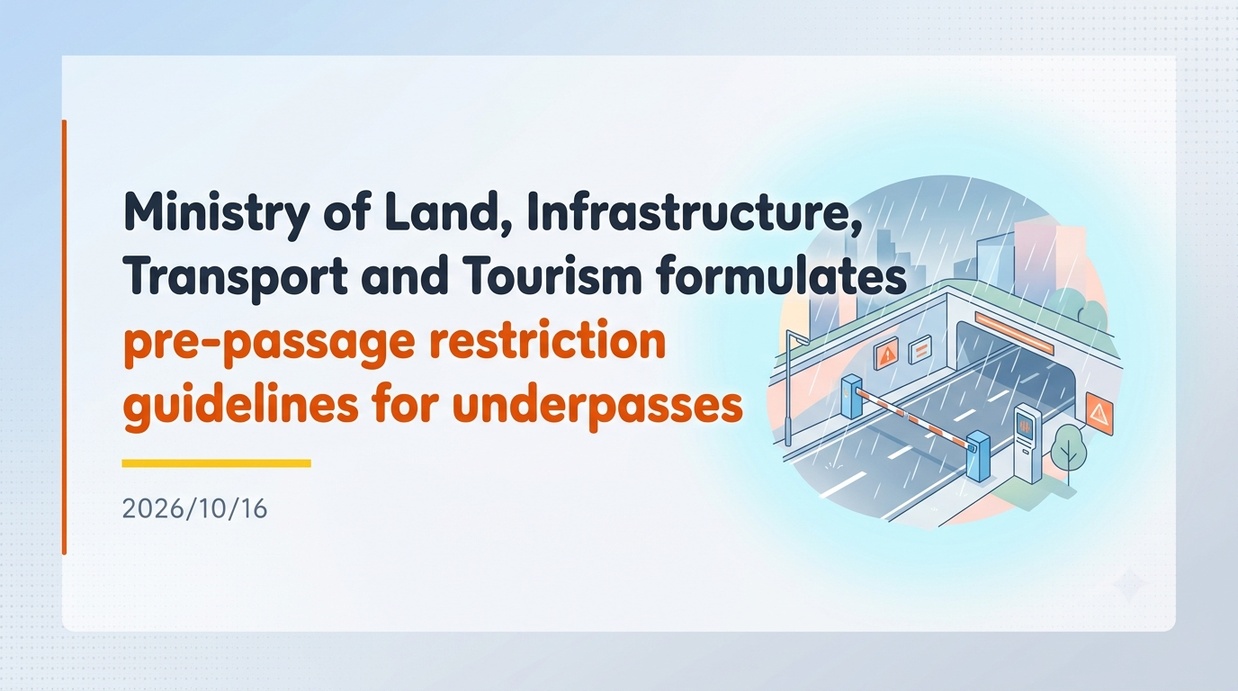
On October 6, 2026, the Ministry of Land, Infrastructure, Transport and Tourism formulated and issued the “Guidelines for Preventing Flooding Accidents in Underpasses” nationwide to prevent submergence accidents caused by increasingly severe heavy rains in recent years. This was driven by a series of tragic casualties and property damage caused by flooded underpasses across various regions, including the Chiba torrential rains in August 2026.
- Formulation of Emergency Guidelines Following the Casualties of the August 2026 Heavy Rain
- Shift from relying on conventional drainage pumps to multi-layered defense and pre-emptive regulation
- 4-tier risk classification and regulatory standards based on past 5 years of damage history and other factors
- Physical intrusion prevention measures utilizing remote-controlled barriers and various sensors
- Operational Challenges and Support Systems in Local Governments and Road Maintenance Operations
- Formulation of the Promotion Plan for Countermeasures Against Underpass Flooding Accidents and Future Prospects
Formulation of Emergency Guidelines Following the Casualties of the August 2026 Heavy Rain
On October 6, 2026, to address the increasing frequency and severity of heavy rainfall associated with recent global warming, the Ministry of Land, Infrastructure, Transport and Tourism (MLIT) formulated the “Guidelines for Preventing Flooding Accidents in Underpasses” and issued them simultaneously to road administrators nationwide, including regional development bureaus, local governments, and expressway companies. The direct catalyst for the formulation of these guidelines was the Chiba torrential rain disaster that occurred in August 2026. In that disaster, a tragic accident occurred at the Route 16 Murata-cho underpass in Chiba City, Chiba Prefecture, where a driver was trapped inside a vehicle and died due to sudden flooding. In response, the MLIT issued an administrative notice titled “Immediate Measures to Prevent Flooding Accidents in Underpasses” to road administrators, the National Police Agency, and the Fire and Disaster Management Agency on August 27 of the same year. However, the new guidelines further systematize these measures and establish them as unified operational rules nationwide. It had been pointed out that during torrential rains, rainwater flows into underground underpasses all at once from the surrounding area, meaning that conventional responses after confirming flooding might be too late. Through the implementation of these guidelines, a strong shift toward a safety management system that prevents accidents before they occur is required.
Shift from relying on conventional drainage pumps to multi-layered defense and pre-emptive regulation
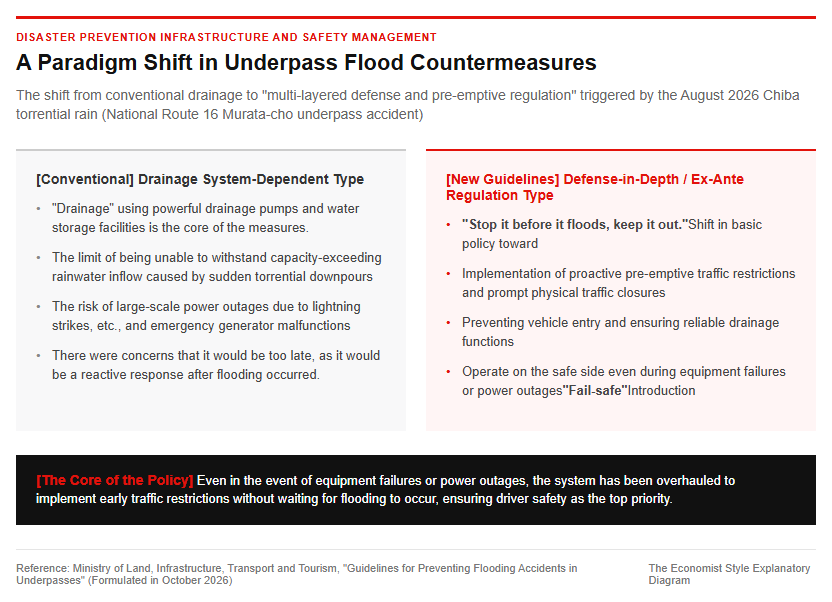
The biggest turning point in the new guidelines is that they move away from a structure that relies solely on drainage facilities for countermeasures against underpass flooding. Traditionally, the core of these measures was to install powerful drainage pumps and water storage facilities to pump out water. However, when torrential guerrilla rainfalls caused water inflow exceeding capacity, coupled with large-scale power outages due to lightning strikes or malfunctions of emergency generators, the limitations of relying solely on drainage facilities to prevent human casualties became apparent.
In response, the Ministry of Land, Infrastructure, Transport and Tourism has presented a new basic policy: “stopping flooding before it happens and keeping water out.” Specifically, it introduces a “multi-layered defense” approach that combines multiple measures: preventive pre-emptive traffic restrictions, prompt physical traffic restrictions during flooding, vehicle entry prevention measures, and securing drainage functionality.
Furthermore, the concept of “fail-safe”—automatically shifting operations in a safe direction even when abnormal situations such as equipment failure or power outages occur—has been incorporated into on-site operations. This establishes a system that prioritizes drivers’ safety by initiating traffic closures early, without waiting for flooding to occur, even if an unexpected failure happens to the equipment.
Four-Level Inundation Risk Classification and Intrusion Prevention / Fail-Safe Technologies
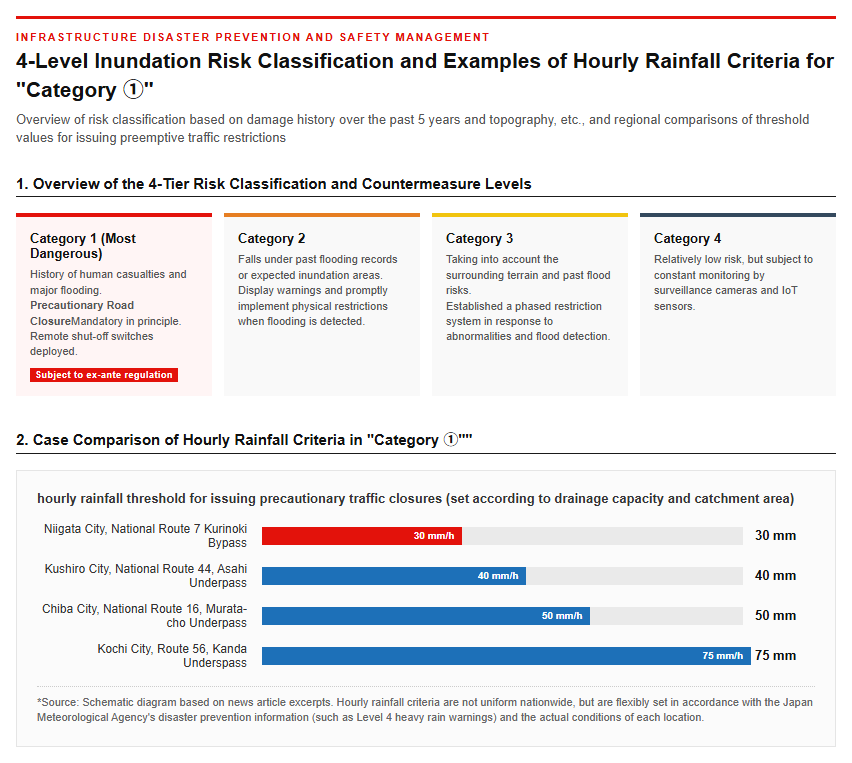
4-tier risk classification and regulatory standards based on past 5 years of damage history and other factors
The guidelines stipulate that underpasses nationwide are classified into four categories according to flood risk, and that phased measures are implemented in response to the risk level. Category determinations are made by comprehensively taking into account factors such as the history of severe damage—including human casualties and submerged vehicles—over the past five years, past flooding records, surrounding topography, and whether the location falls within expected inland flooding areas. For locations designated as “Category 1,” which entail a particularly high risk, “preventative pre-emptive traffic restrictions” that halt traffic even before flooding occurs are mandatory in principle. As a basis for deciding on preventative restrictions, disaster mitigation weather information issued by the Japan Meteorological Agency—such as Level 4 heavy rain warnings, Level 4 flood warnings, and Level 4 storm surge warnings—as well as preset hourly rainfall criteria are utilized. The standard values for hourly rainfall are not uniform nationwide; instead, they are flexibly set according to the drainage capacity and catchment area of each location, such as 30 mm for the Kurinoki Bypass on National Route 7 in Niigata City, 40 mm for the Asahi Underpass on National Route 44 in Kushiro City, 50 mm for the Muratacho Underpass on National Route 16 in Chiba City, and 75 mm for the Koda Underpass on National Route 56 in Kochi City. On the other hand, for “Category 2” and “Category 3” locations, systems are also put in place to promptly implement physical restrictions accompanied by warning displays upon the detection of flooding.
Physical intrusion prevention measures utilizing remote-controlled barriers and various sensors
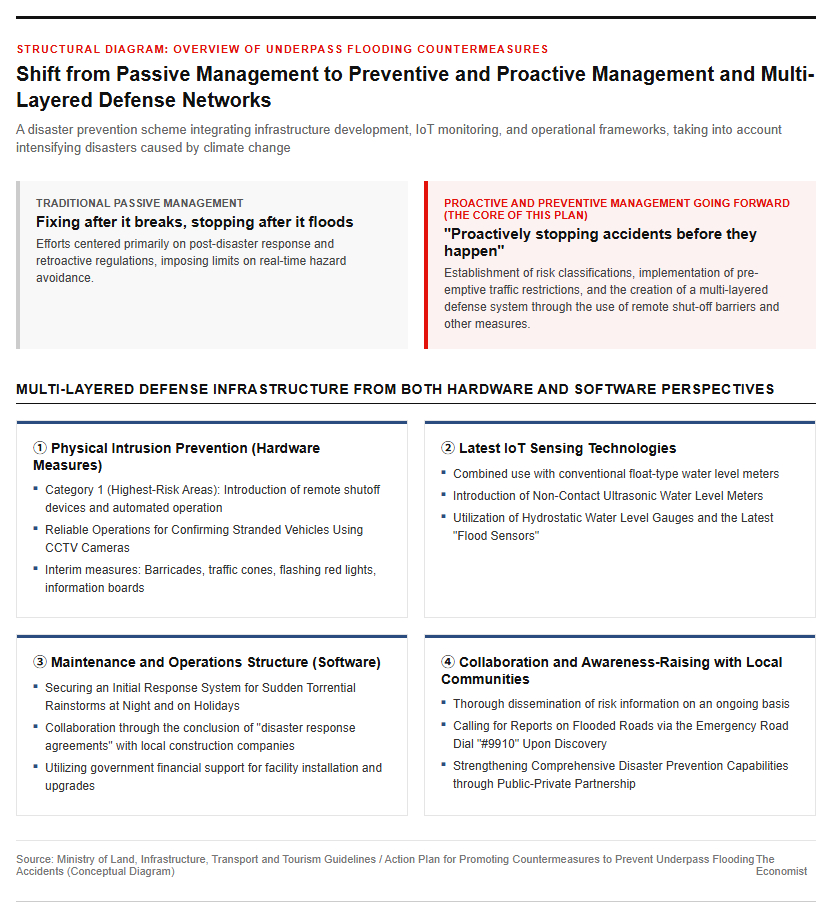
When traffic restrictions are decided, the strengthening of physical entry-prevention equipment and monitoring technology has been incorporated to prevent accidents where drivers mistakenly enter flooded areas. In particular, at the most dangerous locations in “Category ①,” the installation of “remote-controlled barriers” capable of remote operation or automatic activation is the basic principle. When operating the barriers, operational rules have been established to perform remote operation only after thoroughly confirming traffic conditions and ensuring no vehicles are left behind through surveillance cameras (CCTV) installed on-site. In addition, until the installation of the barriers is completed, entry will be blocked by alternative measures such as setting up barricades and traffic cones, turning on red flashing lights, and raising awareness of danger through road information boards. To grasp water levels, in addition to conventional float-type water level gauges, a variety of IoT technologies will be utilized, including ultrasonic non-contact water level gauges, hydraulic water level gauges, and the latest “flooding sensors” whose introduction is progressing through demonstration experiments nationwide. Furthermore, road users are urged to be thoroughly informed of risk information during normal times and to make prompt reports via the road emergency dial “#9910” if they discover flooding, thereby establishing a comprehensive entry-prevention network that combines infrastructure equipment with the cooperation of local residents.
Impact on On-site Operations and Future Challenges Toward Zero Accidents
Operational Challenges and Support Systems in Local Governments and Road Maintenance Operations
These guidelines have been issued as “technical advice” based on Article 245-4, Paragraph 1 of the Local Autonomy Act for roads managed by local governments, and are having a significant impact on the practical operations of local municipalities nationwide as well as private companies responsible for road maintenance and management. Collaboration has become essential across a wide range of industries, not only civil engineering construction but also telecommunications, traffic safety facilities, security, and patrol services. In particular, when sudden torrential downpours occur late at night or on holidays, securing initial response systems—such as who will rush to the site and at what timing barricades should be installed—remains a challenge. In response to this, Minister of Land, Infrastructure, Transport and Tourism Ibayashi stated at a press conference, “If there are budget requests from local governments, we would like to provide comprehensive support,” and indicated the policy that the national government will provide financial assistance for the installation and renewal costs of safety equipment such as barrier gates and monitoring sensors. Furthermore, since it is difficult for road administrators alone to complete on-site responses, concluding “disaster agreements” with local construction companies in the area, and organizing in advance the dispatch procedures in the event of anomalies, contact systems for nights and holidays, and measures to ensure on-site safety, are extremely important keys toward building an effective disaster prevention system.
Formulation of the Promotion Plan for Countermeasures Against Underpass Flooding Accidents and Future Prospects
The Ministry of Land, Infrastructure, Transport and Tourism has made it clear that it will not stop at publishing these guidelines, but will also formulate an “Underpass Flooding Accident Prevention Measures Promotion Plan” looking ahead. In this promotion plan, the Ministry plans to compile the risk classifications set by road administrators nationwide, and clarify targets for implementing proactive pre-emptive traffic restrictions, schedules for installing intrusion prevention equipment such as remote barriers, and nationwide countermeasure policies. Furthermore, even after the plan is formulated, the Ministry will regularly monitor the implementation status of measures in each region and the occurrence of accidents, building a cyclical improvement system that appropriately revises the guidelines and promotion plan according to progress. Amid a daily reality where linear precipitation bands and localized torrential rains exceeding conventional expectations are becoming commonplace due to global warming, the significance of shifting road infrastructure management from passive management—such as “fixing it after it breaks” or “stopping traffic after flooding occurs”—to proactive and active management—such as “stopping traffic ahead of time to prevent accidents”—is extremely significant. Whether the public and private sectors can work together to establish multi-layered defenses combining both hardware and software aspects, and achieve zero flooding accidents in underpasses, will be a key focal point that tests the true value of local disaster prevention capabilities moving forward.
Reference page
- [Press Release: Guidelines Formulated to Prevent Flooding Accidents in Underpasses ~ Promoting Measures to “Stop and Keep Out Before Flooding Occurs” ~ – Ministry of Land, Infrastructure, Transport and Tourism] https://www.mlit.go.jp/report/press/road01_hh_002153.html
- [Guidelines for Preventing Flooding Accidents in Underpasses (Main Text) – Road Bureau, Ministry of Land, Infrastructure, Transport and Tourism] https://www.mlit.go.jp/road/road_fr4_000208.html
【#MinistryOfLandInfrastructureTransportAndTourism #Underpass #FloodAccidentPrevention #PreemptiveTrafficClosure #DisasterPreventionGuidelines #MultiLayeredDefense #RoadSafety】


コメント