NRI SecureTechnologies has started offering the “Security Support Services for AI-Driven Development” to safely promote software development utilizing generative AI and AI agents. This is against the backdrop that the expanding use of AI across the entire development process has made it difficult for conventional management methods to achieve both security assurance and development speed.
- Overview of the Support Services Announced in October 2026
- The Background Behind Manual Verification Reaching Its Limit in Development Environments
- Quality Control of AI-Generated Code and Risks of Excessive Permissions
- Strengthening Governance through Guideline Formulation and Harness Maintenance
- Automated Construction of a Secure Development Process Utilizing CI/CD
- Automating and Streamlining Vulnerability Triage Using AI
- Balancing Development Speed and Safety Through the Proper Division of Roles Between Humans and AI
- Future Outlook and Key Security Measures Required for Enterprises
Overview of the Support Services Announced in October 2026
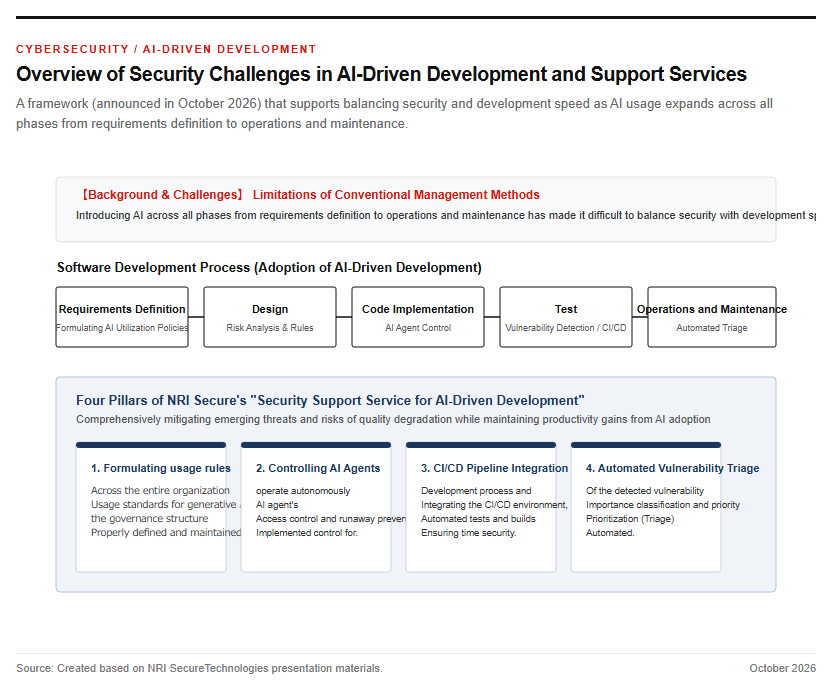
On October 15, 2026, NRI SecureTechnologies, Ltd. launched the “Security Support Service for AI-Driven Development” aimed at companies engaged in software development using generative AI and AI agents. In recent years, within software development environments, “AI-driven development”—where AI is embedded into every stage of the development process, ranging from requirements definition and design to code implementation, testing, and operation and maintenance—has been rapidly expanding. This support service aims to mitigate security threats and quality degradation risks lurking in the new technology while maintaining the benefits of productivity gains through AI adoption. The service comprehensively covers everything from formulating usage rules and controlling AI agents to building development processes integrated with CI/CD pipelines, and even automating the triage of detected vulnerabilities. This effectively presents a comprehensive framework for companies to maximize the benefits of AI development. Please refer to the figure below.
The Background Behind Manual Verification Reaching Its Limit in Development Environments
With the advancement of AI technology, developers can now generate hundreds of lines of code in just a few seconds simply by entering a prompt. However, this dramatic leap in development speed is putting immense pressure on traditional security management frameworks. As the volume of generated code skyrockets, it is becoming practically impossible for human security personnel and development leads to manually review the code for safety and specification compliance. Furthermore, the use of AI agents has seen a prominent rise in cases where excessive access privileges are granted to connect to specific software or databases, and experts have pointed out the risk that inadequate permission management could lead to data breaches or unauthorized operations. While development speeds accelerate, if security checks and review procedures become a bottleneck, it risks triggering rogue AI usage on the ground and the hollowing out of internal rules. Moving away from conventional human-dependent management and establishing mechanisms to integrate automated security management across the entire process has become an unavoidable challenge in modern software development.
Quality Control of AI-Generated Code and Risks of Excessive Permissions
In AI-driven development, the risks that demand the most vigilance boil down to two key points: vulnerabilities latent in the generated code and the over-privileging of AI agents. Code output by generative AI can contain typical security flaws such as cross-site scripting (XSS) and SQL injection, and deploying such code to a production environment without sufficient testing can lead to serious security incidents. Additionally, if autonomously operating AI agents are granted unnecessary system privileges or broad data read/write permissions, there is a risk that data across entire core systems could be tampered with or leaked due to inappropriate instructions or external attacks. For deliverables automatically generated and executed by AI, clear risk judgment criteria are essential to determine to what extent automation should be allowed and where human approval should be required. NRI Secure’s services are attracting attention for providing concrete technical and organizational solutions to these dual risks unique to AI: vulnerabilities and lack of control.
Four Comprehensive Support Menus Offered by NRI Secure
Strengthening Governance through Guideline Formulation and Harness Maintenance
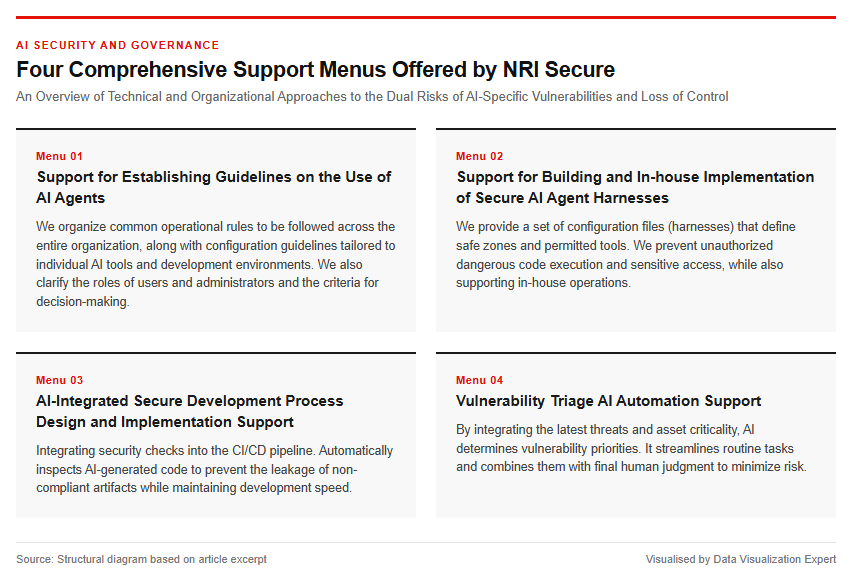
The first and second menus that form the core of this support service are “Support for Developing Guidelines on AI Agent Usage” and “Support for Developing and In-House Implementation of Secure AI Agent Harnesses.” In the guideline development support, common operational rules to be observed across the organization and configuration guidelines tailored to individual AI tools or development environments are organized, clarifying the roles and criteria for judgment of users and administrators. Meanwhile, in the harness development support, we provide a set of configuration files (harnesses) that predefine security rules, permitted tools, and standard operating procedures that AI agents should reference. Because AI agents operate constrained by this harness, they are prevented from deviating from the pre-configured safe zone to execute dangerous code or access confidential information. Furthermore, NRI Secure provides operational support for in-house implementation so that companies can continuously update and review these harnesses themselves.
Automated Construction of a Secure Development Process Utilizing CI/CD
The third service offering, “AI-Embedded Secure Development Process Design and Construction Support,” is an initiative that integrates security checks into the CI/CD (Continuous Integration/Continuous Delivery) pipeline, which serves as the foundation for development automation. During the software build and testing phases, this establishes a mechanism to automatically inspect AI-generated program code and design deliverables, preventing any outputs that fail to meet security or quality standards from advancing to subsequent phases or the release stage. This makes it possible to detect and fix security issues early without sacrificing development speed. It can be described as an approach that rebuilds the concepts of “Security by Design” and “DevSecOps,” which have long been recommended in traditional software development, tailored to the context of AI-driven development. By creating an environment where only secure code is deployed—even without conscious effort from developers—it achieves a stable supply of high-quality deliverables.
Automating and Streamlining Vulnerability Triage Using AI
The fourth menu item is “Vulnerability Triage AI Automation Support”. When vulnerabilities are detected during system development or operation, the “triage” process of evaluating their severity and response urgency to determine the handling order has traditionally required an enormous amount of time and advanced specialized knowledge. This service assists in building a mechanism that utilizes AI to prioritize detected vulnerability information by integrating the latest threat intelligence, the criticality of target IT assets, and the organization’s overall risk tolerance. While maintaining a structure where humans are responsible for final remediation judgments and decision-making, AI automates routine tasks such as preliminary research and impact assessment, significantly reducing the verification workload for security personnel. This enables a prompt response to high-priority, critical vulnerabilities, thereby making it possible to minimize the risk of cyber damage associated with delays in remediation work. Please refer to the figure below.
The Future of AI-Driven Development and Security Governance
Balancing Development Speed and Safety Through the Proper Division of Roles Between Humans and AI
The key to successful AI-driven development lies not in blindly outsourcing all development tasks to AI, but in establishing an appropriate division of roles and a collaborative framework between humans and AI. While AI excels at high-speed processing such as generating large volumes of code, primary testing, and organizing routine vulnerability information, human intervention remains essential for complex contextual risk assessment and business decision-making. The support service recently presented by NRI Secure realizes a hybrid development framework that appropriately controls the autonomous operations of AI through harnesses and rules while ensuring that humans perform reliable checks at critical junctures. By entrusting automation-capable tasks to AI to maximize development speed, and allowing humans to focus on advanced design and security determinations, it is possible to achieve a high-level balance between two traditionally conflicting goals: a dramatic boost in productivity and the assurance of rigorous security.
Future Outlook and Key Security Measures Required for Enterprises
Generative AI and AI agent technologies are evolving day by day, and it is seen as certain that the scope of AI utilization in software development will expand even further in the future. Amid this environment, what companies are required to do is not to solidify once-formulated rules and systems, but to establish a flexible governance framework that continuously brushes up countermeasures in accordance with the latest technology trends and changes in threats. NRI Secure has indicated its policy to bring together the knowledge it has accumulated over many years in the fields of secure development, DevSecOps, and vulnerability management, and to continue providing hands-on support tailored to the maturity level of each individual company’s development organization. On November 26, 2026, a specialized seminar hosted by the company titled “What is the Secure Development Process Required in the AI Era” is also scheduled to be held, and dissemination of information regarding cutting-edge checking methods and case studies will continue. Rather than standing by and watching AI technological innovation, companies need to quickly revamp the security of their development infrastructure and prepare the digital competitiveness that enables safe and rapid service deployment.
Reference page
- [Nomura Research Institute News Release] https://www.nri.com/jp/news/newsrelease/20261015_1.html
- 【NRI Secure Service Guide】https://www.nri-secure.co.jp/service/consulting/ai-development
[#NRISecure #AIDrivenDevelopment #Cybersecurity #AIAgent #DevSecOps]
コメント