The Japan Actors Union has announced the “Guidelines for the Use of Generative AI Concerning Voice,” aimed at achieving coexistence between the protection of performers’ rights and the utilization of AI. Amid inadequate legal protections, it is drawing attention as a set of voluntary rules aimed at the sound development of the entire industry.
- 1-1. Background and Circumstances Leading to the Release of the Japan Actors Union’s First Guidelines
- 1-2. The Legal Vacuum Surrounding “Voice Rights” in Japan
- 2-1. Thorough Prior Consent and Return of Fair Compensation
- 2-2. Multilingual Rollout and Ethical Considerations for the Deceased
- 3-1. Legal Organization by Judicial Decisions and the Ministry of Justice Study Group
- 3-2. The Emergence of Hybrid Voice Actors and Future Outlook
1-1. Background and Circumstances Leading to the Release of the Japan Actors Union’s First Guidelines
The Japan Council of Performers Rights (known as Nihon Haifu Ren), a cooperative representing approximately 2,600 actors and voice actors, officially released its “Guidelines for the Use of Generative AI Regarding Voice” on October 15, 2026. In recent years, alongside dramatic advances in generative AI technology, voice cloning technology—which can reproduce human voices with high precision using only text inputs—and AI dubbing technology have rapidly spread. Meanwhile, damage from the unauthorized collection of performers’ past appearance works and voice data from the internet, which is then used as AI training material, has become increasingly severe. There is no end to cases where synthetic voices mimicking individuals are generated without their consent and diverted to commercial use or malicious fake videos. A voice is an identity built by a performer through years of rigorous training, and unauthorized theft not only destroys their economic foundation but also constitutes a serious violation of artistic dignity and personality rights. To avoid confusion in production environments and establish a transactional environment where both performers and business operators can feel secure, the organization has formulated these industry-first guidelines.
1-2. The Legal Vacuum Surrounding “Voice Rights” in Japan
The biggest motivation behind the release of the guidelines lies in a serious legal vacuum: under Japan’s current legal system, there is no explicit statute that comprehensively protects the “voice” itself. While discussions exist regarding portrait rights and publicity rights concerning one’s face and appearance, laws directly regulating the unauthorized training on voices or the public release and use of AI-synthesized voices remain undeveloped. Under the Copyright Act, specific expressions (performances) such as singing and spoken lines are protected, but the raw material of voice quality and vocal characteristics has been interpreted as falling outside the scope of protection. Due to this lag in the law, the industry has effectively turned into a lawless zone. While this poses a threat to the survival of performers, it also causes businesses to shoulder major legal risks such as future copyright infringement lawsuits and a loss of credibility. Driven by a strong sense of crisis that merely waiting for the government to establish laws would not keep pace with the spread of damage, voluntary standards ensuring transparency and fairness were deemed necessary.
The Four Basic Principles of the Guidelines and Their Operational Mechanism
2-1. Thorough Prior Consent and Return of Fair Compensation
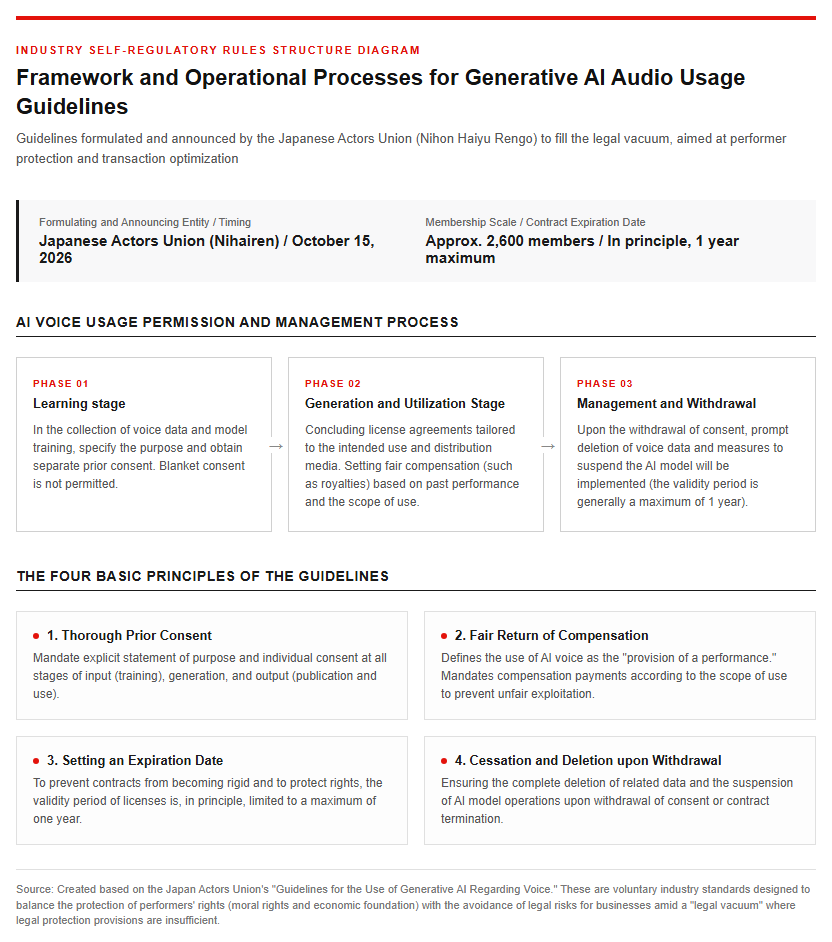
These guidelines establish clear rules on four particularly important issues in order to balance the protection of performers’ rights with the safe business development of operators. The first principle is the “thorough implementation of prior consent.” It requires that at every stage of AI technology—learning (input), generation, and publication/use (output)—the purpose must be clearly stated to the target performers and individual consent must be obtained in advance. Comprehensive blanket permissions are not permitted, and the validity period is generally set to a maximum of one year. The second principle is the “payment of appropriate compensation.” It defines the use of AI-generated voices as equivalent to a new form of “performance provision” by performers, stating that fair remuneration (such as royalties) should be paid according to the scope of use and actual results. This opens up a new path for voice actors to safely license their voices and earn revenue, while allowing business operators to budget while avoiding criticism of unfair exploitation through the standardization of payments. An overview of the consent process is shown below.
- Training Phase: Explicit Purpose and Prior Consent in Audio Data Collection and Model Training
- Generation and Usage Stage: Licensing and compensation settings according to the intended use and distribution media of the generated voice
- Management and Withdrawal: Deletion of audio data and implementation of AI model suspension measures upon withdrawal of consent
2-2. Multilingual Rollout and Ethical Considerations for the Deceased
The third principle is “Points to keep in mind regarding multilingualization (global expansion).” When automatically translating and dubbing performances in the original language into English, Chinese, or other languages using AI technology, it demands the preservation of the performer’s acting quality and artistic identity. For multilingualization, it guarantees the right to secure new usage licenses and additional compensation corresponding to overseas deployment, thereby preventing unauthorized use that diminishes the work’s appeal. The fourth principle is the “Treatment of deceased performers.” Regarding “AI clones” that recreate a deceased person’s voice using AI, the basic principle is to maximize respect for the individual’s wishes while they were alive. When performing AI generation, strict consent from the surviving family members or administrators who inherit the rights is established as mandatory, creating an ethical safety net to prevent commercial exploitation and disrespect toward the deceased. Regarding these stringent procedures, some business operators have complained that “the procedures are cumbersome,” but the Japan Federation of Actors (Nippairen) has countered that “things were too easy until now,” advocating for sustainable coexistence with AI through fair transactions.
Social Impact and Future Institutional Outlook
3-1. Legal Organization by Judicial Decisions and the Ministry of Justice Study Group
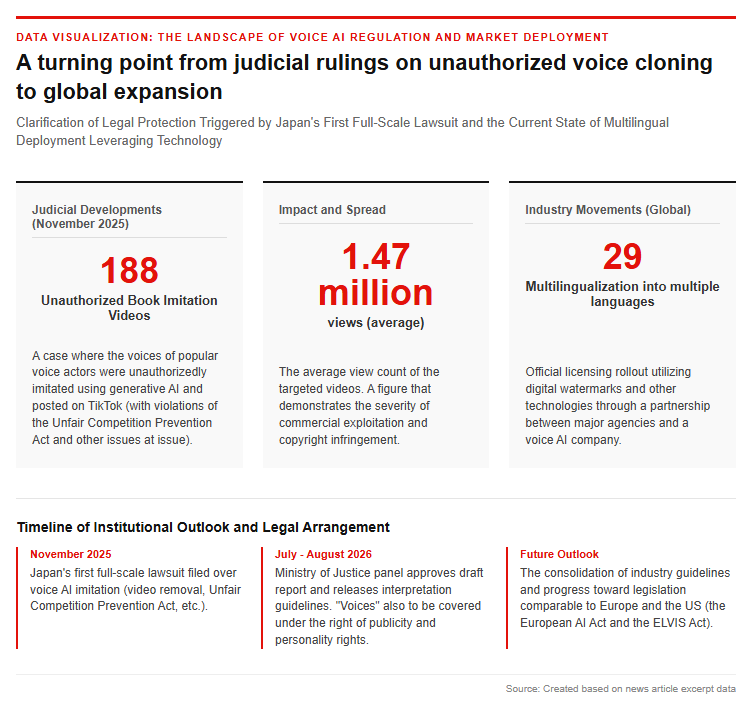
Behind the release of the guidelines are major developments within the judicial and administrative branches. In November 2025, popular voice actor Kenjiro Tsuda filed a lawsuit against the operator of TikTok demanding the removal of videos, claiming that 188 videos (averaging 1.47 million views each) featuring unauthorized generative AI imitations of his signature deep voice had been posted. This has garnered attention as Japan’s first full-scale lawsuit surrounding AI voice cloning, with vocal similarity and violations of the Unfair Competition Prevention Act as the key legal battlegrounds. In response to these circumstances, an expert panel at the Ministry of Justice approved a draft report in July 2026 and released interpretive guidelines in August. Based on the case law principles of the current Article 709 of the Civil Code, the guidelines explicitly state that a person’s “voice,” much like their likeness, falls under the protection of publicity rights and personality rights. It clarifies that the unauthorized reproduction of a person’s voice for commercial purposes can be deemed illegal, effectively providing legal reinforcement for industry guidelines.
3-2. The Emergence of Hybrid Voice Actors and Future Outlook
The formulation of the guidelines is seen not merely as regulation, but also as an opportunity for new content creation and market expansion utilizing AI technology. Major voice actor agency 81 Produce has formed a business partnership with voice AI company ElevenLabs, promoting localization into 29 languages while protecting voice rights using technologies such as digital watermarking and C2PA. This is expected to give birth to a new form of expression called “hybrid voice actors,” who deliver works around the world by combining human performance with AI. The Japan Actors Union (Nippon Haiyu Rengou) plans to establish these guidelines as the industry’s standard rules while stepping up its lobbying efforts with the government toward legislation. Attention is focused on whether Japan’s efforts to balance technological evolution with the dignity of performers will serve as a pioneering model case in the global audio content industry, alongside Europe’s AI Act and the U.S. ELVIS Act.
- Rights Protection Technology: Prevention of unauthorized use via digital watermarking and voiceprint registration (such as J-VOX-PRO)
- Market Expansion: Multilingual Distribution Based on Official Licenses and Cultivation of Overseas Fan Bases
- Regulatory Design: From Voluntary Guidelines to Industry Standards, and Then to Legislation
Reference page
- 【Japan Federation of Actors: “Guidelines for the Use of Generative AI Regarding Voice”】https://www.nippairen.com/about/jau_guideline.html
- [Ministry of Justice: “Study Group on the Form of Civil Liability for the Unauthorized Use of Portraits, Voices, etc.”] https://www.moj.go.jp/MINJI/minji07_00400.html
【#GenerativeAI #VoiceActors #VoiceRights #JapanFederationOfActors #Guidelines #Copyright】
コメント