A Cabinet decision was made regarding a government ordinance based on the revised Logistics Efficiency Act, and a new system to promote truck relay transport is set to take effect on November 1, 2026. As addressing the “2024 logistics problem” and the “2026 problem”—characterized by driver shortages and overtime regulations—becomes an urgent priority, initiatives such as certification systems for relay transport, financial support, and site-level efficiency improvements through logistics DX are getting into full swing.
- Cabinet Decision on Government Ordinance for Enforcement on November 1, 2026 and Key Points of Events
- The Working Environment of Truck Drivers and the Structural Background of the 2024 and 2026 Problems
- Certification System for Truck Relay Transport Businesses and Consolidation of Administrative Procedures
- Requirement Designation for Specific Relay Facilities and Generous Financial and Tax Support Measures
- Three Legal Obligations Imposed on Specified Businesses and the Risk of Recommendations and Orders
- Future Developments and Key Points Opened Up by Logistics DX and Automation Technology
Cabinet Decision on Government Ordinance for Enforcement on November 1, 2026 and Key Points of Events
On October 16, 2026, the Cabinet approved a Cabinet Order setting the enforcement date for the Act Partially Amending the Act on the Streamlining of Material Distribution. With this Cabinet Order, the enforcement date of the revised Logistics Efficiency Act, whose main objective is to promote relay transport by trucks, has been officially set for November 1, 2026. The revised act itself was promulgated on May 20, 2026, and this Cabinet Order establishes the enforcement date and specific administrative system required to implement the law.
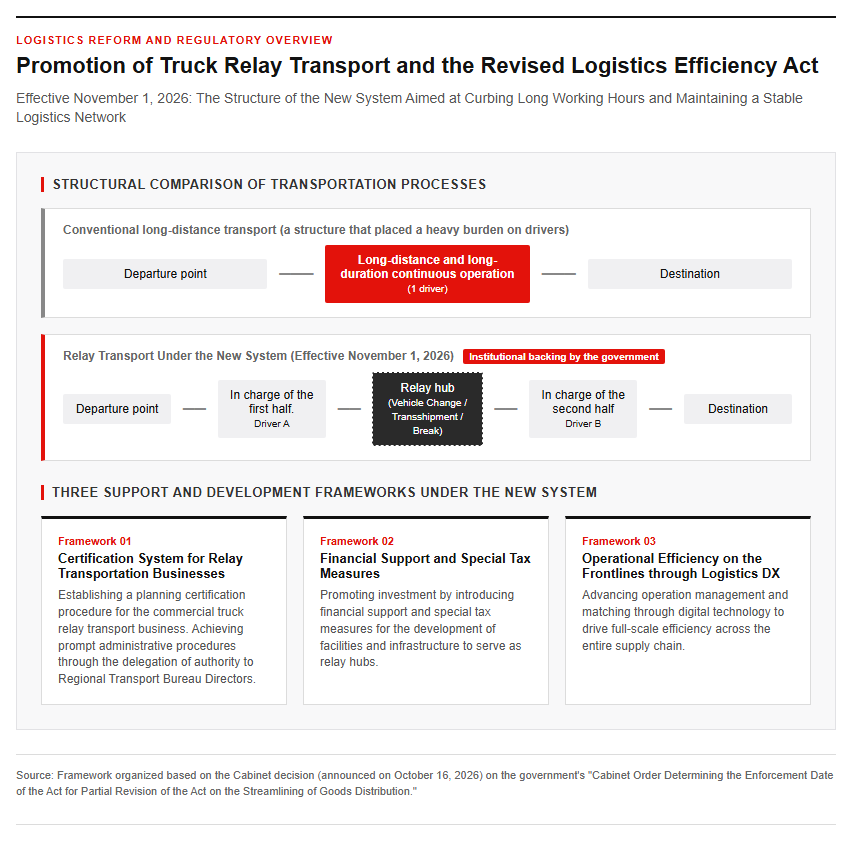
The most significant point of this cabinet order is that it provides institutional backing at the national level for “relay transport”—a method in which transportation is shared among multiple drivers and trucks to avoid long-distance continuous driving by a single driver. Specifically, the following framework has been established.
- Establishment of a Certification System for Commercial Truck Relay Transportation Businesses and Development of Plan Certification Procedures
- Delegation of Certification Authority to Regional Transport Bureau Directors-General for Operations Completed within the Jurisdiction of a Single Regional Transport Bureau
- Provision of financial support and introduction of preferential tax measures for the development of transit hubs
As shown in the diagram below, by performing driver handovers and cargo transshipments during long-distance transport, we aim to simultaneously prevent driver fatigue and maintain a stable transportation network.
Ahead of the enforcement date, the establishment of an integrated cooperative framework involving shipper companies, warehouse operators, and trucking businesses is accelerating.
The Working Environment of Truck Drivers and the Structural Background of the 2024 and 2026 Problems
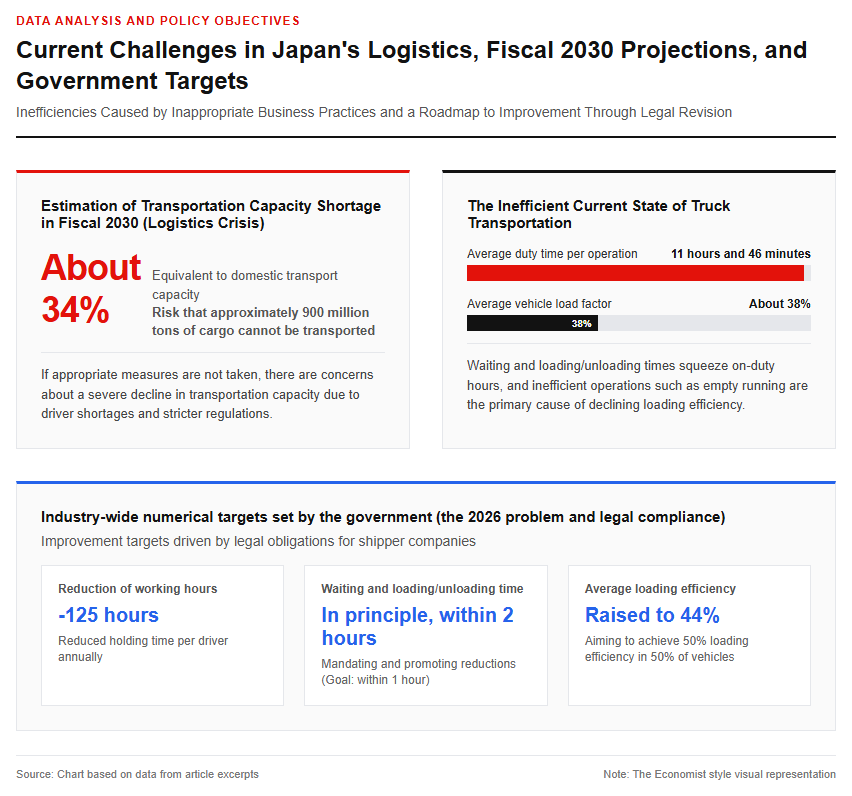
Japan’s logistics industry is facing major structural challenges, namely a severe driver shortage and the normalization of long working hours. Starting in April 2024, limits on overtime work for truck drivers (an annual cap of 960 hours) under the revised Labor Standards Act have been applied, bringing the so-called “2024 logistics problem” to the surface. It is estimated that without appropriate measures, approximately 900 million tons of cargo—equivalent to about 34% of domestic transport capacity—may go unhauled by fiscal 2030.
Behind this shortage of transport capacity are prolonged “waiting times” and “loading and unloading times” caused by inappropriate business practices. The on-duty time per trip for truck drivers averages 11 hours and 46 minutes, with non-driving tasks such as waiting and cargo handling accounting for a large portion of that time. Furthermore, the loading efficiency remains at an overall average of approximately 38%, making empty return trips and inefficient transport major challenges.
Against this background, the government has set the following numerical targets to encourage improvements across the entire industry.
- Reduction of 125 binding hours per year per truck driver
- Reduce the waiting and cargo handling time per operation to within 2 hours in principle (target: within 1 hour)
- Increase the average loading efficiency across all vehicles to 44% (achieving 50% loading efficiency in 50% of the vehicles)
With legal obligations for shipper companies (the “2026 Problem”) also beginning in April 2026, logistics issues have shifted from on-site operational challenges to a top-priority issue that management must address.
Institutional Support and Certification Systems Centered on Relay Trucking
Certification System for Truck Relay Transport Businesses and Consolidation of Administrative Procedures
Newly established under the Amended Logistics Efficiency Act, the “motor truck relay transport business” is a system through which the government certifies and supports operations involving driver switches and cargo handovers between trucks. By having multiple transport operators jointly formulate a “motor truck relay transport implementation plan” and obtain certification from the Minister of Land, Infrastructure, Transport and Tourism, they can receive various legal exceptions and support measures.
A major feature of this system is the consolidation of licensing and approval procedures (deemed provisions). For initiatives included in the certified business plan, the permits and procedures under the following laws are deemed to have already been completed.
- Various permits and notifications based on the Motor Truck Transportation Business Act
- Business Licensing and Approvals under the Automobile Terminal Act
- Registration, modification, etc., of warehouse business based on the Warehousing Business Act
Procedures that previously required individual applications to various ministries and local governments will now be centralized, significantly reducing administrative costs for businesses. In addition, for relay transport businesses that are completed within the jurisdiction of a single Regional Transport Bureau, authorities such as certification and reporting collection will be delegated to the Director of the Regional Transport Bureau. This has established a system for the prompt review of community-oriented relay transport plans.
Furthermore, an obligation to make an effort to cooperate in the smooth implementation of relay transport to the extent that it does not interfere with primary operations is also imposed on shippers and warehouse operators, creating a system in which everyone involved in the supply chain promotes transportation efficiency.
Requirement Designation for Specific Relay Facilities and Generous Financial and Tax Support Measures
To enhance the effectiveness of relay transportation, it is essential to develop hubs where trucks can smoothly stop by for driver handovers and cargo transshipment. The legal amendment defines such hub facilities as “Specified Motor Carrier Relay Transportation Facilities” and establishes clear facility requirements.
To be recognized as a specified relay facility, it is a prerequisite to be located near arterial roads such as expressways and to have space where multiple large trucks can safely park, stop, and temporarily store. In addition, to improve on-site operational efficiency and working conditions, the implementation of the following facilities and systems is required.
- an information processing system that manages the loading, unloading, and sorting of cargo
- Material handling equipment and forklifts that automate and streamline cargo handling operations
- Waiting areas and bathing facilities for drivers to recover from fatigue
As shown in the facility layout image below, functionality will be enhanced in both hardware and software aspects.
The national government has prepared powerful support measures to encourage the development of specified transit facilities and the formulation of plans. In addition to the establishment of funding investment and loan systems by the Japan Railway Construction, Transport and Technology Agency (JRTT), subsidies for plan formulation costs and first-year operating expenses, as well as special tax reduction measures for property tax and urban planning tax related to the facilities, will be implemented. Even when urban planning permits and approvals are required, consideration from administrative agencies is mandated, strongly promoting infrastructure development.
Corporate Legal Mandates and Solution Approaches through Logistics DX
Three Legal Obligations Imposed on Specified Businesses and the Risk of Recommendations and Orders
Under the revised Logistics Efficiency Act, business operators and logistics operators of a certain scale or larger are designated as “specified business operators,” and are subject to strict “legal obligations” that go beyond the conventional “voluntary obligations.” The designation criteria for specified business operators are established as follows, and over 3,000 companies, mainly large enterprises, will be subject to them.
- Specified Consignors (Type 1, Type 2, and chain business operators): Annual freight handling volume of 90,000 tons or more (approx. 3,200 companies)
- Specified warehouse operators: Annual storage volume of 700,000 tons or more (approx. 70 companies)
- Specified Motor Truck Transportation Operators: Fleet of 150 or more vehicles (approx. 790 companies)
Companies designated as specified business operators are primarily subject to three obligations. First, appointing a “Chief Logistics Officer (CLO)” from among executive-level management. Second, creating and submitting a medium-to-long-term plan aimed at improving loading rates and reducing cargo waiting times. Third, submitting an annual regular report on waiting times and the status of these initiatives.
If efforts toward the plan or its implementation status are judged to be severely insufficient, the government will collect reports and conduct on-site inspections, taking phased administrative measures. If no improvement is observed, a “recommendation” will be issued, and if the recommendation is not followed, the company’s name will be made public. If measures are still not taken after the public disclosure, an “order” will be issued, and violations of the order carry the risk of a fine of up to 1 million yen (criminal penalty). Furthermore, failing to submit the required notification is also subject to a fine of up to 500,000 yen.
Future Developments and Key Points Opened Up by Logistics DX and Automation Technology
The key to complying with tighter legal regulations and building a sustainable supply chain is the promotion of “logistics DX” (Digital Transformation). Toward the intensive reform period leading up to fiscal 2030, the government is also powerfully rolling out support for logistics efficiency from a budgetary standpoint. On the corporate front, there is a growing trend to go beyond mere compliance and leverage digital technology to transform logistics into a source of competitive advantage.
Representative DX solutions and automation technologies being adopted on-site include the following:
- Vehicle entry/exit management and automated visualization of stay duration utilizing license plate recognition cameras and AI
- Berth Reservation Systems and Delivery Route Optimization AI to Reduce Driver Wait Times
- Complete Elimination of Manual Cargo Handling and Through-Palletization through Rental Use of Standard Pallets (T11 Type)
- Implementation of autonomous mobile robots (AMRs) and WMS to streamline warehouse operations
In the future, it is also expected that specific relay facilities currently being developed will function as hub terminals to accept autonomous trucks. Furthermore, the accumulation of transportation and delivery data will facilitate joint deliveries among shippers and modal shifts.
Taking the enforcement of the revised Logistics Efficiency Act as an opportunity, it will become an essential step for shippers and logistics businesses to form partnerships and make maximum use of the latest IT tools and relay transport infrastructure to support the future growth and stability of the Japanese economy.
Reference page
- [Ministry of Land, Infrastructure, Transport and Tourism: Regarding the Logistics Efficiency Act] https://www.mlit.go.jp/seisakutokatsu/freight/seisakutokatsu_freight_mn1_000029.html
- 【Portal Site for Promoting Understanding of the “Logistics Efficiency Act”】[suspicious link removed]
- [Ministry of Economy, Trade and Industry (METI) Logistics Efficiency Act Related Pages][suspicious link removed]
【#RevisedLogisticsEfficiencyAct #LogisticsDX #2024Problem #RelayTransport #MLIT #ChiefLogisticsOfficer #SupplyChain】


コメント