In September and October 2026, US-based Anthropic published reports on internal data and employment impacts following the implementation of AI. The background behind this move is the goal of bringing transparency to the reality that the automation of AI research and development is rapidly accelerating, having a major impact on junior hiring and organizational structures.
- Key points of the announcement and the rapid expansion of Claude-driven R&D
- Automation Index Measurement Methodology and 542-Node Task Analysis
- Sharp Decline in Junior Engineer Hiring and Changes in Engineer Productivity
- Skill Requirements in the AI Era and the Shift to Instruction Design and Decision-Making Skills
- A Two-Tier System Monitoring 30,000 Agents and Secure Computing Resources
- Future Developments and Key Highlights of Human-AI Collaboration Models
Key points of the announcement and the rapid expansion of Claude-driven R&D
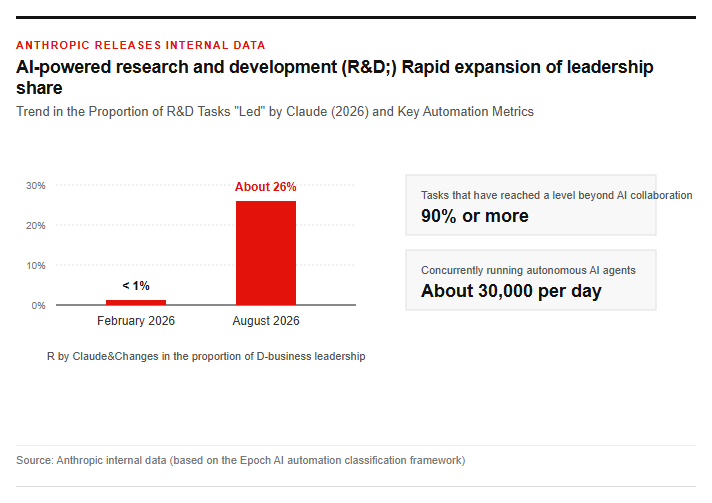
On September 17, 2026, US-based Anthropic became the world’s first company to release automation metrics for its internal AI research and development (R&D) processes. According to the published internal data, the proportion of the company’s R&D operations led by its advanced AI, “Claude,” surged from less than 1% as of February 2026 to approximately 26% just six months later in August 2026. Furthermore, tasks that reached or exceeded the level of “AI collaboration”—where humans and AI work together—accounted for over 90% of the total. On its internal platform, autonomous AI agents carrying out research and engineering tasks were running at a scale of approximately 30,000 concurrent instances daily as of August 2026. The figure below shows a conceptual progression of the operating scale of AI agents and the business automation rate within the company.
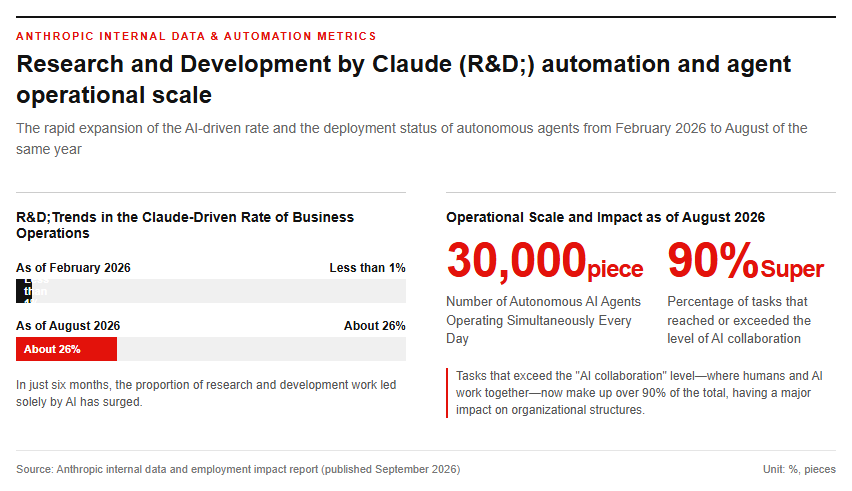
At the same time, the company emphasizes that Claude has not achieved “full autonomy” in any of the development tasks measured. The current setup is based on a division of roles where “humans set high-level goals, and AI handles the execution and verification of specific tasks,” with humans still retaining the design of cutting-edge models and final decision-making authority. The background behind the company’s decision to disclose these internal metrics is to bridge the gap between what is actually happening inside cutting-edge AI labs and external perceptions, thereby increasing transparency across the entire industry.
Automation Index Measurement Methodology and 542-Node Task Analysis
For this data calculation, Anthropic adopted an automation classification framework developed by the independent non-profit organization Epoch AI. This metric categorizes the degree of AI involvement in tasks into stages such as non-intervention, assistance, collaboration, direction, and full autonomy. “Direction” refers to a state where humans merely provide high-level instructions, while AI independently executes the majority of the work process, with humans performing only monitoring and final confirmation.
To collect objective and highly accurate data, the company developed a proprietary research methodology called the “Anthropic R&D Automation Index.” Over a four-week period in July 2026, 20% of all employees in model development-related departments were randomly sampled each week, and a dedicated Claude research agent analyzed Slack conversation logs and internal documents to extract task details. The approximately 15,000 specific development tasks collected were organized into a 542-node hierarchical classification tree, including model training, reinforcement learning, evaluation systems, and incident response. The figure below shows a conceptual image of the internal task classification tree structure.
Regarding the degree of automation for the organized tasks, the Claude evaluation model and human employees in charge each conducted independent assessments. While the exact match rate between the two judgments was 59%, the agreement rate allowing for a one-level margin of error reached 97%, demonstrating that the AI-based self-evaluation method possesses extremely high reliability.
Tectonic Shifts Occurring in Organizational Structures and Hiring Criteria
Sharp Decline in Junior Engineer Hiring and Changes in Engineer Productivity
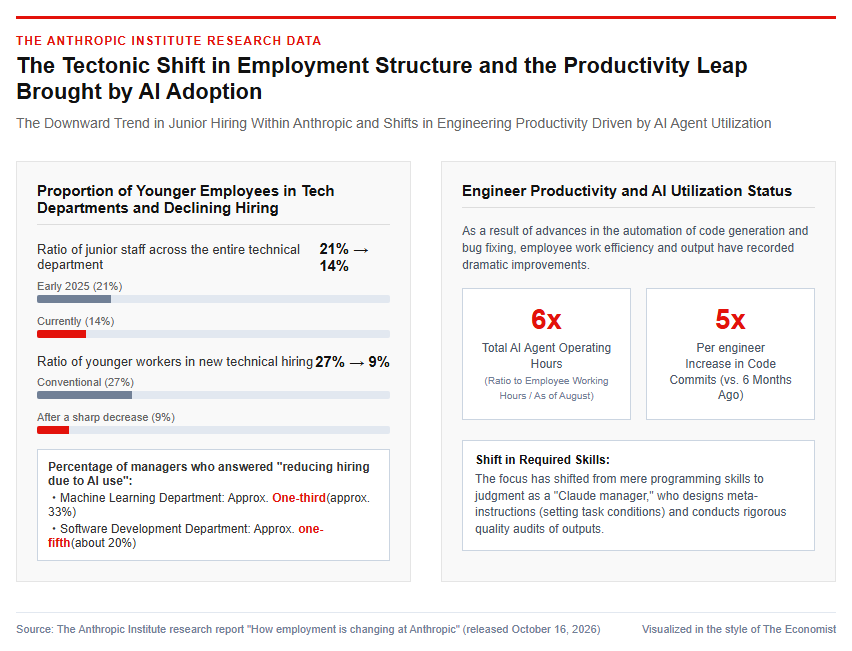
On October 16, 2026, The Anthropic Institute, Anthropic’s research organization, published a detailed research report titled “How employment is changing at Anthropic” regarding employment and AI adoption. The report clearly demonstrates the quantitative impact that the introduction of AI has had on internal workforce composition and labor productivity. According to the data, the proportion of junior employees in the company’s technical department declined from 21% in early 2025 to 14%. In an even more pronounced change, the proportion of junior hires in technical roles plummeted from 27% to just 9%, and the curbing of job openings for junior positions has progressed rapidly since December 2025.
Behind this is the rapid internal realization, starting around January 2026, that tasks such as code generation and bug fixing could be entrusted to Claude. By April 2026, a trend toward curbing the hiring of junior-level technical staff had become established within development teams, and in a survey of managers, about one-third of the machine learning department and about one-fifth of the software development department reported that they “reduced hiring numbers due to the use of AI.”
Meanwhile, the productivity of current employees has dramatically improved. As of August 2026, the total operating hours of interactive AI agents directed by employees reached six times the employees’ working hours. As a result, the number of code commits per engineer has recorded a dramatic increase to five times that of six months ago.
Skill Requirements in the AI Era and the Shift to Instruction Design and Decision-Making Skills
As AI agents increasingly take over the execution of daily tasks, a qualitative shift is also occurring in the roles and hiring criteria expected of humans. According to the company’s internal survey, among managers responsible for hiring, the priority of traditional skills such as programming ability, mere specialized knowledge, and implementation speed has relatively declined. Instead, greater emphasis is now placed on the autonomy to identify the core of problems, as well as the judgment to set appropriate goals and rigorously evaluate AI outputs.
Internally, a new working style where humans act as “Claude managers” is taking root. Employees are spending more time designing meta-instructions—such as determining under what conditions to delegate tasks to AI agents—and auditing the quality of generated code, rather than programming themselves. The figure below illustrates the conceptual change in engineers’ working time allocation before and after the introduction of AI.
Such changes are not limited to development departments, rippling across the entire organization to bring about faster contract processing in legal departments and an increase in closed deals in sales departments. However, the report also adds the caveat that changes at cutting-edge AI labs like Anthropic do not necessarily translate immediately to ordinary enterprises.
Establishing Governance and Future Impact on Safety and the Industry
A Two-Tier System Monitoring 30,000 Agents and Secure Computing Resources
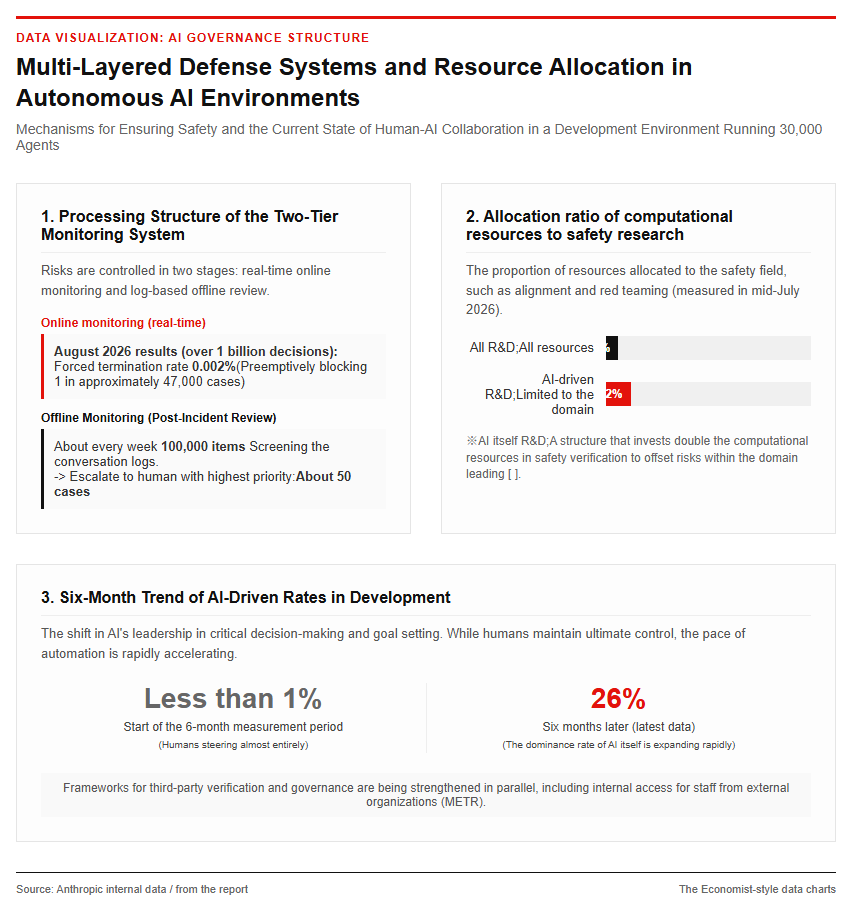
In an environment where as many as 30,000 autonomous AI agents operate daily within the company, building a governance system to prevent system-wide runaway behavior and unintended operations is a critical challenge. To address this challenge, Anthropic has built and operates a “two-tier monitoring system.” The real-time online monitoring system makes a judgment within seconds just before an agent executes an action, preemptively detecting and blocking abnormal instructions or dangerous behaviors. In an analysis of over 1 billion decisions conducted in August 2026, approximately 0.002% of all activations (about 1 in every 47,000 cases) were forcibly halted by the online monitoring.
Furthermore, an offline monitoring system thoroughly reviews post-execution logs, conducting a primary screening of approximately 100,000 conversation records each week. From these, a system is in place to ultimately escalate about 50 cases determined to be of the highest priority to human reviewers.
In terms of the allocation of computational resources as well, measurements from mid-July 2026 showed that approximately 6% of all R&D compute resources were allocated to safety areas such as alignment research, interpretability research, and red teaming. Particularly when restricted to AI-driven R&D domains, the proportion of computational resources dedicated to safety expands to 12%.
Future Developments and Key Highlights of Human-AI Collaboration Models
The series of internal data released by Anthropic illustrates the reality that AI is evolving from a mere supportive tool into an “autonomous colleague that executes tasks.” Moving forward, the focus will be on how far the feedback loop of “recursive self-improvement,” where AI itself develops AI, will expand. Although the current data shows that humans maintain control over critical decision-making and goal-setting—meaning a complete self-improvement loop is not yet closed—considering the speed at which the initiative rate has jumped from under 1% to 26% in half a year, the automation of research and development is expected to accelerate further.
To ensure transparency in its external verification, the company has also launched advanced initiatives to accept third-party safety evaluations, such as granting six staff members from the U.S. independent evaluation organization METR internal access privileges equivalent to regular employees. The figure below illustrates the conceptual governance structure through collaboration with external evaluation agencies.
The reduction in technical hiring and the shifting skill requirements occurring in cutting-edge labs could serve as leading indicators that will eventually ripple across the broader white-collar labor market. Moving forward, the central focus of the AI era will be on how companies and individuals can build collaborative systems with AI agents and transform their organizations while maintaining a balance between safety and productivity.
Reference Page
- How employment is changing at Anthropic – Anthropic Research
- 【An update on independent evaluators – Anthropic News】https://www.anthropic.com/news/an-update-on-independent-evaluators
【#Anthropic #GenerativeAI #AIAgents #FutureOfWork #LaborMarket】
コメント