Japanese semiconductor distributor Macnica has announced that it will acquire a 50.1% stake in UAE-based cybersecurity firm CyberSec IT Consulting to make it a subsidiary. Behind this move is a strategy to foster the cybersecurity business as a revenue pillar second only to its core semiconductor business and to rapidly expand its business foundation in the high-growth Middle East and Africa region.
- Overview of the Share Acquisition and Full Picture of the Acquisition Scheme
- Strengths and Value Proposition of the Target Company, CyberSec IT Consulting
- Past Acquisition Track Record and the Goal of Developing the Middle East and Africa
- Targeting FY2027 Net Sales of 230 Billion Yen and Business Model Transformation
- Surging Cyber Threats and the Necessity of Operational Management Services
- Post-Acquisition PMI and Outlook for Mid-to-Long-Term Business Development
Overview of the Share Acquisition and Full Picture of the Acquisition Scheme
On October 16, 2026, Macnica, Inc. (headquartered in Yokohama, Kanagawa Prefecture; President and Representative Director: Kazumasa Hara), a subsidiary of major semiconductor trading company Macnica Holdings, Inc., announced that it has reached an agreement to acquire a 50.1% stake (501 shares) in CyberSec IT Consulting, a cybersecurity company based in Dubai, United Arab Emirates (UAE), making it a subsidiary. The share transfer agreement was signed on October 16, 2026, with the actual share transfer scheduled for late November 2026. While the acquisition cost is undisclosed based on a confidentiality agreement with the seller, the impact of this share acquisition on Macnica’s consolidated financial performance is expected to be minimal. The target company plans to change its corporate structure by the share transfer date, with a capital of 276,983 United Arab Emirates Dirhams (AED) and headed by Mr. Anuj Jain as its representative. While its core business is the import, export, and sale of semiconductors and electronic components, Macnica positions the cybersecurity sector as its second pillar of revenue after semiconductors, and aims to accelerate its business expansion in the fast-growing Middle East and Africa region through this acquisition.
Strengths and Value Proposition of the Target Company, CyberSec IT Consulting
CyberSec IT Consulting, which is becoming a subsidiary this time, is a company that has been providing advanced cybersecurity services primarily in the Middle East and Africa region since its establishment in 2019. The company’s business encompasses a wide range of services, starting with Managed Security Services (MSS) that continuously operate and monitor corporate IT infrastructure and security systems on a 24/7 basis, as well as security consulting, technical training, on-site engineer support, and implementation and technical assistance. Its greatest strengths lie in its exceptional ability to develop and mobilize engineers with advanced expertise, and in building robust cooperative frameworks with diverse global vendors and local partners. Furthermore, the company has a track record of business dealings with the Macnica Group, resulting in exceptionally high operational compatibility. Because it is equipped with an operational management structure that not only sells security product licenses but also comprehensively undertakes complex operational management, threat detection, and response post-implementation, it is able to directly meet the rapidly surging security demand in the region. By integrating this on-site operational service capability and high-level human resources—which it previously lacked—into its own group, Macnica aims to dramatically enhance the value it delivers to customers.
The Background of Expansion into the Middle East and Africa and Macnica’s Growth Strategy
Past Acquisition Track Record and the Goal of Developing the Middle East and Africa
This is not Macnica’s first full-scale expansion into the Middle East. In March 2023, the company also announced the acquisition of CyberKnight Technologies, a fast-growing cybersecurity company headquartered in Dubai, UAE. In just three years since its founding, CyberKnight grew into one of the largest value-added distributors (VADs) in the Middle East, expanding its business operations across six Middle Eastern countries: the UAE, Saudi Arabia, Qatar, Kuwait, Egypt, and Jordan. By bringing the company—which has a prime customer base including finance, telecommunications, energy, and government agencies—under its umbrella, Macnica established a foothold in the Middle East market. When entering a new overseas market, building a customer base and dealing with regulatory compliance from scratch takes a tremendous amount of time and cost, but acquiring a strong local company offers the advantage of being able to immediately leverage its sales network and expertise. Please refer to the figure below.
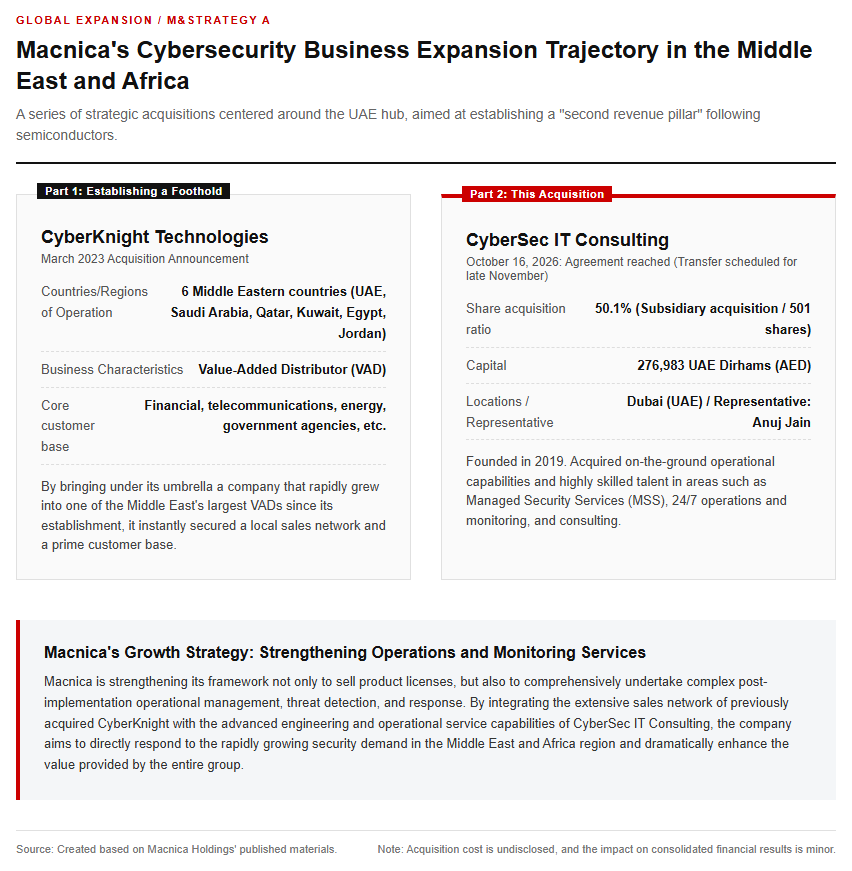
The acquisition of CyberSec IT Consulting is a strategic approach to create synergies with the existing CyberKnight and expand its business domain from the Middle East further into surrounding emerging markets such as Turkey and Africa.
Targeting FY2027 Net Sales of 230 Billion Yen and Business Model Transformation
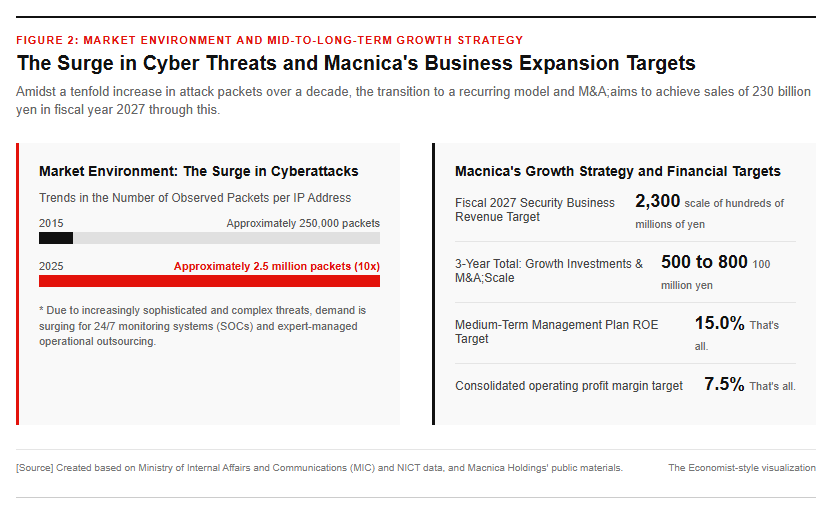
As part of its medium- to long-term growth strategy, Macnica Holdings has set a goal to expand the revenue of its cybersecurity business to the scale of 230 billion yen by fiscal 2027. While its mainstay semiconductor business has surpassed 1 trillion yen in revenue, the semiconductor market is susceptible to economic fluctuations, making the establishment of a second pillar for a stable revenue base an urgent priority. Chief Financial Officer (CFO) Makoto Okawara has revealed plans to achieve a return on equity (ROE) of 15.0% or higher and a consolidated operating profit margin of 7.5% or higher under the medium-term management plan (fiscal 2025–2027), and to execute 50 billion to 80 billion yen in growth investments and M&A over the three-year period combined. In the security business, the company is strongly promoting a shift from a one-off sales model of simply wholesaling software products from overseas manufacturers to a recurring business model that combines implementation support, continuous system monitoring, and operational maintenance. Because continuous operational management services involve long customer engagement periods and generate stable, high profit margins, they will serve as a critical driving force toward achieving these targets.
The Sophistication of Cyberattacks and Future Focus Points in the Market Environment
Surging Cyber Threats and the Necessity of Operational Management Services
Globally, methods of cyberattacks are becoming extremely sophisticated and complex, and the security risks faced by corporations and government agencies are intensifying. According to documents released by the Ministry of Internal Affairs and Communications and data from the National Institute of Information and Communications Technology (NICT), the number of cyberattack-related packets observed per IP address in 2025 reached approximately 2.5 million packets, a 10-fold increase over the 10-year period from about 250,000 packets in 2015. In addition, there have been successive cases of unauthorized access damage targeting ransomware attacks and vulnerabilities in supply chains, with reported average damage costs in the event of an incident swelling to the scale of tens of millions to billions of yen. Under such circumstances, merely introducing conventional perimeter security products is insufficient for defense; 24/7 real-time monitoring and incident response structures (SOC) operating on the premise of a breach have become indispensable. However, due to a shortage of personnel with specialized knowledge and the high costs of operation, the number of companies capable of maintaining a monitoring system entirely on their own is limited, and the demand to outsource operations to specialized firms is rapidly increasing.
Post-Acquisition PMI and Outlook for Mid-to-Long-Term Business Development
To ensure the success of this acquisition and drive medium- to long-term corporate value enhancement, it is key to advance the post-merger integration (PMI) process extremely smoothly. In integration with emerging market companies, it is necessary not simply for management teams to reach an agreement, but also to discover and nurture local key figures as change agents, set clear key performance indicators (KPIs), and integrate strategy and operations through the establishment of a management office (PMO). By fusing Macnica’s advanced technical support capabilities and proprietary services cultivated in the Japanese domestic market with CyberSec’s local operational know-how and engineer mobilization capabilities, it will be possible to roll out differentiated services that no other company can replicate. Please refer to the figure below.
While the short-term contribution to earnings is considered to be minor, if post-merger integration (PMI) can realize synergies early on and successfully balance securing specialized talent with improving profitability, it will lead to establishing a firm position in the Middle East and African markets. The market will continue to keep a close eye on Macnica’s challenge to transform itself from a semiconductor trading company into a comprehensive technology solutions company.
Reference page
- 【Macnica Holdings Investor Relations (IR)】https://holdings.macnica.co.jp
- [Ministry of Internal Affairs and Communications Information and Communications White Paper Related Data] https://www.soumu.go.jp/johotsusintokei/whitepaper/ja/r08/html/datashu.html#f00271
【#Macnica #Cybersecurity #MandA #UAE #MiddleEastExpansion #ITConsulting】

コメント