The Ministry of Land, Infrastructure, Transport and Tourism (MLIT) has begun new deliberations on evaluation methods for public works projects, reviewing its excessive reliance on the cost-benefit ratio (B/C) with a view to revising the social discount rate. The background to this includes the shift toward infrastructure management, recent interest rate trends, and the need to appropriately evaluate diverse social values such as disaster prevention and mitigation.
- Launch of a Research Committee Aimed at Breaking Away from Cost-Benefit Ratio Dependency
- Basic Policy 2026 and the Catalyst for Institutional Shift Prompted by the Council on Economic and Fiscal Policy
- Review and Impact of the 4% Social Discount Rate Fixed for 20 Years
- Introduction of Comprehensive Evaluation and Reference Indicators to Capture Diverse Effects
- Maintenance and Management of Existing Stock and Revision of the Revaluation System
- Summary for Winter 2026 and Future Points to Watch
Launch of a Research Committee Aimed at Breaking Away from Cost-Benefit Ratio Dependency
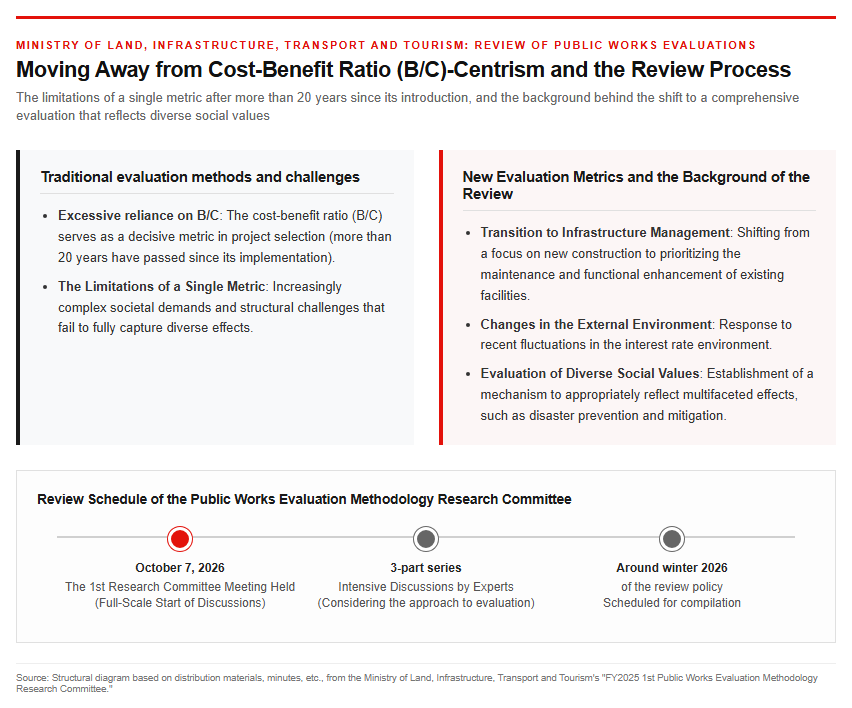
On October 7, 2026, the Ministry of Land, Infrastructure, Transport and Tourism held the “1st Public Works Evaluation Methodology Research Committee for Fiscal 2025,” initiating full-scale discussions on a review of public works evaluation methodologies. In conventional public works evaluations, the benefit-cost ratio (B/C)—calculated by dividing the benefits generated by a project by its costs—has been used as the decisive indicator for adoption. However, more than 20 years after its introduction, limitations have been pointed out regarding an evaluation method that relies excessively on a single numerical value. At the beginning of the research committee, Senior Technical Councilor Ken Matsumoto emphasized the need for continuous review to appropriately evaluate the necessity and diverse effects of public works. In addition, there is a demand for evaluation methods that align with the “shift to infrastructure management,” which places greater emphasis on the maintenance, management, and functional enhancement of existing facilities rather than the construction of new infrastructure. The committee is composed of experts and plans to compile a review policy around the winter of 2026 after a total of three rounds of discussions. The transition from the existing B/C-centric approach to a comprehensive evaluation that considers multifaceted values will be a change that significantly influences the future direction of public works. As shown in the figure below, the systematization of the evaluation process and the ensuring of transparency are the main focuses.
Basic Policy 2026 and the Catalyst for Institutional Shift Prompted by the Council on Economic and Fiscal Policy
This revision of the evaluation methodology is closely linked to the government’s overall economic and fiscal policy. At the Council on Economic and Fiscal Policy in April 2026, private-sector members pointed out the need for a fundamental overhaul of the conventional public works evaluation system. In response, the “Basic Policy on Economic and Fiscal Management and Reform 2026” (Basic Policy 2026), approved by the Cabinet on July 21 of the same year, explicitly included a departure from evaluations that excessively rely on the cost-benefit ratio. Specifically, it calls for a shift to a “comprehensive evaluation methodology” that takes into account diverse values such as national strategy, disaster prevention and mitigation, national resilience, and the foundational functions protecting local livelihoods. Furthermore, in response to recent changes in interest rate conditions, the government’s policy also indicated a review of the “social discount rate” used when converting future values into present values. The rapid rise in policy demand to re-evaluate the development effects of social infrastructure from a long-term and multi-faceted perspective—rather than uniformly selecting public works solely based on short-term economic benefits that are easily converted into monetary terms as in the past—has strongly propelled this institutional revision.
Main Revision Points in Evaluation Methods and the Social Discount Rate
Review and Impact of the 4% Social Discount Rate Fixed for 20 Years
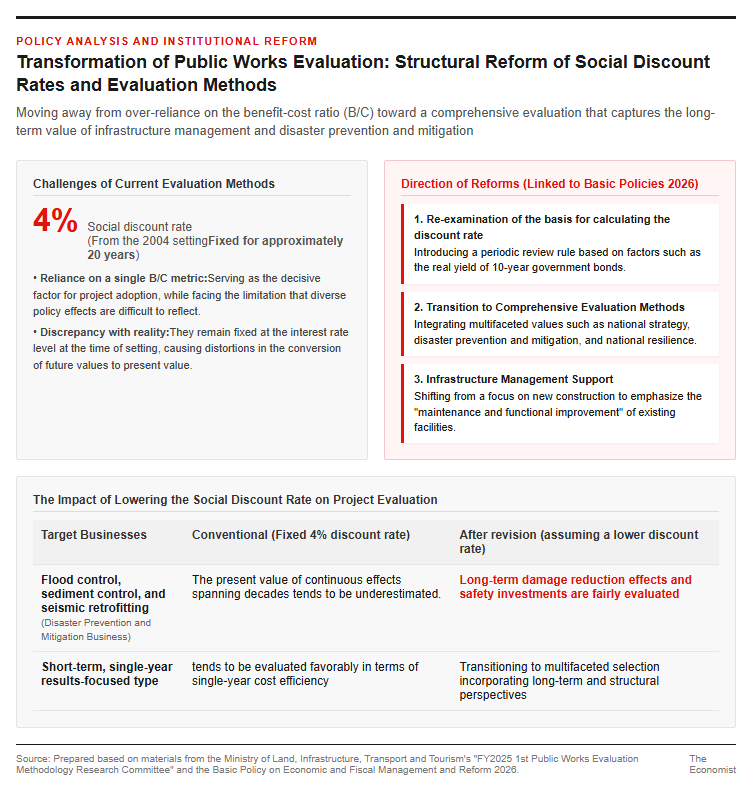
The social discount rate is an index used to discount future costs and benefits to their present value, and the lower the figure, the higher the calculated present value of benefits obtained in the distant future. The current social discount rate has remained fixed without change for approximately 20 years since it was set at 4% in 2004. However, the interest rate levels and economic environment at the time of its setting differ significantly from the present, and the divergence from actual conditions has been cited as an issue. At the research committee, discussions are underway to re-examine the basis for calculating the discount rate while referencing objective indicators such as the real yield on 10-year government bonds, as well as to utilize the Economic Internal Rate of Return (EIRR) and introduce rules for periodic reviews. If the social discount rate is lowered, the present value of disaster prevention and mitigation projects—such as river flood control, erosion control, and seismic retrofitting, whose damage-mitigation effects continue for decades—will be evaluated more favorably. There are expectations for a revision to a framework that properly evaluates long-term, structural safety investments, which have traditionally tended to be undervalued in terms of single-year cost-efficiency. By transforming the evaluation method for future value, the necessity of long-term infrastructure development will become clearer.
Introduction of Comprehensive Evaluation and Reference Indicators to Capture Diverse Effects
Efforts to comprehensively evaluate various quantitative and qualitative effects that are difficult to capture in the cost-benefit ratio (B/C) are also taking concrete shape. In road projects, the Ministry of Land, Infrastructure, Transport and Tourism (MLIT) has traditionally used three main benefits: reduction in travel time, reduction in travel expenses, and reduction in traffic accidents. In addition to these, starting from projects newly initiated in fiscal 2025 (Reiwa 7), the Ministry is introducing the calculation of a “reference B/C (B’/C)” that reflects the effects of improved time reliability and CO2 emission reductions. For example, project report cards for initiatives such as the National Route 57 Kumamoto Ring Connecting Road document contributions to specific regional issues, such as shortened access times to local emergency medical facilities and improved logistics efficiency for the semiconductor-related industry. The policy is to quantify, to the extent possible, the strengthening of disaster prevention functions that are difficult to convert into monetary terms, residents’ sense of security, and the impact on tourism promotion, and to include them alongside evaluation reports and project cards to clarify the comprehensive necessity of the projects. By broadly visualizing not only a single economic efficiency index but also the sustainability and social impact of local communities, the Ministry aims to improve accountability and transparency to the public regarding public works projects.
Transition to Infrastructure Management and Future Outlook
Maintenance and Management of Existing Stock and Revision of the Revaluation System
As social infrastructure built during the period of high economic growth rapidly ages, there is an urgent need to transition from a focus on new construction to “infrastructure management,” which emphasizes the maintenance, renewal, and functional improvement of existing facilities. Along with this, reviews of the “re-evaluation system”—which determines whether to continue or cancel projects—are also underway. Because conventional re-evaluation methods easily gave rise to the misunderstanding that cost-benefit analysis results were the absolute standard for investment decisions, the evaluation implementation guidelines were revised. The revised guidelines introduced “continued improvement” as a course of action as an option when improving facility scales or business plans in response to changes in social conditions, new regional needs, and discrepancies between preliminary surveys and site conditions. A framework has been established that allows for continued evaluation while optimizing project contents by considering “social demands” such as increased disaster risk and reduced environmental impact, rather than stopping at cost reduction or the examination of alternatives. This enables flexible maintenance and renewal adapted to the changes of the times, even in long-term project promotion.
Summary for Winter 2026 and Future Points to Watch
The Ministry of Land, Infrastructure, Transport and Tourism’s Research Committee on Public Works Evaluation Methods plans to compile a final review policy around the winter of 2026, following a total of three meetings. With the introduction of the new evaluation framework, key future focal points will include the specific application criteria for the revised social discount rate and the allocation balance between quantitative and qualitative indicators in comprehensive evaluations. Furthermore, while the institutional changes are expected to improve the evaluation of disaster prevention and mitigation projects and regional infrastructure that offer long-term benefits, supply-side constraints such as soaring labor and material costs and a shortage of workers are becoming prominent in the construction industry. Project prioritization will shift from simply following B/C numerical order to multi-dimensional decision-making that incorporates construction feasibility and regional urgency. Ripple effects on subsidized projects implemented by local governments, as well as the disclosure of the evaluation process to the public and ensuring transparency, are also critical issues. Attention is focused on whether the final report to be compiled in the winter of 2026 will serve as a new guideline for Japan’s future infrastructure development and the sustainable development of local communities.
Reference page
- [Materials from the 1st Public Works Evaluation Methodology Research Committee for Reiwa 7 (2025) – Ministry of Land, Infrastructure, Transport and Tourism] https://www.mlit.go.jp/policy/shingikai/s201_hyouka01.html
- [Overview of Re-evaluation – Ministry of Land, Infrastructure, Transport and Tourism] https://www.mlit.go.jp/seisakutokei/hyouka/public_evaluation/re-evaluation/index.html
- [Regarding the Revision of Guidelines for Project Evaluation Implementation, etc. for Public Works Projects under the Jurisdiction of the Ministry of Land, Infrastructure, Transport and Tourism – Chugoku Regional Development Bureau, Ministry of Land, Infrastructure, Transport and Tourism] https://www.mlit.go.jp/page/content/001768480.pdf
[#PublicWorks #MinistryOfLandInfrastructureTransportAndTourism #SocialDiscountRate #CostBenefitAnalysis #InfrastructureManagement #NationalResilience #DisasterPreventionAndMitigation #PoliticsAndSociety]

コメント