In the web programming language PHP, a critical-severity vulnerability affecting approximately 70% of all websites worldwide, dubbed “PHP2Shell,” was discovered by OpenAI’s AI models and others, prompting emergency security measures to be implemented across the globe. Behind this lies the challenge of a significant gap between the rapidly accelerating speed of vulnerability discovery driven by frontier AI and the organizational response structures required to safely patch and apply fixes for discovered vulnerabilities.
- Critical Vulnerabilities Discovered by AI and Their Impact on Websites Worldwide
- Instability in Coordinated Disclosure and Accelerated Response Due to CVE Information Leaks
- Mechanism of Vulnerability Occurrence and Risks Prior to Input Validation
- An Organizational Security Process Beyond Mere Patching
- The Importance of Remediation Capabilities in the Era of AI-Driven Mass Vulnerability Discovery
- Key Focus Areas for Future Cyber Defense Posture and Technology Investment
Critical Vulnerabilities Discovered by AI and Their Impact on Websites Worldwide
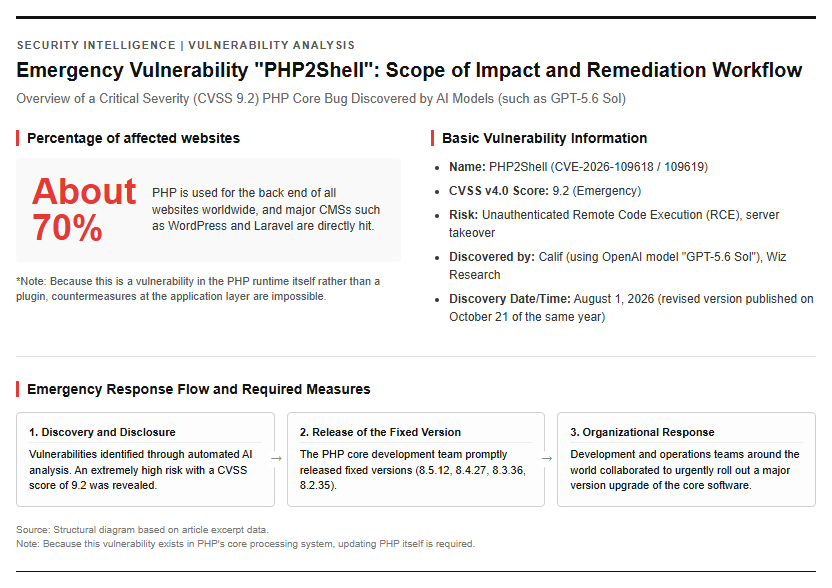
On October 21, 2026, two critical vulnerabilities of the highest severity classification were patched in the core of PHP, a programming language widely used in web systems. Designated as CVE-2026-109618 and CVE-2026-109619, and collectively referred to as PHP2Shell, these vulnerabilities have been assigned an extremely high score of 9.2 on the Common Vulnerability Scoring System (CVSS) v4.0. If these flaws are exploited, unauthenticated external attackers could remotely execute arbitrary code (RCE), posing a risk of server takeover and the theft of confidential information. PHP is used in the backend of approximately 70% of websites worldwide, and services built with major CMSs and frameworks such as WordPress and Laravel are directly affected. Because these vulnerabilities reside within the PHP runtime itself—prior to the startup of application programs—they cannot be prevented by updating plugins or similar measures, and users are urged to promptly update the PHP core to the patched versions: 8.5.12, 8.4.27, 8.3.36, and 8.2.35. AI technology has significantly contributed to the discovery of these vulnerabilities; Calif, participating in OpenAI’s security initiative “Patch the Planet,” used the “GPT-5.6 Sol” model to discover the first vulnerability on August 1, 2026, while Wiz Research also independently identified a similar flaw. The diagram below illustrates the scope of impact and the emergency response workflow for PHP2Shell.
Instability in Coordinated Disclosure and Accelerated Response Due to CVE Information Leaks
Normally, vulnerability information is kept private among the parties involved, following a Coordinated Vulnerability Disclosure (CVD) process where it is published only after sufficient patches are prepared. However, the security release originally scheduled for October 22, 2026, was forced to be brought forward due to unexpected trouble. Following the leak of CVE numbers and incorrect severity information on social media and bulletin boards on October 20, the PHP development team announced that the release would be moved up to October 21 at 14:00 UTC (23:00 Japan time on the same day). Furthermore, due to a series of incidents including the accidental publication of a verification video by the finder and the early distribution of patched images by an external vendor, a tense situation arose where attackers were able to analyze the fix before the official release. In response, the National Cyber Directorate, Prime Minister Sanae Takaichi, and IPA (Information-technology Promotion Agency) urgently issued warnings in Japan, calling for the temporary suspension of websites as an effective mitigation measure until patches could be applied. Domestically, over 200 organizations and web services, including Niconico, pixiv, and Codmon, implemented emergency maintenance or service suspensions. Meanwhile, in the private market, the stock prices of security companies such as Cloudflare, which provides WAF (Web Application Firewall) services, surged, and IT support firm Selva launched emergency update support starting at 100,000 yen, reflecting major movements surrounding swift defensive measures.
Technical Background and Security Response Process of PHP2Shell
Mechanism of Vulnerability Occurrence and Risks Prior to Input Validation
The major difference between PHP2Shell and conventional application-layer flaws is that the vulnerability is triggered during the request initialization phase in PHP’s execution engine (the Zend Engine). The first, CVE-2026-109618, stems from cleanup handling when the memory limit (OOM) is reached during the processing of multipart (multipart/form-data) requests used for tasks such as file uploads. When the initialization of internal states is interrupted due to a memory shortage, subsequent processing uses that incomplete data as-is, resulting in memory corruption. Furthermore, the second vulnerability, CVE-2026-109619, is an issue where references to memory freed in a previous request remain in the global state, adversely affecting subsequent requests processed by the same worker process. Especially in a mod_php configuration operating embedded in the Apache web server, the attack succeeds even before the user-created web application code executes, rendering login authentication and input validation filters set on the application side ineffective. Additionally, session progress tracking features such as PHP_SESSION_UPLOAD_PROGRESS are also involved, meaning that simply modifying php.ini settings does not provide complete protection, and a fundamental engine update is essential.
An Organizational Security Process Beyond Mere Patching
The PHP2Shell incident highlighted that the entire security response process—ranging from vulnerability discovery and patch development to distribution and deployment in production environments—is an organizational challenge that goes far beyond mere code fixes. According to the background report by the PHP Foundation, signs of the memory management bug related to OOM itself had already been recognized at the time of the 2024 external audit. However, because it involved complex decision-making, such as trade-offs regarding maintaining compatibility, impacts on other modules, and the risk of denial of service—combined with a shortage of core developer resources—the remediation work had stalled for a long period. Entering 2026, an AI-assisted investigation demonstrated an actionable attack vector, which raised the priority to the highest level and prompted emergency remediation. When enterprises and organizations cannot immediately apply emergency patches, they tend to fall into an extreme dilemma between completely shutting down services or operating while vulnerable. In response to this, architectural designs that gracefully degrade functionality—such as leveraging HTTP specifications to allow only browsing-related GET/HEAD requests, isolating login and file upload functions, or delivering static content—serve as effective risk reduction measures. However, these are merely temporary mitigation measures, and ultimately, completing the application of patches and operational verification is the ultimate goal of organizational defense.
Cybersecurity in the AI Era and Future Organizational Design
The Importance of Remediation Capabilities in the Era of AI-Driven Mass Vulnerability Discovery
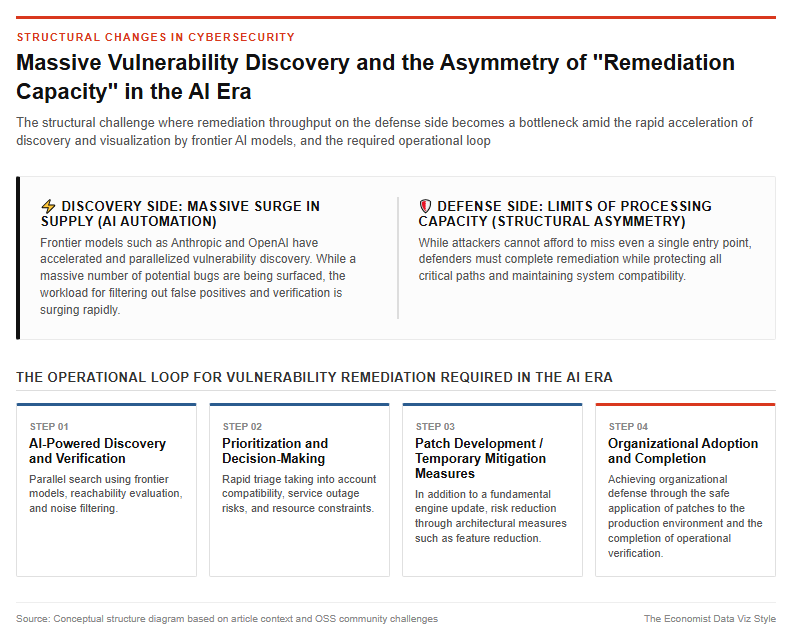
The advancement of generative AI has dramatically shifted the main battleground in security from a traditional shortage of discoveries to a shortage of processing capacity. With the emergence of frontier models such as Anthropic’s Project Glasswing, Claude Mythos, and GPT-5.6 Sol, vulnerability hunting—which traditionally required vast amounts of time from skilled researchers—has been parallelized and accelerated, bringing a massive number of potential bugs to light. However, even as the supply of discovered vulnerabilities surges, the processing capacity (remediation throughput) on the defending side to verify them, assess reachability, develop patches, and safely apply them to production environments does not automatically scale. Defenders face a structural asymmetry: an attacker succeeds by finding just a single entry point among countless paths in a system, whereas defenders must protect all critical paths and complete fixes while maintaining compatibility with existing systems and audit trails. Within the open-source software (OSS) community as well, the verification of AI-generated reports arriving in large volumes and the task of eliminating false positives are sharply increasing the burden on a small number of maintainers, prompting ongoing financial and technical support from OpenSSF and major tech companies. The following diagram illustrates the operational loop of vulnerability remediation required in the AI era.
Key Focus Areas for Future Cyber Defense Posture and Technology Investment
Going forward, the cybersecurity measures that companies and organizations should aim for are not simply about introducing high-precision scanners or AI tools, but rather establishing a remediation operations infrastructure (a “remediation OS”) to safely and reliably handle discovered risks. This requires a “state circuit” to grasp the full picture of the software owned by the company and the OSS it depends on, a “control circuit” that defines change approvals and emergency shutdown criteria, and a “connection circuit” that links validation environments and release pipelines. Management is required to view emergency patch responses not merely as temporary expenses, but as technological investments that enhance organizational capabilities, such as maintaining architecture diagrams, automating response procedures, and accumulating records of decision-making. In addition, since operations where humans individually perform all verification tasks will collapse due to processing explosion, designing delegatability—deciding how much judgment to delegate to AI agents and under what boundary conditions to hand over to humans—will become a critical focus. With security accountability across the entire lifecycle of digital products being legislated, starting with Europe’s Cyber Resilience Act (CRA), companies bear the responsibility of not leaving known vulnerabilities unaddressed. In an era where AI increases the speed at which vulnerabilities are discovered, developing organizational systems capable of resolving and remediating issues at a corresponding pace will be the most critical key to ensuring future business continuity.
Reference page
- [PHP Official Advisory] https://www.php.net/archive/2026.php
- [PHP Foundation Security Release Statement] https://thephp.foundation/blog/2026/10/21/todays-php-security-release-and-how-were-strengthening-php-security/
- [OpenAI Coordinated Disclosure Announcement] https://openai.com/index/coordinated-disclosure-of-critical-vulnerabilities/
- [IPA Cybersecurity Alert] https://www.ipa.go.jp/security/security-alert/2026/pre-alert20261021.html
- [CERT-EU Security Advisory 2026-018] https://cert.europa.eu/publications/security-advisories/2026-018
【#PHP2Shell #Cybersecurity #VulnerabilityCountermeasures #GenerativeAI #InformationSecurity #OSSSecurity #RiskManagement】


コメント