In September 2026, the value of public works contracts in Saga Prefecture reached 13.1 billion yen, an increase of 12.1% from the same month of the previous year, showing steady growth. This was driven by proactive fiscal measures, including the promotion of major projects such as the prefectural university construction project and the formulation of supplementary budget proposals that incorporate infrastructure disaster prevention and mitigation measures.
- Preliminary Summary of September Public Works Contract Amounts: 13.1 Billion Yen
- September Supplementary Budget Bill and the Background of Promoting Major Public Works
- Regional Characteristics of the Number of Construction Contractors and Construction Value Per Contractor
- Design Labor Unit Costs and the Challenge of Chronic Labor Shortages
- 75.5 Trillion Yen Domestic Construction Investment and the Trend of Construction DX
- Future Focus and Points to Watch in the Saga Prefecture Construction Market
Preliminary Summary of September Public Works Contract Amounts: 13.1 Billion Yen
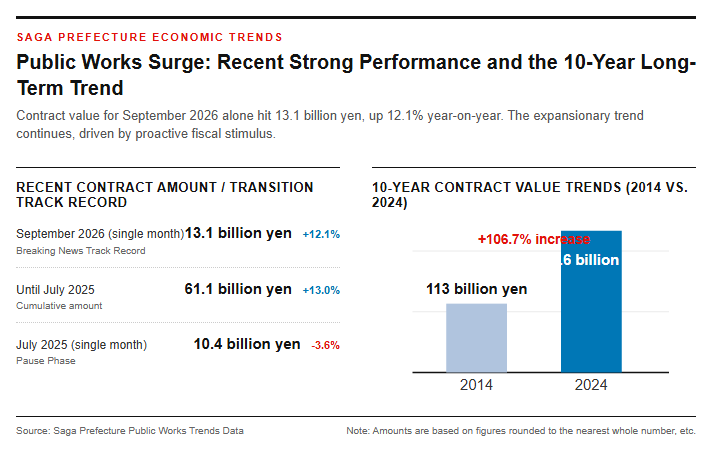
It has been revealed that the amount of public works contracts in Saga Prefecture for September 2026 reached 13.1 billion yen, representing a 12.1% increase compared to the same month of the previous year. This single-month growth has been significantly driven by the full-scale progression of social capital development and infrastructure repair work underway in various regions across the prefecture. Looking back at recent trends, while the public works contract amount for July 2025 alone was approximately 10.4 billion yen—showing a temporary slowdown with a 3.6% decrease year-on-year—the cumulative contract amount up through July in fiscal 2025 reached approximately 61.1 billion yen, maintaining a steady upward trend with a 13.0% increase over the previous fiscal year. The sharp rebound to a 12.1% increase in September alone holds critical significance for the revitalization of the local economy and the securing of order opportunities for local construction businesses. Public works contract amounts in Saga Prefecture have shown a 106.7% increase over the 10-year period from 113 billion yen in 2014 to 233.6 billion yen in 2024, demonstrating that, as a long-term trend, public investment remains a primary pillar supporting the prefectural economy. The chart and table below provide a detailed illustration of investment trends and changes within Saga Prefecture.
The increase in public works contract amounts is expected to have a ripple effect across a wide range of related industries, including civil engineering and construction, as well as electrical and equipment installation businesses.
September Supplementary Budget Bill and the Background of Promoting Major Public Works
In the September supplementary budget proposal announced by Saga Prefecture on August 26, 2026, multifaceted measures to support an increase in public works have been incorporated. At a press conference, Governor Yoshinori Yamaguchi emphasized the importance of investment aimed at solving structural regional issues. As one of the main highlights of the supplementary budget, the development project for the Saga Prefectural University (tentative name) has set a total of 146.6 billion yen as multi-year funding from fiscal 2026 through fiscal 2029 for its opening in the spring of 2029, preparing for the full-scale construction work corresponding to the design. The policy to keep the total project cost of this development project within approximately 20 billion yen—factoring in the impact of rising material and soaring prices—remains maintained, with construction orders planned to be placed sequentially, starting with the budget allocation for fiscal 2026 in the September supplementary budget proposal. Furthermore, diverse budget allocations have been implemented with an eye toward regional safety and security and future infrastructure development, including a support project for installing spot coolers in municipal elementary and junior high schools to improve the environment of school facilities, and an external support budget for verifying technical issues concerning the Nishi-Kyushu route of the Kyushu Shinkansen. These fiscal measures serve as the direct catalyst pushing up the amount of public works contracts from September onward.
Structural Indicators and On-Site Environment of the Saga Prefecture Construction Industry
Regional Characteristics of the Number of Construction Contractors and Construction Value Per Contractor
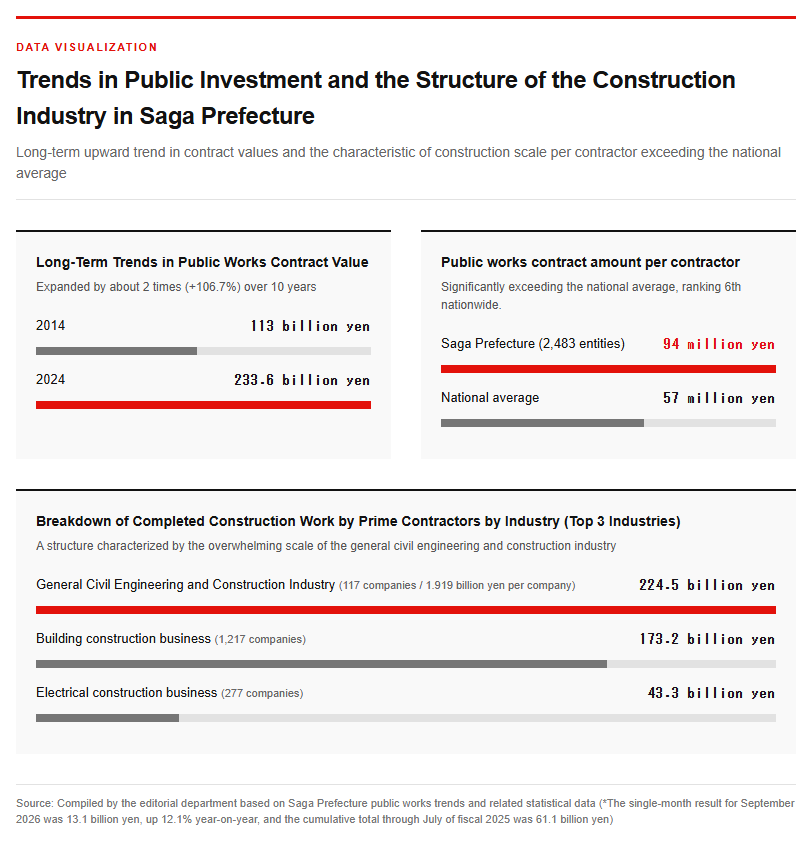
Examining the construction industry structure in Saga Prefecture through objective indicators reveals unique regional characteristics. As of 2023, the number of construction contractors in Saga Prefecture is 2,483, placing it in a relatively small category nationwide in terms of the number of contractors. On the other hand, the value of public works contracts per contractor, calculated by dividing the total public works contract amount by the number of construction contractors, reaches 94 million yen according to the editorial department’s estimates. This significantly exceeds the national average of 57 million yen, showing a high level that ranks 6th out of the 47 prefectures. While the large scale of construction work allocated per contractor contributes to stabilizing the order-receiving base of local businesses, it is also an environment that tests the management strength and technical capabilities required to win specific large-scale projects. Looking at the breakdown of completed prime contractor construction volume by industry, general civil engineering and building construction is the largest at 224.5 billion yen (117 contractors, 1.919 billion yen per contractor), followed by building construction at 173.2 billion yen (1,217 contractors), and electrical work at 43.3 billion yen (277 contractors). Below is a comparative image of the contractor composition and completed construction volume within the prefecture.
In this way, businesses that support the local community are organized across various construction trades, and the stable placement of public works orders is directly linked to their sustainability.
Design Labor Unit Costs and the Challenge of Chronic Labor Shortages
Securing labor costs and human resources is an unavoidable challenge in maintaining public works execution systems. Looking at Saga Prefecture’s design labor unit prices for public works applicable from March 2026, 9 out of the 10 major job categories fall below the national simple average. Specifically, the unit price for general laborers is 20,700 yen (ranking 43rd nationwide, national average 23,534 yen), scaffolders are 28,100 yen (ranking 41st nationwide, national average 30,166 yen), and formwork carpenters are 30,600 yen (ranking 29th nationwide, national average 31,162 yen). This unit price gap with the national average poses a challenge in preventing skilled workers from leaving the prefecture and encouraging them to settle locally. Examining the employment situation within Saga Prefecture, the active job opening-to-applicant ratio as of July 2025 remains at a high level of 1.27x, exceeding 1.2x for 49 consecutive months since 2021. With the number of job openings exceeding job seekers, securing skilled workers at construction sites is far from easy. Moreover, the Consumer Price Index (in Saga City) continues to soar, reaching 112.9 as of July 2025 (a 4.1% increase year-on-year), making raising labor wages and improving on-site working conditions an urgent priority.
National Construction Investment Trends and Future Outlook
75.5 Trillion Yen Domestic Construction Investment and the Trend of Construction DX
Comparing Saga Prefecture’s situation with nationwide construction trends makes the structural challenges and the direction toward solutions clearer. Although domestic construction investment peaked at 83.9 trillion yen in fiscal 1992 and subsequently declined, it has been on a recovery trend in recent years, with the fiscal 2025 outlook projected to reach the scale of 75.5 trillion yen. The domestic return of manufacturing industries, urban redevelopment, and infrastructure demand for national resilience are driving this investment. However, at the same time, the number of construction workers has dropped by about 30% from 6.85 million in 1997 to 4.77 million in 2024, and aging and labor shortages are becoming acute, with workers aged 55 and older accounting for 36.7% of the workforce. To address these challenges, the use of ICT and digital tools at construction sites is advancing rapidly. For instance, cloud services like the construction management system Buildee have been adopted by approximately 90% of major general contractors, unifying on-site coordination meetings, safety document management, and entry/exit management linked with facial recognition and CCUS. Work style reform through labor-saving and paperless operations is key to improving productivity, even at regional construction sites.
Future Focus and Points to Watch in the Saga Prefecture Construction Market
The focus of public works and the construction market in Saga Prefecture moving forward lies in the steady execution of projects and ensuring the sustainability of construction sites. While it has gotten off to a strong start with a 12.1% increase in September contract amounts, the soaring prices of building materials and energy, as well as rising logistics costs, are weighing heavily. As Saga Prefecture Governor Yamaguchi has pointed out, while budget management must incorporate an inflation rate of around 8%, flexible measures capable of responding to further sharp price fluctuations are required. Furthermore, it is important to create a virtuous cycle through the stable ordering of public works, enabling local construction companies to secure fair profits and channel funds into the recruitment and training of young engineers as well as capital investment. The main points to watch are as follows.
- Progress of bidding and construction for large-scale projects (such as the prefectural university and Shinkansen-related technology verification)
- Setting appropriate construction prices in response to design labor cost and material price revisions, and preventing dumping
- Reduction of working hours and establishment of a five-day workweek system through the implementation of construction DX tools
Efforts are expected to ensure that the growth in public investment does not end as a temporary phenomenon, but is instead tied to strengthening regional disaster prevention capabilities and enhancing the economic foundation.
Reference page
- [August 26, 2026: Governor’s Regular Press Conference & Governor’s Press Conference on the September Supplementary Budget Proposal – Q&A – Saga Prefecture] https://www.pref.saga.lg.jp/chiji/kiji003120798/index.html
【#PublicWorks #SagaPrefecture #ConstructionIndustry #LocalEconomy #SupplementaryBudget #ConstructionDX】


コメント