On October 22, 2026, Kao Kim Hourn, Secretary-General of the Association of Southeast Asian Nations (ASEAN), paid a courtesy call on Minister of Land, Infrastructure, Transport and Tourism Ibayashi, and they exchanged a wide range of views on promoting cooperation in the fields of transportation, smart cities, and tourism. This meeting took place against the backdrop of a growing need to further strengthen sustainable, effective, and high-quality infrastructure cooperation between Japan and ASEAN with regard to reinforcing supply chains and enhancing regional connectivity.
- The Three Major Priority Areas Discussed During the October 22 Courtesy Visit
- The Positioning of Land, Infrastructure, Transport and Tourism Administration in Japan-ASEAN Relations
- Deepening Cooperation in the Transport Sector and the Luang Prabang Action Plan
- The Roles of SmartJAMP and JASCA in Accelerating Smart City Deployment
- Re-expansion of tourism exchange and strengthening of “people-to-people connectivity”
- The Future of High-Quality Infrastructure Overseas Expansion Toward 2030
- Looking ahead, key points of focus include the progress of the following initiatives:
The Three Major Priority Areas Discussed During the October 22 Courtesy Visit
On October 22, 2026 (Reiwa 8), a meeting took place at the Ministry of Land, Infrastructure, Transport and Tourism between Minister of Land, Infrastructure, Transport and Tourism Ibayashi and ASEAN Secretary-General Kao Kim Hourn. During this courtesy call, discussions were held regarding specific future cooperation frameworks, focusing on three key areas between Japan and ASEAN: the development of transport infrastructure, smart city development, and the promotion of tourism exchange. The atmosphere of the meeting and an overview of the discussion themes are shown in the image below.
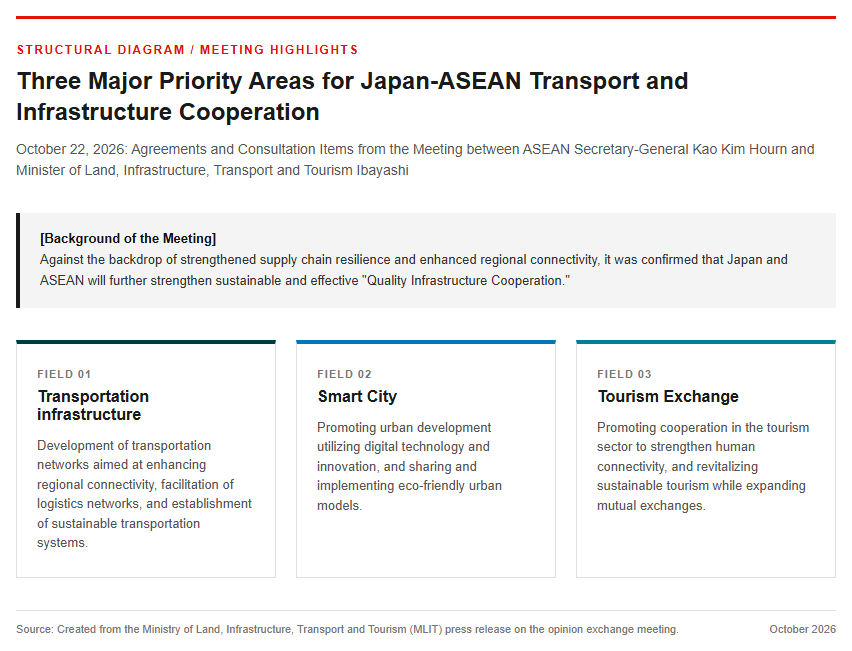
In the transportation sector, strengthening physical and institutional connectivity to facilitate intra-regional logistics and the movement of people became a key theme. In the smart city sector, discussions were held on solutions to urban challenges utilizing digital technologies and decarbonization (GX) approaches. In the tourism sector, a policy was shared to revitalize people-to-people exchanges between both sides and aim for the creation of vitality in regional economies. This exchange of views served as an important step in taking the multi-layered cooperative framework between Japan and ASEAN, which has been built over many years, to the next level.
The Positioning of Land, Infrastructure, Transport and Tourism Administration in Japan-ASEAN Relations
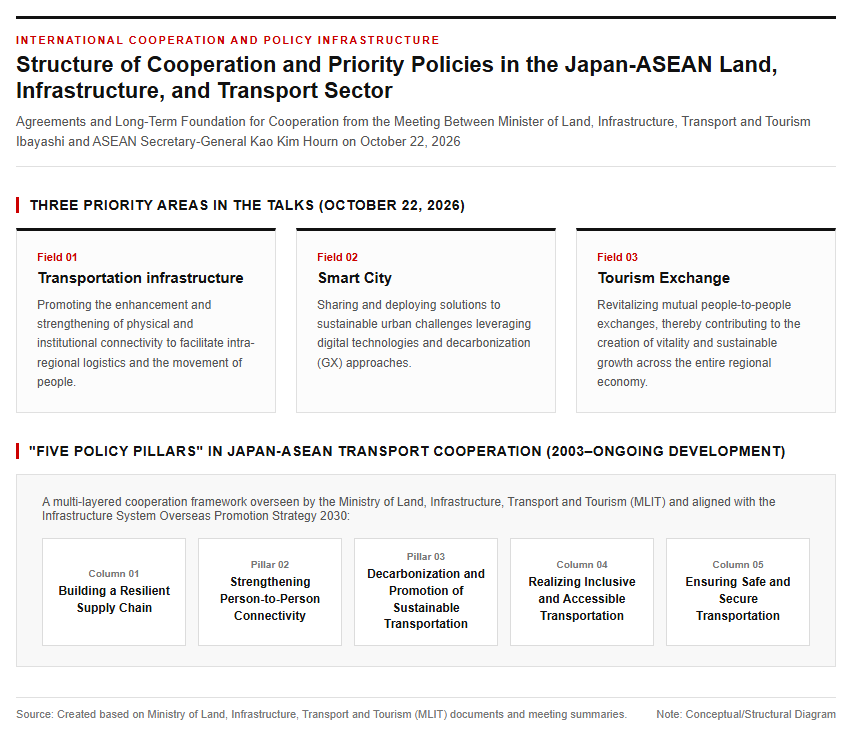
Japan and ASEAN have built a close partnership for over half a century since the initiation of their dialogue in 1973. In particular, the policies concerning transport, urban development, and tourism overseen by the Ministry of Land, Infrastructure, Transport and Tourism have played a core role in supporting economic integration and overcoming social challenges across the entire ASEAN region.
In 2003, the Ministry of Land, Infrastructure, Transport and Tourism established the “Japan-ASEAN Transport Partnership” and has continued cooperative projects under the following five policy pillars.
– Building a Resilient Supply Chain
– Strengthening Person-to-Person Connectivity
– Decarbonization and Promotion of Sustainable Transportation
– Realizing Inclusive and Accessible Transportation
– Ensuring Safe and Secure Transportation
Under the “Infrastructure System Overseas Expansion Strategy 2030,” the Japanese government is promoting the enhancement of international competitiveness through co-creation with partner countries and the incorporation of societal transformations such as GX and DX. In these national strategies, the ASEAN region is positioned as the highest-priority partner for cooperation.
Promotion Structure and Specific Initiatives for Sector-Specific Cooperation
Deepening Cooperation in the Transport Sector and the Luang Prabang Action Plan
In Japan-ASEAN transport cooperation, initiatives covering all transport modes—land, maritime, and air—are being implemented through mechanisms such as the ministerial-level Japan-ASEAN Transport Ministers Meeting (ATM+Japan) and working-level working groups. The meeting framework and the current status of project implementation are illustrated in the figure below.
Under the Luang Prabang Action Plan, which covers the 10-year period from 2024 to 2033, work plans are being implemented as concrete operational plans. Recently, the following achievements and new projects have been agreed upon and approved.
– Support for Human Resource Development of Aids to Navigation Personnel
– Development of the CORSIA Eligible Fuel Certification Guidebook and Diversification of SAF Feedstocks
– Completion of the Joint Hydrographic Survey in the Straits of Malacca and Singapore
– Formulation of Guidelines for Providing Information to Small Vessels
These initiatives are making a significant contribution to improving logistics efficiency, establishing cold chains, and enhancing transport security within the ASEAN region.
The Roles of SmartJAMP and JASCA in Accelerating Smart City Deployment
With the rapid urbanization of ASEAN member states, the importance of smart city initiatives to address urban challenges such as traffic congestion and environmental pollution is rapidly increasing. The Japanese government is promoting public-private joint support targeting 26 cities across 10 countries participating in the ASEAN Smart Cities Network (ASCN).
Under “SmartJAMP” (a smart city support initiative) rolled out by Japan, support is being advanced based on the following four pillars.
– Acceleration of Project Formation Surveys for Overseas Smart Cities
– Promotion of investment and financing for related projects
– Strengthening Response Capabilities in Each Country
– Mutual Cooperation through the Japan-ASEAN Smart City Network Public-Private Council (JASCA)
At the 6th ASCN High-Level Meeting held in Tokyo in October 2024, active discussions were held regarding the introduction of GX technologies toward realizing a decarbonized society, as well as the utilization of next-generation mobility, including AI on-demand transport and MaaS.
Overcoming Regional Challenges and Future Prospects
Re-expansion of tourism exchange and strengthening of “people-to-people connectivity”
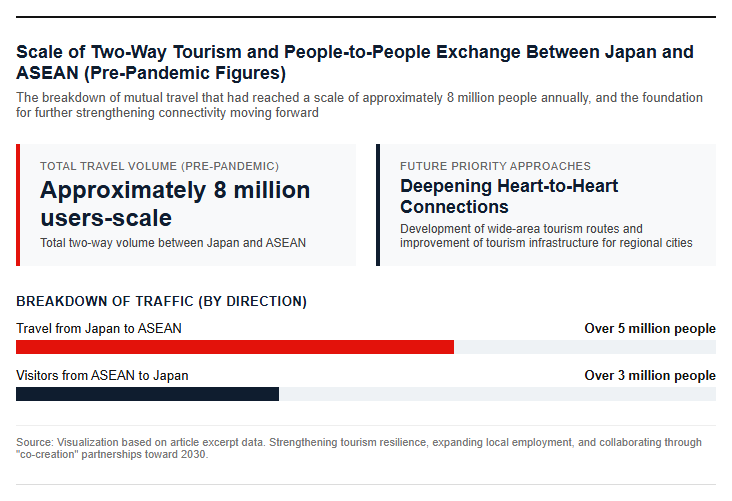
The tourism sector and people-to-people exchanges are extremely important foundations supporting mutual understanding and economic revitalization between Japan and ASEAN. Two-way travel between Japan and ASEAN had reached a scale of 8 million people annually prior to the spread of infectious diseases (over 5 million from Japan and over 3 million from ASEAN).
As a primary approach toward expanding future exchanges, the following initiatives are being promoted.
– Strengthening Tourism Resilience and Adopting a Joint Statement Through the ASEAN+3 Tourism Ministers Meeting
– Development of Regional Tourism Routes to Promote Visits to Regional Cities
– Deepening “heart-to-heart connections” through youth exchange and human resource development
During the recent consultations between Secretary-General Cao and Minister Ibayashi, agreement was also reached on building a sustainable tourism model and expanding local employment through the development of tourism infrastructure. Expanding two-way travel will contribute not only to the tourism industry but also to creating a virtuous cycle in the regional economy.
The Future of High-Quality Infrastructure Overseas Expansion Toward 2030
The cooperative relationship between Japan and ASEAN has evolved from mere assistance into a “co-creation” partnership that brings together their respective strengths. Based on the basic policy outlined in the government-wide “Infrastructure System Overseas Promotion Strategy 2030,” public-private collaborative project formation (offer-type cooperation) and the utilization of PPP financing are being further strengthened. Future points of focus and developments are as outlined in the image below.
Looking ahead, key points of focus include the progress of the following initiatives:
- Enhancement of soft infrastructure (such as MaaS) utilizing digital technology and big data
- Introduction of low-environmental-impact vessels and utilization of renewable energy toward decarbonization
Triggered by the courtesy visit in October 2026, Japan-ASEAN cooperation is expected to be further strengthened across the pillars of transportation, urban development, and tourism, and to make a significant contribution to the realization of a sustainable, open, and free Indo-Pacific region.
Reference Page
- [Courtesy Call on Minister Ibayashi by Kao Kim Hourn, Secretary-General of the Association of Southeast Asian Nations (ASEAN)] https://www.mlit.go.jp/page/kanbo01_hy_011172.html
- 【Japan-ASEAN Transport Cooperation】https://www.mlit.go.jp/kokusai/kokusai_tk1_000104.html
【#JapanASEAN #MLIT #OverseasInfrastructureDeployment #SmartCity #InternationalCooperation】


コメント