US-based Cloudflare has reported that regarding the severe PHP vulnerability “PHP2Shell,” which occurred in October 2026, exploitation attempts reached several million within just hours of its disclosure. Behind this lies a changing environment where attackers instantly deploy automated attacks against web infrastructure flaws discovered by AI tools.
- Surge in attacks immediately following public disclosure and observation data by Cloudflare
- Mechanisms and Risks of Two “PHP2Shell” Issues That Break Memory Safety
- Vulnerability Discovery Using AI Models and Collaboration Among Research Entities
- Timeline of Information Leakage and Patching in Coordinated Disclosure
- The Persistence of Older Versions in Web Servers Worldwide and Emergency Response Measures
- Vulnerability Management in the AI Era and Overcoming Structural Challenges
Surge in attacks immediately following public disclosure and observation data by Cloudflare
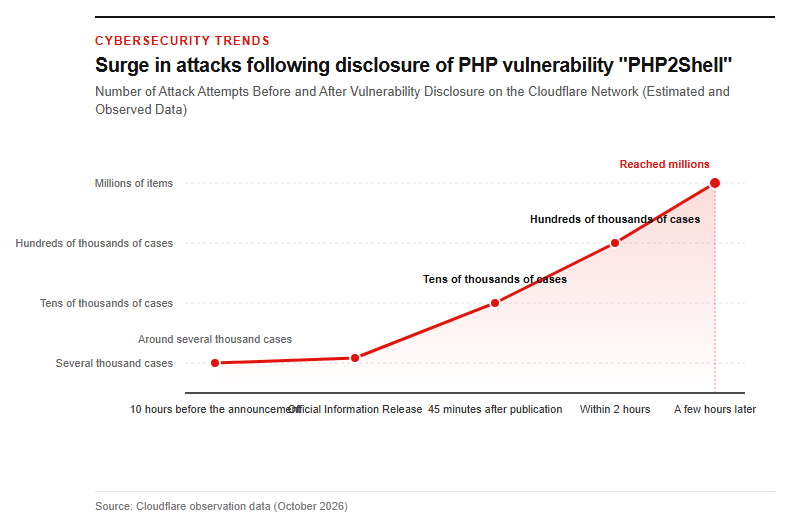
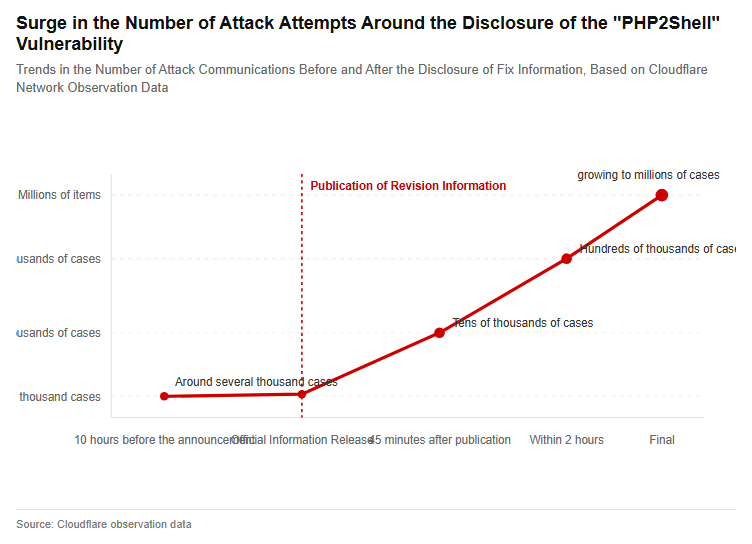
On October 22, 2026, Matthew Prince, CEO of the US-based company Cloudflare, announced that global attempts to exploit “PHP2Shell,” an emergency-level vulnerability existing in the PHP programming language, had exploded worldwide. According to observation data from the company’s network, attack attempts in the 10 hours prior to the release of patch information by the PHP development team were limited to just a few thousand. However, attack traffic surged immediately after the official information was published, reaching tens of thousands of attempts within 45 minutes of the release, hundreds of thousands within two hours, and ultimately swelling to millions. This dramatic shift demonstrates the reality that the time it takes for attackers to detect published vulnerability information, create exploit code (exploits), and launch indiscriminate attacks has been drastically shortened. To prevent the spread of damage, Cloudflare applied Web Application Firewall (WAF) automated defense rules by default to all plans, both free and paid, even before the vulnerability details were publicly disclosed, aiming to block the threat. Please refer to the figure below.
Mechanisms and Risks of Two “PHP2Shell” Issues That Break Memory Safety
The vulnerabilities that became an issue this time are managed under the identification numbers CVE-2026-109618 and CVE-2026-109619, and have been rated with a severity score of 9.2 (Critical) in the Common Vulnerability Scoring System (CVSS) v4.0. Commonly referred to as “PHP2Shell,” this issue is not a bug in a specific application, but rather stems from memory-related processing flaws in the PHP processing system (core) itself. Specifically, it includes flaws where incomplete data is treated as normal values during cleanup when an out-of-memory (OOM) error occurs during request processing, as well as state corruption involving continued references to already freed memory space. Attackers are at risk of executing arbitrary code (RCE) on the web server without authentication simply by sending specially crafted HTTP requests. It is viewed with extreme seriousness that even in operating environments for major content management systems (CMS) such as WordPress, Drupal, and Joomla, these vulnerabilities can bypass application-side defense logic and cause direct damage.
A New Paradigm in AI-Driven Vulnerability Discovery and Security Defense
Vulnerability Discovery Using AI Models and Collaboration Among Research Entities
What was distinctive about this vulnerability discovery was that cutting-edge artificial intelligence (AI) models played a decisive role. In August 2026, security firm Calif used OpenAI’s “GPT-5.6 Sol” AI model to discover a critical issue lurking in the PHP core. Additionally, Wiz, which was conducting a separate investigation, utilized its own Wiz Atlas and Google’s “Gemini 4 Argon” to demonstrate an attack path leading to unauthenticated remote code execution. This effectively means that the verification of complex memory safety, which previously required advanced expertise and a vast amount of analysis time, has been significantly accelerated with the support of large language models. Following this achievement, under OpenAI’s open-source security support initiative “Patch the Planet,” multi-stakeholder coordination involving the PHP Foundation, Cloudflare, and the U.S. Cybersecurity and Infrastructure Security Agency (CISA), among others, progressed regarding the development of a fix patch and preparations for proactive defense measures. Please refer to the figure below.
Timeline of Information Leakage and Patching in Coordinated Disclosure
Behind the process from vulnerability discovery to the release of a fix, confusion also arose surrounding information disclosure. Initially, the PHP development team planned to release the fixed version on October 22, 2026. However, because the CVE identification number and related information were leaked online around October 20, the release schedule was moved up by one day to October 21 at 14:00 UTC (23:00 Japan time). Ultimately, PHP versions 8.2.35, 8.3.36, 8.4.27, and 8.5.12 with the patch applied were released. However, according to an investigation by Amazon Threat Intelligence, it was reported that attempts to attack this vulnerability had already been observed in a honeypot environment as early as October 17—four days prior to the official patch release. The reality that the “Defender’s Window” before the patch release collapsed and attack activities began even before the fix information circulated highlights a critical challenge in threat management in the age of AI.
Emergency Measures to Prevent Damage and Future Security Outlook
The Persistence of Older Versions in Web Servers Worldwide and Emergency Response Measures
PHP is a widespread foundational technology used in approximately 69.3% of all known websites worldwide. However, according to analyses by security research firms (such as Mallory and Modat), it is estimated that out of approximately 2.6 million PHP hosts exposed to the internet, more than 70% (about 1.9 million) are running outdated versions (such as PHP 5.x, 7.x, 8.0, and 8.1) that have passed their official End-of-Life (EOL) period. Because official automatic update patches are generally not provided for these environments, concerns over the potential spread of damage have heightened. As countermeasures, prompt updates to actively supported versions (8.3 or higher) are strongly recommended, while systems that cannot be updated immediately are advised to implement emergency mitigation measures such as blocking traffic via a WAF, disabling session settings (session.upload_progress.enabled=0), and restricting external access (such as migrating behind a VPN or temporarily suspending public exposure).
Vulnerability Management in the AI Era and Overcoming Structural Challenges
Looking ahead, the advancement of AI has a dual nature: while it brings more sophisticated security defenses, it simultaneously facilitates automation and acceleration for attackers. As demonstrated by the PHP2Shell case, the transition period from AI-based discovery to actual attacks has shortened from days to hours, leading to an increasing number of cases where traditional human-driven periodic patching cannot keep up in time. Consequently, enterprises and organizations must continuously track various types of middleware and open-source software (OSS) dependencies (SBOM) within their internal systems, combined with automated detection using WAF and EDR. Furthermore, because these attack attempts have been confirmed as early as October 17—prior to public disclosure—operators are urged not only to apply updates, but also to establish a post-audit framework that retrospectively investigates server logs and worker process behavior from that date forward to verify whether any suspicious shell executions or unauthorized file creations occurred.
Reference page
- PHP Security Release & Advisories
- [PHP Foundation Security Update] https://thephp.foundation/blog/2026/10/21/todays-php-security-release-and-how-were-strengthening-php-security/
- 【National Cyber Security Centre (NCSC) Alert】https://www.ncsc.gov.uk/news/critical-security-issue-affecting-php
- 【Cloudflare Security Blog】https://blog.cloudflare.com/php-vulnerabilities-waf-protection
- OpenAI Coordinated Disclosure Report
【#PHPVulnerability #PHP2Shell #Cloudflare #Cybersecurity #AIVulnerabilityDiscovery #WAF #RCE #SecurityCountermeasures】

コメント