The Ministry of Finance has proposed a review of the system for corporate subsidies, including the thorough enforcement of profit-returning mechanisms, where a portion of the profits earned from projects is paid back to the state. The background behind this includes curbing the subsidy budget that has ballooned since the COVID-19 pandemic and ensuring an appropriate return on investment for public funds.
- Profit Repatriation Demanded by the Ministry of Finance and the Expanding Subsidy Budget
- Corporate Subsidy Dependency and Concerns Over Moral Hazard
- Overview of the Revenue Return System and Recent System Changes
- Severe repayment penalties due to unmet requirements and reporting negligence
- Shift from subsidies to loans and financial support
- Growth Targets and Medium- to Long-Term Financial Planning Required of Companies
Profit Repatriation Demanded by the Ministry of Finance and the Expanding Subsidy Budget
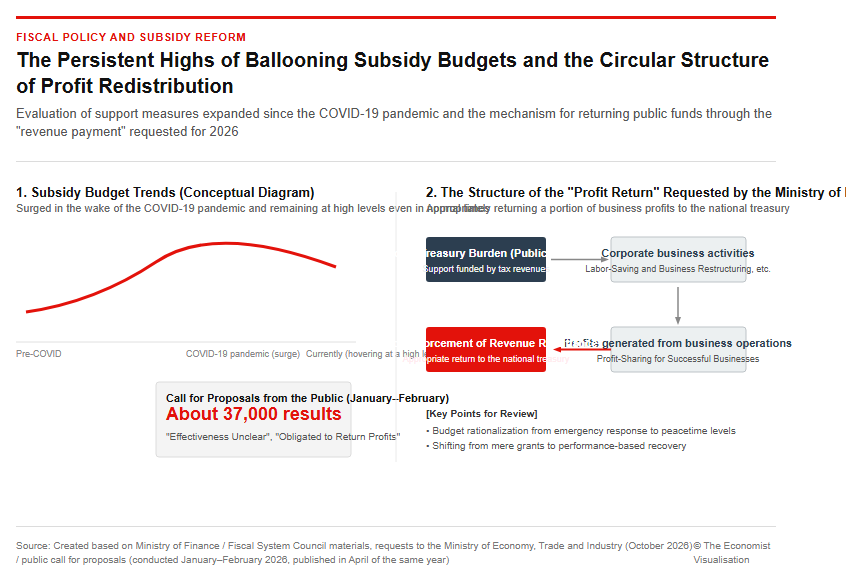
In October 2026, the Ministry of Finance made a request to the Ministry of Economy, Trade and Industry regarding corporate subsidies, specifically concerning a profit-return mechanism to return a portion of the profits generated from business activities to the national treasury. Since the COVID-19 pandemic, the Japanese government has compiled large supplementary budgets and established funds under the names of business restructuring and labor-saving initiatives, significantly expanding subsidies for small and medium-sized enterprises (SMEs). However, even in discussions by the Fiscal System Council, strong concern has been raised over the current situation where the subsidy budget, which had swelled as an emergency crisis response, has failed to return to peacetime levels and remains stubbornly high. According to government initiative documents published in April 2026, a total of approximately 37,000 opinions were gathered through a public call for proposals conducted from January to February. Among them, there were many concerns expressed regarding subsidies that continue with unclear effectiveness, along with arguments pointing out that successful businesses should be required to return profits in proportion to the public funding received. As this support is financed by tax revenues, the Ministry of Finance has clearly demonstrated its stance of aiming not just to provide grants, but to ensure returns to the national treasury and optimize the budget. The diagram below illustrates the structure of public funding and profit returns.
Corporate Subsidy Dependency and Concerns Over Moral Hazard
Behind the Ministry of Finance’s push to review subsidy programs is a strong sense of crisis regarding corporate dependency on subsidies and moral hazard. Because generous subsidy support has become the norm over a long period, a trend has spread among businesses of making capital investments “on the assumption that subsidies will be available.” Critics point out that this hinders productivity improvements that should otherwise be achieved through independent management efforts and strict cost control, paradoxically resulting in delayed business metabolism. Specifically, there have been instances where companies intentionally keep their business scale within SME limits to avoid falling out of support requirements for small and medium-sized enterprises, or where management plans are crafted with an obsession over adoption rates and requirements. Furthermore, exorbitant price estimates detached from market realities and issues involving the improper receipt of funds by businesses and support agencies are occasionally observed, threatening the credibility of the system as a whole. Breaking away from a structure that relies entirely on government funds has become an unavoidable challenge toward building a sustainable Japanese economy.
The Mechanics of Revenue Sharing and the Reality of Repayment Risks
Overview of the Revenue Return System and Recent System Changes
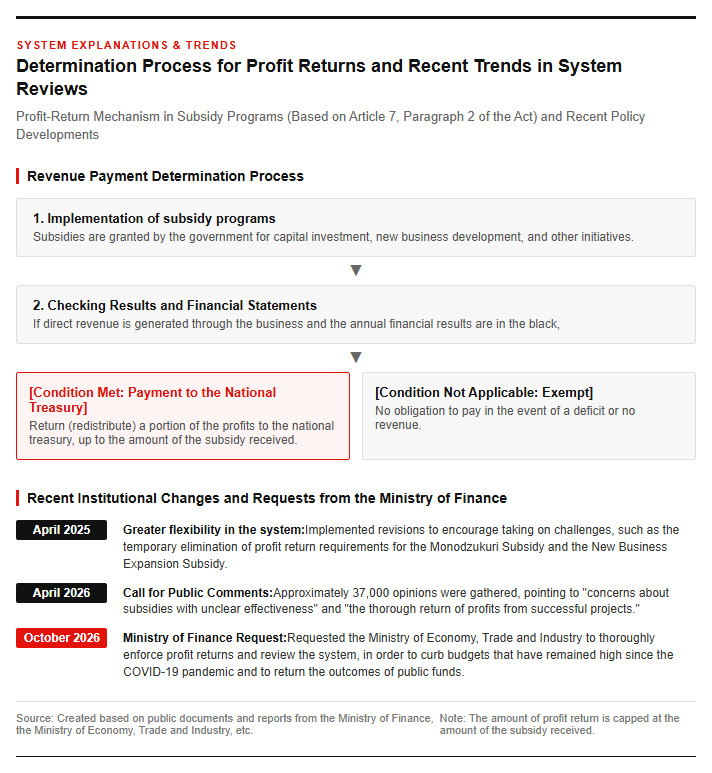
Revenue return (shueki nofu) is a system established based on Article 7, Paragraph 2 of the Act on Optimization of Execution of Budgets Relating to Subsidies. When a business implemented utilizing subsidies generates direct revenues and finishes the fiscal year in the black, it is obligated to return a portion of the profits to the national treasury, up to the amount of the subsidy received. It is positioned as a liquidation procedure to prevent all profits from being monopolized by companies and to ensure fairness. On the other hand, it has been pointed out that the complexity of the system is a factor that makes small and medium-sized enterprises hesitant to take on challenges, and flexible measures were implemented in the system revision starting in April 2025, such as the temporary abolition of revenue return for manufacturing subsidies and new business expansion subsidies. However, following this proposal by the Ministry of Finance, there is a high possibility that profit-sharing rules for companies that have achieved certain results will be strengthened again in the future. The following diagram illustrates the judgment process for revenue return.
Severe repayment penalties due to unmet requirements and reporting negligence
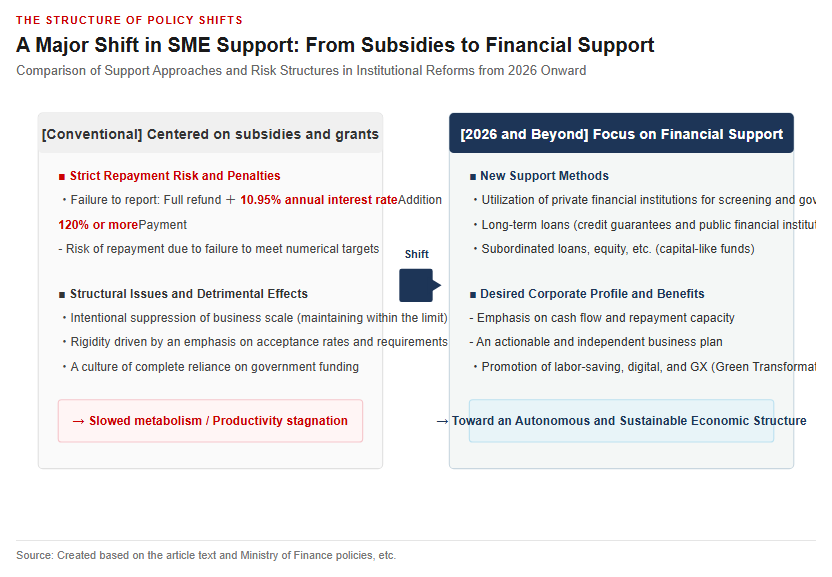
The risk of subsidy repayment faced by companies goes beyond profit returns. If numerical targets, such as wage increase requirements set after the subsidy grant decision, are not achieved, companies are required to return all or part of the granted subsidy based on the unachieved rate. Moreover, if they fail to submit the commercialization status report, which is mandatory for five years following the completion of the subsidized project, strict penalties exist where the grant decision is revoked and full repayment is ordered along with a surcharge at an annual rate of 10.95 percent. Furthermore, if judged to be used for unintended purposes or improperly received, a surcharge and late fees equivalent to 20 percent of the received amount are imposed, and 120 percent or more of the received amount must be paid to the government. In fact, complete revocations of grant decisions and repayment orders for the Business Restructuring Subsidy have been successively announced as of March 27, 2026, demonstrating that even “mere deficiencies” can directly translate into serious business risks.
Major Shift in Support for SMEs from 2026 Onward and Key Focus Areas for the Future
Shift from subsidies to loans and financial support
From 2026 onward, the government’s support policies for small and medium-sized enterprises (SMEs) are expected to significantly shift their focus from “granting subsidies” to “loan and fundraising support through financial institutions.” The Ministry of Finance is calling for an end to excessive support via non-repayable subsidies, urging the active utilization of loan systems that leverage the screening functions and governance of private financial institutions, as well as equity finance and subordinated loans. Concurrently, traditional subsidy programs will be repositioned as auxiliary tools to complement growth investment. For companies undertaking capital investments such as labor-saving investments, digitalization, and GX (Green Transformation) investments, long-term loans coordinated with credit guarantee corporations and the Japan Finance Corporation, alongside financial support frameworks that emphasize repayment viability, are slated for expansion. Consequently, companies will find it essential to formulate actionable business plans backed by their own cash flow and repayment capacity, rather than subsidy-dependent plans. The diagram below illustrates the concept of the new support framework.
Growth Targets and Medium- to Long-Term Financial Planning Required of Companies
Under future support programs, companies will be required to set clear growth targets aligned with their growth stages. In discussions by the Ministry of Economy, Trade and Industry (METI) regarding its approximate budget requests for fiscal 2027 and beyond, a movement is underway to make milestone achievements a requirement and to selectively filter companies based on their scale—such as small businesses aiming for 100 million yen in sales, mid-sized company candidates aiming for 1 billion yen, and growing companies aiming for 10 billion yen. The environment is shifting toward one where generous government subsidies will be less readily available for equipment purchases or promotional activities aimed merely at maintaining the status quo. Business leaders are expected to formulate mid-term management plans looking 3 to 5 years ahead and clearly present performance indicators such as sales, added value, and wage increase levels. Building a robust financial foundation capable of executing investments regardless of subsidies, and deepening trust with financial institutions, will become the most crucial survival strategy for SMEs facing this period of major transformation.
Reference page
- [e-Gov Law Search] Act on Optimizing Execution of Budgets Relating to Subsidies, etc.
e-Gov 法令検索電子政府の総合窓口(e-Gov)。法令(憲法・法律・政令・勅令・府省令・規則)の内容を検索して提供します。elaws.e-gov.go.jp - [Ministry of Finance] Materials Submitted to the Fiscal System Council Subcommittee on the Fiscal System
https://www.mof.go.jp/about_mof/councils/fiscal_system_council/sub-of_fiscal_system/proceedings/material/zaiseia20251107/02.pdf - [Ministry of Economy, Trade and Industry, Small and Medium Enterprise Agency] Subsidy Application Information
指定されたページまたはファイルは存在しませんwww.chusho.meti.go.jp


【#Subsidies #MinistryOfFinance #RevenueReturn #SMESupport #EconomicPolicy #BusinessPlanning #FinancialStrategy】

コメント