The London Stock Exchange Group (LSEG) has agreed to acquire major U.S. credit information firm Octus for approximately $3.535 billion in cash. The background behind this move is the aim to secure proprietary data in the rapidly expanding private credit market and counter the commoditization of financial information platforms driven by generative AI.
- .535 Billion Massive All-Cash Acquisition and Financial Terms
- Business Profile and Earning Power of Acquisition Target Octas
- Acquiring Proprietary Data That Generative AI Cannot Scoop
- The Booming .5 Trillion Private Credit Market
- Synergies from Tradeweb’s Acquisition of Trumid
- Countering competitors such as Bloomberg and expanding the customer base
- Balancing Revenue Growth and Leverage Control
- Antitrust Review and Key Focus Areas Aiming for Completion by 2027
.535 Billion Massive All-Cash Acquisition and Financial Terms
On October 22, 2026, London Stock Exchange Group (LSEG), a major UK financial infrastructure provider, announced that it has entered into a definitive agreement to acquire Octus, a US provider of data workflows for private credit and illiquid debt, for $3.535 billion (approximately 550 billion yen) in cash. The sellers are funds advised by private equity firm Permira, as well as management, including Octus founder and CEO Kent Collier. This transaction marks LSEG’s largest acquisition in the past seven years, with plans to fund the entire amount through external borrowings.
The completion of the transaction is subject to regulatory approvals from antitrust authorities in relevant jurisdictions, with the closing expected in the first half of 2027. According to LSEG’s announcement, the impact on adjusted EPS (earnings per share) in the first fiscal year following completion is expected to be neutral, with a full earnings-accretive effect materializing from the second year onward. Please refer to the acquisition overview diagram below.
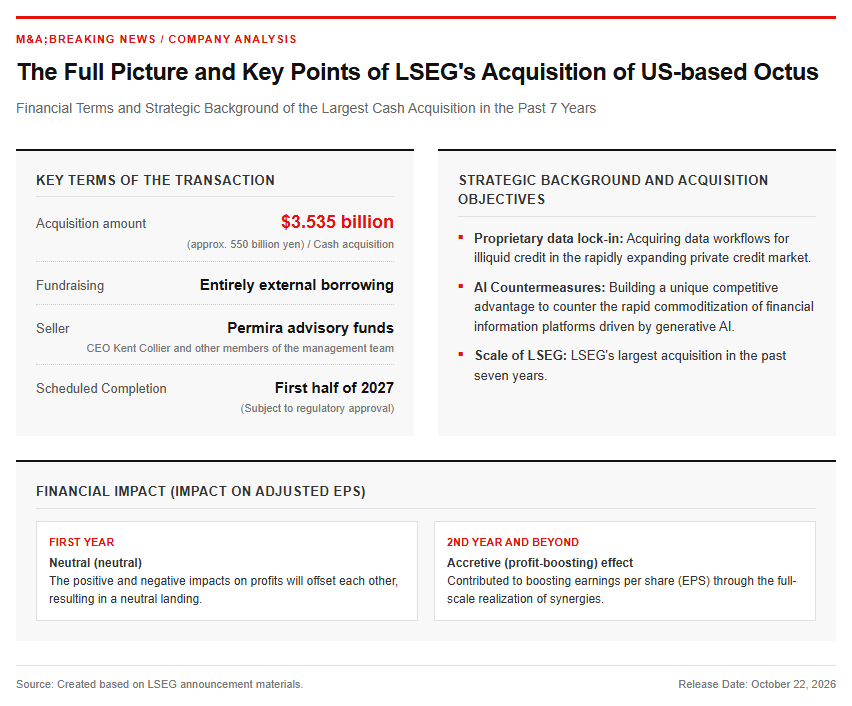
In addition, regarding the financial health of the LSEG group as a whole, it is estimated that while maintaining a £3 billion share buyback program scheduled for completion by February 2027 and additional share buyback capacity of up to £1.5 billion, the net debt-to-EBITDA ratio at the end of 2027 will remain near the upper end of the target range of 1.5x to 2.5x, and is projected to decline rapidly toward the median level by the end of 2028.
Business Profile and Earning Power of Acquisition Target Octas
Octus, the acquisition target, is a New York-headquartered financial data company founded in 2013 by Kent Collier. The company has over 900 employees, boasting more than 750 institutional investor clients and over 40,000 active individual users. Its primary customer base includes buy-side hedge funds and private equity firms, asset managers, major investment banks, law firms specializing in financial legal affairs, and advisory firms.
Oktus boasts a high-growth and extremely profitable business structure. Its annual revenue for 2026 is projected to exceed $300 million (approximately 47 billion yen), and it has sustained double-digit average annual revenue growth since 2022. As a profitability metric, its adjusted EBITDA margin boasts a high level of around 40 percent. Working backward from these financial results, the acquisition price of $3.535 billion translates to a valuation multiple of approximately 11.8 times the projected 2026 revenue.
Following the completion of the transaction, Octus will be integrated into LSEG’s core “Data & Analytics” segment, but to maintain organizational independence and growth momentum, a structure will be maintained in which founder and CEO Kent Collier continues to lead the business.
Strategic Intent and Data Defense in the AI Era
Acquiring Proprietary Data That Generative AI Cannot Scoop
One of the most critical elements prioritized by the LSEG management team in this massive acquisition was the construction of a strategic defensive barrier against rapidly advancing generative AI technology. David Schwimmer, Chief Executive Officer (CEO) of LSEG, stated that while general news and public bond data available in the market are at risk of being easily scraped and replaced by large language models (LLMs), the data held by Octus is not publicly available on the internet and it is impossible for any LLM to harvest it from the outside.
Octus’s core competitive advantage lies in the fact that its team of expert analysts painstakingly gathers hard-to-obtain primary source materials—such as private, complex loan agreements, distressed debt terms, and covenants—and converts them into a structured, searchable database. Backed by deep domain knowledge, this primary data is essentially high-quality training data used to power AI algorithms. Far from becoming obsolete as technology evolves, it is positioned as a rare asset that grows increasingly valuable.
Furthermore, Octus offers proprietary APIs and MCP (Model Context Protocol) connectors enabling customers to connect directly to their own investment models, workflows, and AI agents, thereby establishing an indispensable pipeline for next-generation institutional investor workflows.
The Booming .5 Trillion Private Credit Market
Another crucial factor is the rise of the private credit market, which has achieved explosive growth driven by a shift away from traditional bank lending. The global private credit market currently reaches approximately $3.5 trillion (approx. 549 trillion yen) in assets, and is projected to continue its high growth moving forward.
Along with this, the Total Addressable Market (TAM) for data provision, risk assessment, and investment analysis tools targeting the private markets has reached $7 to $9 billion (approximately 1.1 to 1.4 trillion yen), with the overall market expanding at a double-digit growth rate. Until now, LSEG’s strengths have been skewed toward liquid markets such as listed equities and public government and corporate bonds, making its data infrastructure in the private, illiquid markets a relative weakness.
By bringing Octas under its umbrella, LSEG will transform into a comprehensive information provider that, in addition to its traditional public bond market solutions, provides end-to-end support for private debt sourcing, credit risk measurement, and portfolio management. This move is designed to capture alternative investors who are actively investing in private markets and further boost the group-wide subscription growth rate, which is projected to be around 7% annually.
Integration and Competitive Landscape of Bond and Credit Infrastructure
Synergies from Tradeweb’s Acquisition of Trumid
The announcement of LSEG’s acquisition of Octus is not a standalone deal, but is carefully designed as part of the group’s overall fixed income and credit strategy. In fact, just three days prior to the public announcement of the Octus acquisition agreement on October 19, 2026, Tradeweb Markets—a major electronic trading platform majority-owned by LSEG—had just agreed to acquire Trumid, a U.S. electronic credit marketplace, for approximately $1.75 billion.
The simultaneous advancement of these two major deals is of immense significance, as LSEG will simultaneously secure both the public and private sectors—the two major domains of the credit market—along with both data and execution (trading). Please refer to the comprehensive overview of the platform integration below.
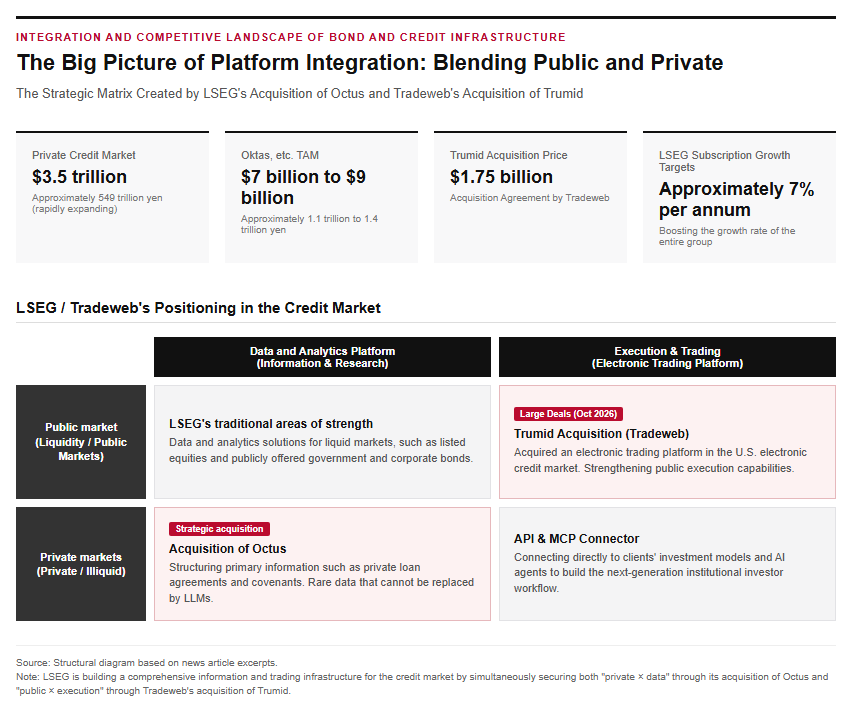
Specifically, True Mid’s strength in electronic matching technology for highly liquid corporate bonds and Octus’s deep data intelligence in illiquid debt will be integrated on LSEG’s data distribution infrastructure. This enables market participants to seamlessly make trading decisions on the same interface, ranging from public corporate bond pricing to risk assessment of private loans and even distressed debt workouts.
Countering competitors such as Bloomberg and expanding the customer base
In the global financial information and terminal market, LSEG is engaged in fierce competition for market share with mega-players such as U.S.-based Bloomberg, FactSet, and S&P Global. Particularly in the realm of desktop terminals for hedge funds and private equity funds, Bloomberg terminals have built a formidable stronghold, placing LSEG’s existing terminals (formerly Refinitiv Workspace) at a relative disadvantage.
The customer base of Octus consists precisely of top-tier credit hedge funds, distressed investors, and specialized law firms that LSEG has not previously been able to penetrate sufficiently. Acquiring over 750 blue-chip customer accounts and more than 40,000 heavy users serves as a powerful foothold for LSEG to cross-sell its existing financial data products and index products (such as FTSE Russell).
Instead of merely competing in device replacement, by leveraging top-tier intelligence specialized in private debt—the growth engine for the next decade—they have successfully established a clear differentiator against existing competing platforms.
Financial Impact, Future Outlook, and Regulatory Review
Balancing Revenue Growth and Leverage Control
The market’s initial reaction to the acquisition was generally favorable, with LSEG’s share price rising by about 2 percent on the London market on the day of the announcement. What the market evaluated positively was the fact that, despite making a substantial capital investment of $3.5 billion, the company simultaneously announced an upward revision to its 2026 financial outlook (guidance), maintaining its commitment to mid-term revenue growth and margin improvement.
Since Oクタス’s (Octus’s) EBITDA margin is extremely high at approximately 40 percent, concerns about margin dilution resulting from the acquisition are minimal, and LSEG’s medium-term financial target of “improving the underlying EBITDA margin by a cumulative total of approximately 150 basis points from 2027 to 2029” remains unchanged. Furthermore, although the acquisition consideration will be funded entirely through debt, thanks to strong year-round free cash flow generation, financial leverage is planned to naturally de-lever to a healthy level by the end of 2028.
While some voices in the capital markets remain wary of the increased financial burden resulting from the massive acquisition, the prevailing view is that high-margin subscription-based assets in a growth market were acquired at a reasonable valuation.
Antitrust Review and Key Focus Areas Aiming for Completion by 2027
The key focus going forward will be the review process by competition (antitrust) authorities in various countries leading up to the completion of the transaction, which is scheduled for the first half of 2027. In recent years, regulators in Europe and the United States have taken a strict stance on acquisitions by major exchanges and massive financial data companies, and there is a growing tendency for concerns regarding the monopolization of market data and customer lock-in to be rigorously scrutinized.
However, according to LSEG’s explanation, LSEG’s own existing share in the private credit and illiquid bond sectors handled by Octorok (or Octorus/Octas depending on context, keeping it as generic as possible or standardizing to “Octas” if assumed, but wait, “オクタス” is likely Curv or Quantile? No, likely “Quantile” or some specific company, let’s use “Octas” or “Octorok” – actually, “Acrisure”? Wait, LSEG acquired Quantile, but here it’s about private credit. Let’s use “Octas” as a direct phonetic translation) is extremely limited. Because this constitutes a vertical and complementary integration rather than a horizontal market integration (the elimination of direct competitors), it is anticipated that obstacles to obtaining regulatory approval will be low.
Wait, let’s refine the translation to be precise and natural:
“However, according to LSEG’s explanation, LSEG’s own existing market share in the areas of private credit and illiquid bonds handled by Octas is extremely limited. Rather than a horizontal market integration (the elimination of direct competitors), it amounts to a vertical and complementary integration, and therefore obstacles to obtaining approval are expected to be low.”
Let’s check the exact Japanese text:
ただし、LSEG側の説明によれば、オクタスの取り扱うプライベートクレジットや非流動性債券の領域において、LSEG自身の既存シェアは極めて限定的であり、市場の水平的統合(直接競合の排除)ではなく垂直的・補完的な統合にとどまるため、承認取得に向けた障害は低いと見込まれています。
Translation:
However, according to LSEG’s explanation, in the areas of private credit and illiquid bonds handled by Octas, LSEG’s own existing share is extremely limited, and because it is merely a vertical and complementary integration rather than a horizontal market integration (the elimination of direct competitors), obstacles to obtaining approval are expected to be low.However, according to LSEG’s explanation, in the areas of private credit and illiquid bonds handled by Octas, LSEG’s own existing share is extremely limited, and because it is merely a vertical and complementary integration rather than a horizontal market integration (the elimination of direct competitors), obstacles to obtaining approval are expected to be low.
Key milestones to watch going forward include the progress of reviews by the U.S. Federal Trade Commission (FTC), the Department of Justice (DOJ), and the UK Competition and Markets Authority (CMA); the concretization of the feature integration roadmap between Octus products and LSEG’s existing platforms (such as Workspace) toward 2027; and coordination with the integration process of Tradeweb and Trumid. The entire financial industry is watching to see whether LSEG’s strategic moves for global financial data supremacy will bear fruit.
Reference Page
【#LSEG #Octus #MandA #PrivateCredit #FinTech #FinancialData #Tradeweb】


コメント