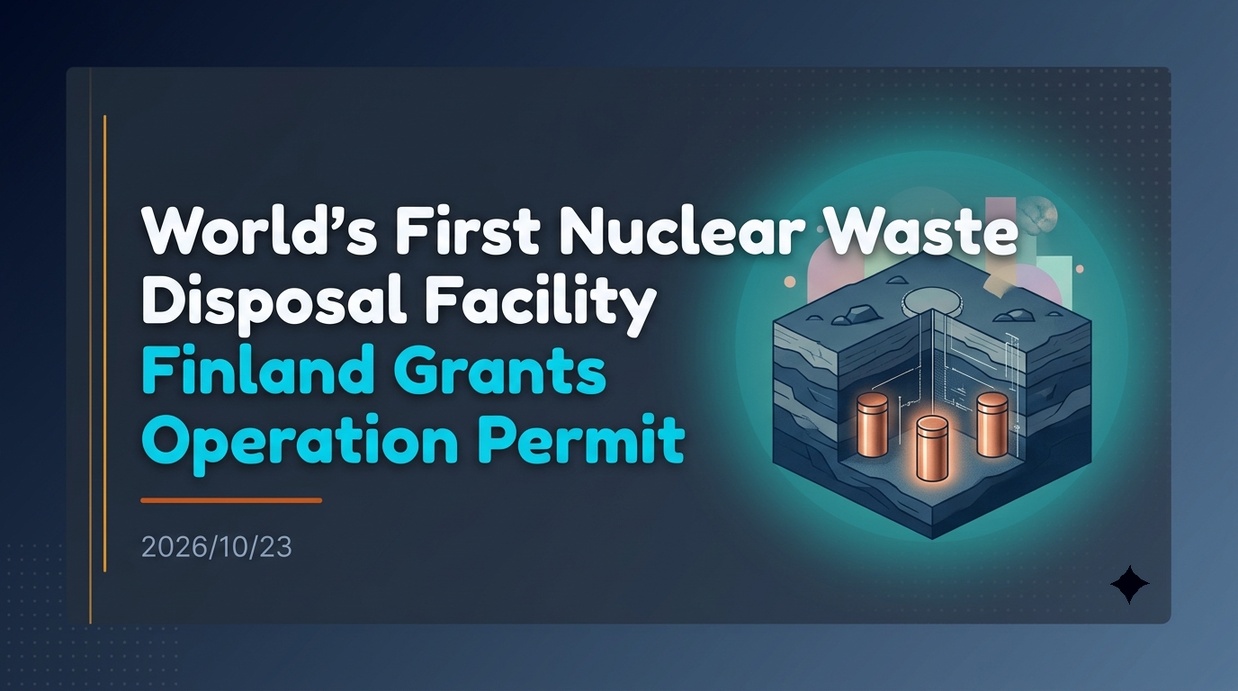
On October 22, 2026, the Finnish government formally approved the operation of the Onkalo high-level radioactive waste repository. This comes after more than 40 years of systematic consensus-building and rigorous safety reviews, as the world’s first geological disposal of spent nuclear fuel enters practical application.
- Decision on the Operating Permit and an Overview of “Onkalo”
- Posiva, the company responsible for the disposal business, and the decisive factor in safety reviews
- Mechanism of the KBS-3V Multi-Barrier System
- Technical Approaches to Bedrock Structures Over 1 Billion Years Old and Long-Term Risks
- The Social Background That Enabled Public Acceptance and Political Consensus
- Ripple Effects on the Global Nuclear Industry and Future Focus
Decision on the Operating Permit and an Overview of “Onkalo”
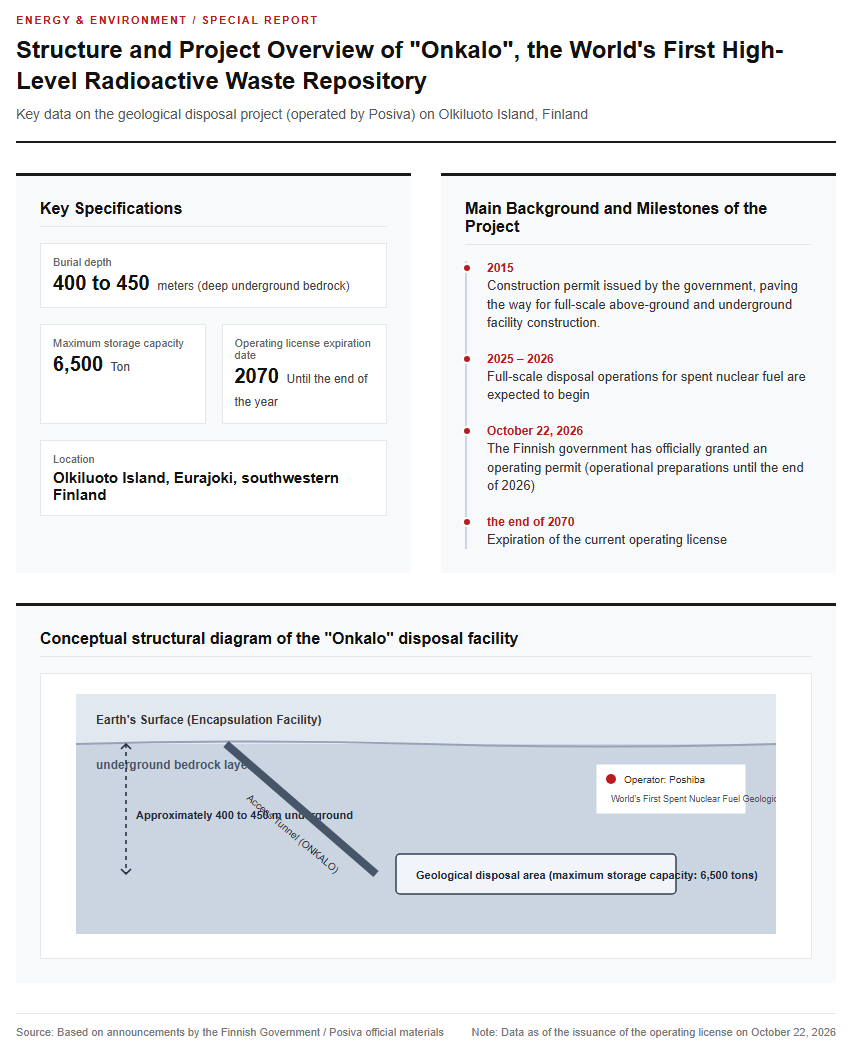
On October 22, 2026, the Finnish government granted an operating license until the end of 2070 to “Onkalo,” the high-level radioactive waste repository built on Olkiluoto Island in the municipality of Eurajoki in southwestern Finland. Onkalo means “cave” or “hiding place” in Finnish, and it is the world’s first geological disposal facility designed to permanently isolate spent nuclear fuel from nuclear power plants by burying it deep within bedrock at a depth of approximately 400 to 450 meters underground. The facility consists of an encapsulation plant built on the surface and an underground tunnel network, with a storage capacity of up to 6,500 tons of spent nuclear fuel generated by nuclear power plants in Finland. Since receiving a construction permit from the government in 2015, construction of surface and underground facilities has been underway, and this operating license completes the procedures for final testing and actual operation. Posiva, the company responsible for operations, aims to complete preparations for operation by the end of 2026, and full-scale burial work for spent nuclear fuel is expected to begin between 2025 and 2026 following safety verification. Please refer to the layout image below.
Posiva, the company responsible for the disposal business, and the decisive factor in safety reviews
Onkalo is constructed and operated by Posiva, a nuclear waste management company established in 1995 as a joint venture between Finland’s major power companies, TVO (60% stake) and Fortum (40% stake). Prior to the government’s issuance of the operating license, Finland’s independent regulatory body, the Radiation and Nuclear Safety Authority (STUK), submitted a comprehensive safety evaluation report in August 2026, having invested more than 250 person-years of review resources. STUK concluded that the operational management system, emergency response, and long-term safety over a period of up to 100,000 years presented by Posiva fully comply with the national Nuclear Energy Act and safety regulations. In addition, the European Commission (EC) confirmed in advance under Article 37 of the Euratom Treaty that there is no risk of radioactive contamination to other countries. In a statement, Minister of Environment and Climate Change Mykkänen emphasized that it is the responsibility of the current generation to ensure safety throughout the entire process from nuclear power plant construction to waste disposal, and Posiva CEO Juha Poikolainen also highly praised the decision as the embodiment of a solution to a long-standing issue in the nuclear industry.
The Technical Structure Supporting Geological Disposal and the 100,000-Year Safety Design
Mechanism of the KBS-3V Multi-Barrier System
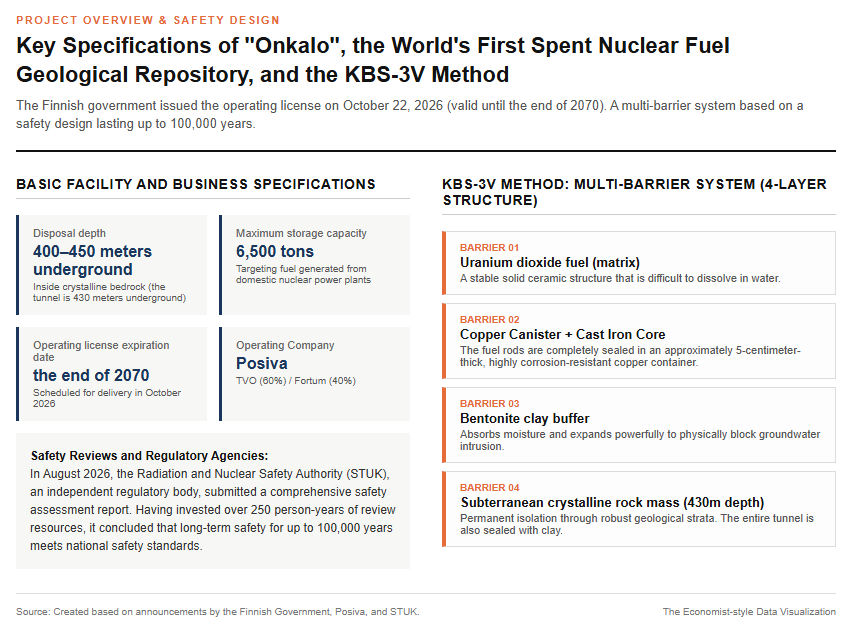
Onkalo employs a multi-barrier system called “KBS-3V,” jointly developed with the Swedish Nuclear Fuel and Waste Management Company (SKB), to isolate spent nuclear fuel from the human environment. This technology is designed so that by combining multiple independent protective barriers, the overall safety is not compromised even if a single failure occurs. Specifically, it consists of the following four barriers.
– the fact that uranium dioxide fuel itself is a solid ceramic structure that is poorly soluble in water
– Sealing the fuel rods, along with a cast iron insert, in a highly corrosion-resistant copper canister approximately 5 centimeters thick
– filling the area around the copper canister with a bentonite clay buffer material that expands strongly upon absorbing moisture to prevent groundwater intrusion
– embedding it within solid crystalline bedrock 430 meters underground and sealing the entire tunnel with clay
Canisters dried and sealed at the encapsulation facility are sequentially emplaced in vertical shafts 8 meters deep and 2 meters in diameter dug within the underground tunnels. Please refer to the conceptual diagram of the multi-barrier system below.
Technical Approaches to Bedrock Structures Over 1 Billion Years Old and Long-Term Risks
The underground bedrock of Olkiluoto Island, selected as the disposal site, is crystalline rock (granite and gneiss) formed during the Precambrian era approximately 1.8 to 1.9 billion years ago, and it has been proven to be geologically extremely stable on a scale of hundreds of millions of years. Geological disposal requires robustness against environmental changes on a 100,000-year scale, such as the recurrence of ice ages causing permafrost, crustal movements, and earthquakes. According to simulation evaluations by Posiva and STUK, even in the unlikely event that permafrost reaching a depth of several meters to several hundred meters develops in the future, it has been confirmed that no leakage of radioactive materials will occur due to the combination of the copper canisters and bentonite buffer buried at a depth of 430 meters. In the past, scientific doubts were raised by researchers from institutions such as the KTH Royal Institute of Technology regarding the corrosion rate of copper in anoxic water, but long-term durability has been demonstrated through follow-up studies and detailed geological analyses. During its 100-year operational period, the final repository will sequentially excavate, backfill, and seal approximately 35 kilometers of tunnels, and upon completion of burial, it will transition to a passively safe state that requires no monitoring.
A 40-Year Consensus-Building Process and Its Impact on the Global Nuclear Waste Issue
The Social Background That Enabled Public Acceptance and Political Consensus
Behind Finland’s world-first achievement of operating a repository lies over 40 years of highly transparent consensus-building and social trust. Since the government determined the basic policy for final disposal in 1983, a 1994 amendment to the Nuclear Energy Act legally banned the import and export of nuclear waste, establishing the principle that “a country must dispose of its own waste domestically.” In selecting the disposal site, in addition to academic geological surveys, a legal framework was established to grant candidate municipalities a right of veto. Through ongoing dialogue with the host municipality of Eurajoki—such as concluding the “Voyoki Agreement” concerning economic promotion and regional infrastructure development—the city council voted by a majority to accept the facility in 1999. Furthermore, the government’s Decision in Principle (DiP) in 2000 and subsequent parliamentary approval in 2001 were passed by an overwhelming majority of 159 to 3. Finland’s uniquely high public trust in administration, science, and technology, combined with clear legal systems and the delegation of ample authority to local governments, served as the driving force to avoid unnecessary political conflict and propel the project forward.
Ripple Effects on the Global Nuclear Industry and Future Focus
The start of Onkalo’s operations has become a symbolic event demonstrating that the “nuclear waste problem is technically solvable” within the international community, which is reassessing nuclear power to realize a decarbonized society. International Atomic Energy Agency (IAEA) Director General Rafael Grossi praised Onkalo as a “game changer for the nuclear industry,” positioning it as a historic achievement that underpins long-term sustainability. Currently, while similar deep geological disposal projects are moving forward in neighboring Sweden (Östhammar), France (the Cigéo project), Canada, and elsewhere, many countries, including Japan, are struggling with selecting disposal sites and building community consensus. In Japan, while literature surveys have been conducted in municipalities such as Suttsu Town and Kamoenai Village in Hokkaido, and Genkai Town in Saga Prefecture, significant challenges remain in moving on to preliminary and detailed surveys. Looking ahead, Onkalo’s focus will shift toward accumulating operational experience in actual disposal operations beginning in 2026, conducting periodic safety assessments mandated every 10 years, and sharing knowledge aimed at technology transfer to other countries and international standardization.
Reference Page
- [International Atomic Energy Agency (IAEA) Official Announcement] https://www.iaea.org/newscenter/news/finlands-spent-fuel-repository-a-game-changer-for-the-nuclear-industry-director-general-grossi-says
- [Posiva Oy Official Website] https://www.posiva.fi/en/
- [Official Website of Finland’s Radiation and Nuclear Safety Authority (STUK)] [suspicious link removed]
[#Finland #Onkalo #NuclearWaste #HighLevelRadioactiveWaste #GeologicalDisposal #Posiva #NuclearPower]

コメント