In June 2026, due to the “double typhoons” of Typhoons No. 7 and No. 8 and the stagnant rainy season front, extensive heavy rain damage occurred across a wide area of the Japanese archipelago. This disaster occurred during the first full-scale implementation of new rules based on the revised Meteorological Services Act, which came into effect at the end of May of the same year, symbolizing a turning point in the national disaster prevention system.
- Record-breaking rainfall and severe human and building damage
- Level 5 “Emergency Safety Assurance” issued in Seika Town, Kyoto Prefecture
- Impact on agriculture, forestry, and fisheries and Okinawa Prefecture’s support system
- Alert for the Tokaido Shinkansen and planned suspension of transportation services
- Widespread suspension of pickup and delivery and delivery delays by the three major delivery companies
- Thorough Disclosure of Warning Level Numbers Due to the Meteorological Services Act Revision
- Establishment of the Disaster Prevention Agency and ‘Crisis Management Investment’ for National Resilience
Record-breaking rainfall and severe human and building damage
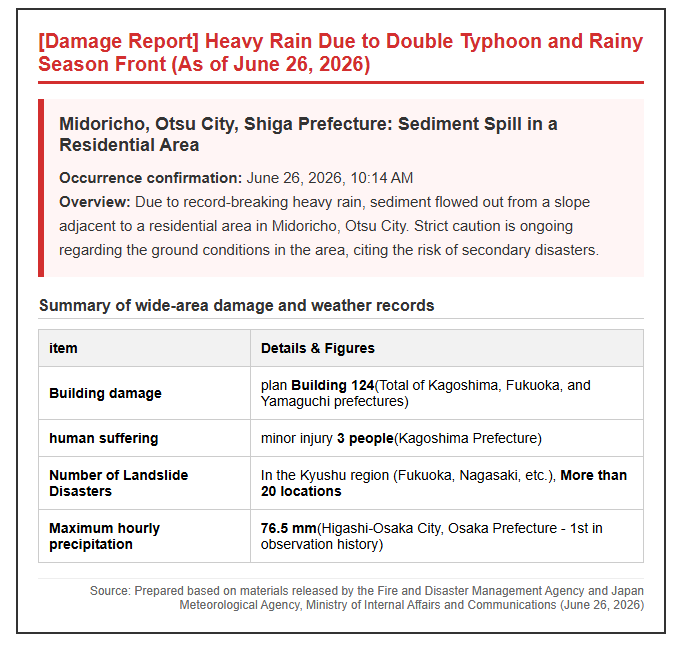
On June 26, 2026, Typhoon No. 7, moving north of Kume Island in Okinawa, and Typhoon No. 8, developing over the southern coast of Japan, both approached simultaneously, sending moist air into the stagnant rainy season front. As a result, extremely heavy rain fell from Kyushu to Kanto-Koshin, and by the morning of the 26th, Higashi-Osaka City in Osaka Prefecture recorded a record-breaking downpour of 76.5 millimeters in one hour, the highest ever recorded. In addition, heavy rain continued across various regions, including 55.5 mm in Aso City, Kumamoto Prefecture, and 51 mm in Kawanehon Town, Shizuoka Prefecture.
The damage has affected both people and material goods. According to the summary by the Fire and Disaster Management Agency of the Ministry of Internal Affairs and Communications as of 7 a.m. on the 26th, three people suffered minor injuries in Kagoshima Prefecture, and the total number of buildings damaged reached 124 buildings across Kagoshima, Fukuoka, and Yamaguchi prefectures. In the Kyushu region, landslides have occurred in more than 20 locations, mainly in Fukuoka and Nagasaki prefectures, raising heightened alert for secondary disasters caused by loose ground. The following image shows the sediment spill that occurred in Otsu City.
Level 5 “Emergency Safety Assurance” issued in Seika Town, Kyoto Prefecture
During this heavy rain, the highest danger level 5 among evacuation information has been issued for ‘Emergency Safety Assurance.’ Seika Town, Kyoto Prefecture, announced this information at around 8:15 a.m. on June 26, reporting a landslide disaster in the town to 239 households and 529 people in the Higashihata district. This calls for the best actions to protect lives in situations where disasters have already occurred or are likely to occur.
Additionally, evacuation orders (alert level 4) were issued across 13 prefectures, affecting 1,080,034 households and a total of 2,229,923 people. Urban areas such as Osaka and Fukuoka Prefectures were also included, and large-scale evacuation actions were carried out across various locations. Based on the new disaster weather information rules that began operation on May 29, 2026, the local government strongly urged residents to evacuate by Level 4 (Hazard Warning).
Impact on agriculture, forestry, and fisheries and Okinawa Prefecture’s support system
The passage of a double typhoon has dealt a severe blow to the regional economy, especially agriculture, forestry, and fisheries. According to a report by Okinawa TV, as of June 3, 2026, the damage to agriculture, forestry, and fisheries in the prefecture has reached over 82.6 million yen due to the continuous damage following Typhoon No. 6. The breakdown of the damage is about 75 million yen for crops such as sugarcane, bitter melon, and chrysanthemum, and about 7.2 million yen for forestry and fisheries.
The detailed damage in the northern part of the main island is still under investigation, and the final damage amount is expected to increase further. In response, Okinawa Prefecture held a Disaster Response Headquarters meeting to urgently confirm the details of the damage and established consultation desks for affected farmers and fishermen, deciding to provide financial support and recovery assistance. As typhoons intensify due to the impacts of climate change, strengthening the resilience of local industries has become an urgent issue.
A chain of stagnation hitting social infrastructure and logistics networks
Alert for the Tokaido Shinkansen and planned suspension of transportation services
The widespread heavy rains caused major disruptions to transportation networks, including the Tokaido Shinkansen, Japan’s main artery. JR Central announced that, considering the possibility of heavy rain or strong winds caused by Typhoons No. 7 and No. 8 from the first train on the 27th, there may be suspensions or delays. The impact on conventional lines is even more severe, with the Tokaido Line between Odawara and Atami and the JR Ito Line suspended all day, and limited express trains such as the “Wakashio” and “Odoriko” also discontinued operation one after another.
For air flights as well, All Nippon Airways (ANA) decided to cancel seven domestic flights, causing restrictions on travel and business travel. On the road network, road closures were implemented between Ichihara Tsurumai IC and Mobara Chōnan IC on the Ken-O Expressway, as well as at the entrance of Anagawa IC on the Keiyo Road. Transportation companies aim to enhance social acceptance by utilizing the “improved accuracy of weather forecasts” strengthened by the legal revision in May 2026, and by implementing planned restraints to ensure safety.
Widespread suspension of pickup and delivery and delivery delays by the three major delivery companies
In logistics, the three major companies—Yamato Transport, Sagawa Express, and Japan Post—announced widespread delivery delays and suspension of collection and delivery due to the impact of Typhoons No. 7 and 8 and earthquakes across various regions. As of 11 a.m. on the 27th, Yamato Transport suspended all receiving and delivery operations for all products in parts of Suzu City and Wajima City in Ishikawa Prefecture due to heavy rain that further impacted the areas affected by the Noto Peninsula earthquake. Additionally, the Cool Takkyubin service to remote islands in Kagoshima Prefecture has been suspended due to ferry cancellations.
Sagawa Express also announced that shipments from across the country to Kansai, Chugoku, Shikoku, Kyushu, and Okinawa are experiencing delays, suggesting that depending on future routes, delays may spread nationwide. Japan Post prioritizes employee safety and may temporarily suspend counter operations and deliveries at post offices. The overlapping cancellations of air and sea routes, along with road regulations, have caused delays to ripple across the entire supply chain, including e-commerce sites.
The “New Rules to Protect Lives” to Take Effect in 2026 and the Role of the Disaster Management Agency
Thorough Disclosure of Warning Level Numbers Due to the Meteorological Services Act Revision
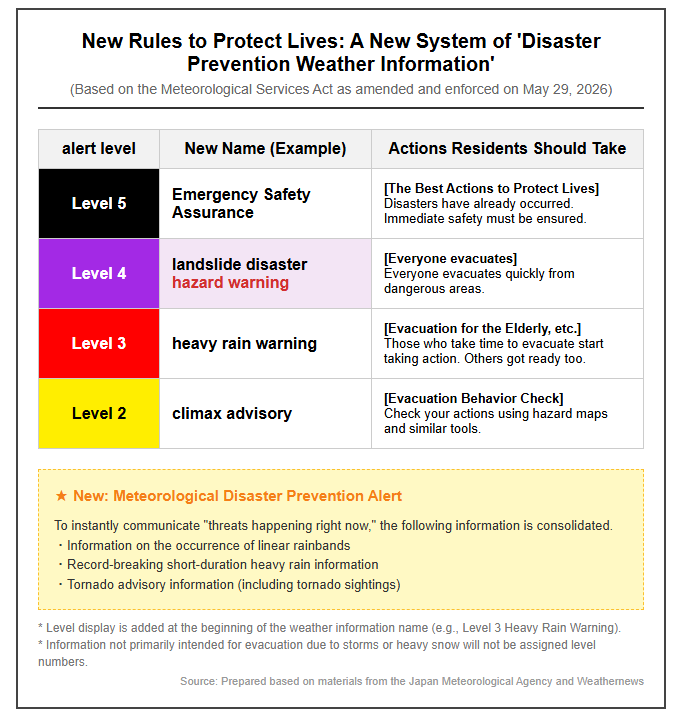
One of the highlights in this disaster response is the new “Disaster Prevention Weather Information,” which began full-scale operation on May 29, 2026. To overcome the challenge that traditional names alone make it difficult to intuitively convey the level of danger, all information now includes numbers indicating five levels of alert, such as “Level 2 Storm Surge Advisory” or “Level 3 Heavy Rain Warning.” This makes it easier for residents to decide what actions to take the moment they receive information.
Furthermore, landslide warning information, which had previously been positioned above ‘Warning,’ was renamed ‘Level 4 Landslide Hazard Warning’ to clarify that it corresponds to Level 4. The establishment of this “danger alert” serves as a stronger basis for local governments to issue evacuation orders, aiming to encourage residents to “quickly evacuate to safe places.” The diagram below explains the new system of alert levels.
Establishment of the Disaster Prevention Agency and ‘Crisis Management Investment’ for National Resilience
In response to a series of natural disasters, on March 6, 2026, the government decided to establish the ‘Disaster Prevention Agency’ as the command center for disaster response. Until now, the responsible ministries were divided for each type of disaster such as earthquakes, typhoons, and volcanoes, but by having the Disaster Prevention Agency serve as a command center with a dedicated minister, rapid decision-making and cross-departmental responses become possible. In his statement speech, Prime Minister Takaichi made the establishment of the “Disaster Prevention Agency” a pillar for fundamentally strengthening the disaster prevention system.
At the same time, the government has positioned “crisis management investment” as the core of its growth strategy and formulated the “First Medium-Term Plan for National Resilience,” projecting a business scale of over 20 trillion yen over five years starting in fiscal 2026. This includes the development of next-generation geostationary meteorological satellites to improve the accuracy of linear rainbands and typhoon forecasts, early assessment of damage using digital technology, and preventive maintenance of aging infrastructure.
Future Developments and Highlights
Even after the double typhoon passes, responses to increasingly severe weather disasters will continue. The first point of interest is the verification of how much the newly launched “Disaster Prevention Weather Information” is connected to actual evacuation actions. In particular, whether the new name “Hazard Alert” has appropriately heightened residents’ sense of crisis will be the focus of future improvements.
Next, we will discuss the specific organizational structure of the Disaster Management Agency, expected to be established within 2026, and strengthen collaboration with local governments. It will test how the authority previously divided among ministries is consolidated and how the speed of initial response changes. Furthermore, whether the government’s “crisis management investment” will go beyond mere public works to enable efficient national resilience using disaster prevention technologies such as AI and drones will be an important point going forward.
[#台風被害 #防災庁 #国土強靱化 #気象業務法 #災害対策 #政治社会 #2026年台風 #物流遅延]


コメント