China’s Moonshot AI has announced the 3-trillion-parameter-class open-weight LLM “Kimi K3.1 Pro.” Behind this launch is the goal of achieving advanced agent capabilities in the open model space—rivaling state-of-the-art commercial models—through post-training backed by massive computational resources.
- The Full Picture of the 3-Trillion-Parameter Foundation Model and High-Speed Version Rollout
- Support for 1 Million Tokens and Open-Weight Release Schedule
- Matches Opus 5.5 and Astra in coding evaluations
- Advanced processing capabilities from 3D creation to financial analysis
- Post-training and safety design backed by massive computational resources
- The Spread of Agentic AI and Its Impact on Industry
The Full Picture of the 3-Trillion-Parameter Foundation Model and High-Speed Version Rollout
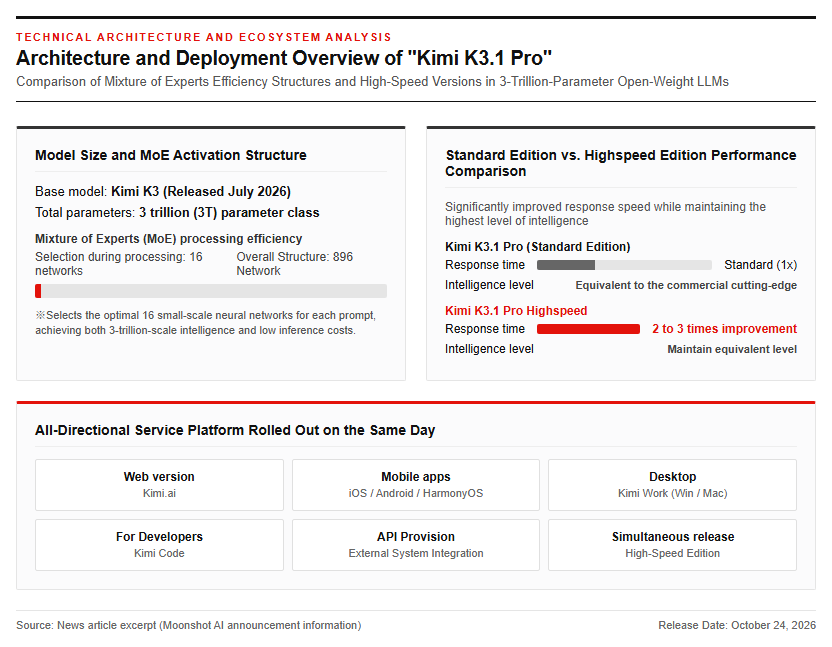
On October 24, 2026, Chinese AI startup Moonshot AI officially announced “Kimi K3.1 Pro,” the latest revised version of its flagship large language model. This model is based on “Kimi K3,” a 3-trillion (3T) parameter open-weight LLM released in July 2026, and has achieved dramatic performance improvements through post-training backed by exceptionally massive computational resources.
The architecture of Kimi K3.1 Pro adopts a Mixture of Experts (MoE) structure composed of 896 small-scale neural networks, and for each input prompt, it selects and processes only the 16 networks that are optimized for that specific instance. This maintains an efficient design that minimizes computational load and operational costs during inference while boasting an overwhelming model scale in the 3-trillion-parameter class.
As for the service rollout, the web version of “Kimi.ai,” mobile apps for iOS, Android, and HarmonyOS, the desktop app “Kimi Work” for Windows and Mac, the developer-focused “Kimi Code,” and API availability were all launched immediately. In addition, “Kimi K3.1 Pro Highspeed”—which improves response speed by two to three times while maintaining the same level of intelligence—was released simultaneously, strengthening support for real-time processing where quick responsiveness is required. A system architecture has been put in place to dramatically improve work efficiency in development environments and office operations.
Support for 1 Million Tokens and Open-Weight Release Schedule
One of the major strengths of Kimi K3.1 Pro is its standard support for a long-context window reaching up to 1 million tokens (equivalent to approximately 1 million characters). This makes it possible to process hundreds of pages of technical documentation, the entire analysis of large-scale source code repositories, and long-form audio transcription data all at once with a single prompt input.
Another aspect of this model’s distribution that is drawing particular attention is its policy of releasing open weights (model weights). Following early availability through commercial cloud APIs and hosted environments, the model weight data is scheduled to be made publicly available worldwide free of charge by November 4, 2026.
For enterprise companies and research institutions that prioritize local operations within their own infrastructure or private environments, open-weight models are of exceptionally high value. Even in environments where the use of external APIs is restricted from a data security standpoint, this provides an environment where LLMs featuring frontier-class intelligence can be built and customized on-premises.
- Available models: Kimi K3.1 Pro and Kimi K3.1 Pro Highspeed
- Context length: 1 million tokens (1M tokens)
- Open weights release date: November 4, 2026
- Main usage channels: Kimi.ai, Kimi Work, Kimi Code, Kimi API
Overwhelming Practical Capabilities and Benchmark Results
Matches Opus 5.5 and Astra in coding evaluations
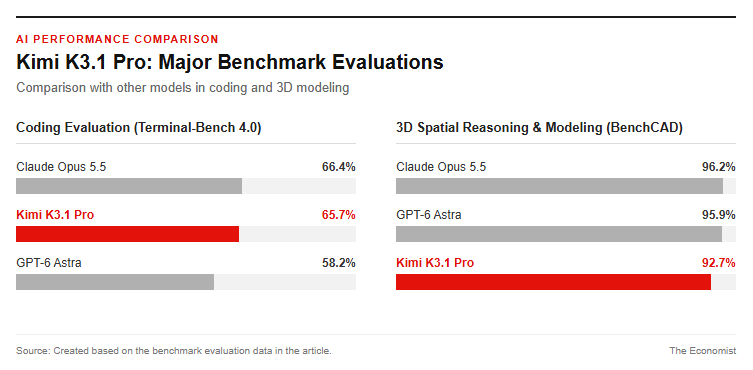
In the performance evaluation of Kimi K3.1 Pro, the most remarkable results were demonstrated in the coding field. In “Terminal-Bench 4.0,” a benchmark that measures the effectiveness of software development agents using an actual terminal environment, Kimi K3.1 Pro recorded a high score of 65.7%.
This record surpasses the 58.2% recorded by OpenAI’s “GPT-6 Astra” by 7.5 points, and represents a remarkable achievement coming within just 0.7 points of Anthropic’s “Claude Opus 5.5” (66.4%), which is considered the industry peak. Furthermore, on the internal evaluation “Kimi Code Bench 3.0 Long-horizon,” which measures long-term problem-solving capabilities including multi-step instruction execution and tool integration, the score has significantly improved from 55.95% for the previous-generation model K3 to 61.2%.
Major use cases for programming assistance include the following:
- From Single-File Bug Fixes to Automated Construction of Multi-Tiered Projects
- Script generation for major game engines such as Unity, Unreal Engine, and Godot
- Outputting Three.js code for interactive Web graphics
This has established its position as a powerful alternative to existing proprietary commercial AI models in the development of complex autonomous coding agents.
Advanced processing capabilities from 3D creation to financial analysis
The versatility of Kimi K3.1 Pro extends far beyond software development. This model demonstrates exceptional performance in 3D modeling and spatial reasoning capabilities. On “BenchCAD”—a benchmark that generates CAD code from multi-view rendered images to reconstruct precise 3D shapes—it recorded a high score of 92.7% with tool integration. This approaches levels close to Claude Opus 5.5 at 96.2% and GPT-6 Astra at 95.9%.
Leveraging this advanced spatial awareness, Moonshot AI has also started offering a new feature called “3D Make”. In addition to creating and editing 3D models from prompts on the web and in apps, users can download the created assets as 3D printing data, or export them as dynamic video files or Live Photo formats. Please refer to the technical comparison below.
Furthermore, in the field of financial practice, it earned high praise in “OfficeQA Pro v2,” a benchmark for analyzing complex financial statements and earnings reports, demonstrating response accuracy that surpasses Claude Opus 5.5 and GPT-6 Astra. Its versatility in seamlessly handling rigorous data analysis and advanced visual creation within a single model has become a major attraction.
Technical Background and Future Developments of Large-Scale Reinforcement Learning
Post-training and safety design backed by massive computational resources
Behind the performance leap achieved by Kimi K3.1 Pro lies the thorough optimization of the entire training stack and a reinforcement learning (RL) framework powered by the massive allocation of computational resources. Moonshot AI has overhauled every layer of its system infrastructure, including improving the efficiency of long-context reasoning, revamping the distributed sandbox environment, and platformizing environment quality-checking functions.
This large-scale reinforcement learning has also significantly mitigated the risk of factual errors (hallucinations) in the model’s responses. According to the company’s verification, on a challenging test set intentionally designed to induce misconceptions, the occurrence rate of factual inaccuracies, which was 23.4% in the previous-generation model, has been reduced to 8.3%.
Meanwhile, in cybersecurity-related benchmarks, it scores lower compared to other companies’ state-of-the-art models. Regarding this, Moonshot AI explains that this is the result of intentionally excluding relevant information from its training data as a safety measure to avoid the risk of misuse for unauthorized access or vulnerability attacks. For the next version, the company has outlined a policy to enhance vulnerability analysis capabilities while maintaining safety.
The Spread of Agentic AI and Its Impact on Industry
The emergence of Kimi K3.1 Pro holds the potential to bring about a major structural shift across the entire AI industry. Traditionally, in order to leverage state-of-the-art LLM performance, users had no choice but to rely on expensive proprietary APIs, with constraints such as high development costs and external data transmission serving as particular barriers to corporate adoption.
However, with Kimi K3.1 Pro—which possesses capabilities on par with frontier-class models—being offered at roughly one-third of the previous API usage cost and further released for free as open weights, it is expected that the speed of AI agent development and social implementation will accelerate at an accelerated pace.
High-quality AI systems will be incorporated into a wide range of industrial fields—such as financial analysis, entertainment production, and automated software development—at a lower cost and with greater flexibility. This new wave of AI adoption, driven by the evolution of open intelligence, will likely become a crucial key that determines future business competitiveness.
Reference page
- [Official Announcement: Kimi K3.1 Pro] https://www.kimi.ai/
[#KimiK31Pro #MoonshotAI #OpenWeights #3TrillionParameters #LLM #GenerativeAI #CodingAgent #3DModeling]

コメント