
On October 24, 2026, in the U.S. market, the VIX index, which indicates market volatility forecasts, rose to 19.58, heightening caution among investors. Behind this are the surfacing of credit risks in AI infrastructure companies and the expansion of volatility due to hedge fund position unwinding.
- Key points of the event where the VIX fear index rose to 19.58
- Credit Uncertainty and Surging CDS of AI Infrastructure Firm CoreWeave
- Hedge Fund Position Unwinding and Rising Volatility
- Risk Propagation Structure from Tech Stocks to Bonds and CDS
- Impact of Expanding U.S. Fiscal Deficits and Persistently High Interest Rates
- Financial system evaluation by the Bank of Japan and securities analysts
- Future Developments and Key Points for Investors to Monitor
Key points of the event where the VIX fear index rose to 19.58
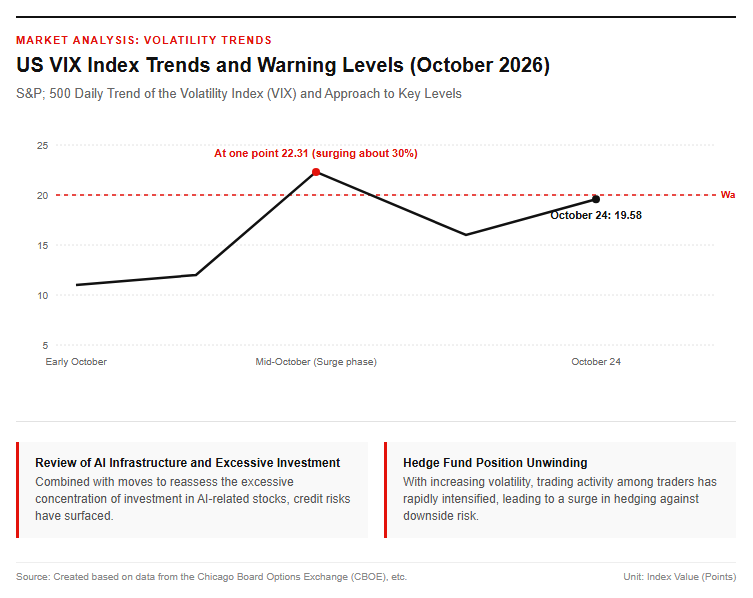
On October 24, 2026, the VIX index, which measures the expected volatility of the S&P 500 stock index calculated by the Chicago Board Options Exchange in the US, rose to 19.58 (up 0.55, or +2.89% from the previous day), further heightening market caution. The VIX index typically ranges between 10 and 20, but as it approaches the key milestone of 20, investors’ risk-averse stance becomes increasingly visible. In mid-October 2026, the index surged by approximately 30% from around 16 in the morning to a temporary high of 22.31, leading to a sharp spike in trading activity among traders on the exchange amid the sudden surge in volatility. This increase in volatility was primarily driven not by a single macro event, but by a combination of reevaluating movements against the excessive concentration of investment in AI-related stocks. Purchases of options to hedge downside risk surged among market participants, raising uncertainty about the future outlook of stock prices. The following figure shows a conceptual image of the volatility index trends during recent market fluctuations.
Credit Uncertainty and Surging CDS of AI Infrastructure Firm CoreWeave
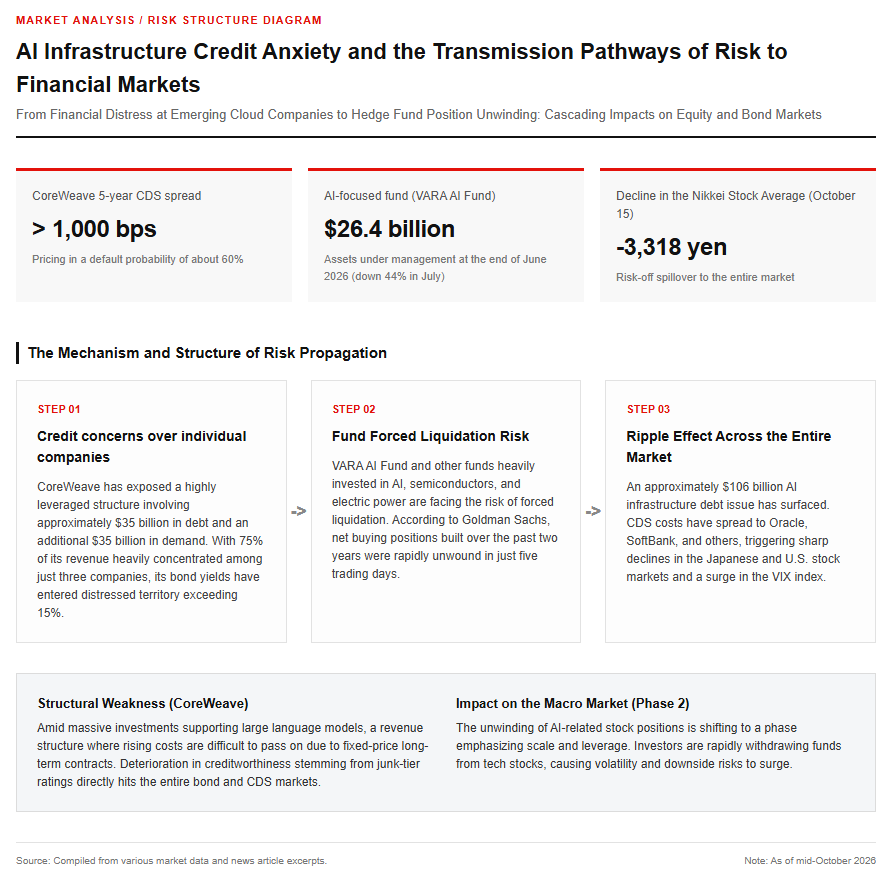
The primary catalyst that cemented the market turmoil was the rapid surfacing of credit concerns surrounding CoreWeave, an emerging startup providing GPU cloud infrastructure for AI. To support the development of large language models, the company had taken on massive borrowings totaling approximately $35 billion and maintained a highly leveraged business structure that required an additional roughly $35 billion in financing. However, vulnerabilities were highlighted, including the fact that roughly 75% of its revenue was heavily concentrated in just three companies, and that long-term contracts were set at fixed prices, making it difficult to pass on rising costs. By mid-October 2026, the company’s bond yields entered distressed territory exceeding 15%, and its 5-year credit default swap (CDS) spreads surged past 1,000 bps. The market-priced probability of the company defaulting within five years reached around 60%, and its stock price dropped by about 25% in a single week, severely shaking the credit standing of emerging cloud providers as a whole.
Hedge Fund Position Unwinding and Rising Volatility
Adding insult to injury for the isolated credit deterioration was the sudden unwinding of positions by major hedge funds. In mid-October 2026, rumors spread that the “VARA AI Fund,” an AI-focused fund boasting approximately $26.4 billion in assets under management as of the end of June 2026, was facing the brink of forced liquidation due to the backfiring of its excessive leveraged investments. The fund had concentrated its investments in AI infrastructure, semiconductors, and electric utility stocks, and recorded a severe drop of approximately -44% in July 2026. Major financial institution Goldman Sachs analyzed that the liquidation of AI-related stock positions had entered “Phase 2″—which emphasizes scale and leverage—pointing out that hedge funds had unwound almost all of the net long positions they had built up over the past two years in just five trading days. This massive selling pressure brought a debt problem worth approximately $106.0 billion related to AI infrastructure to the surface, resulting in a direct surge in the VIX index.
Transmission Channels of Risks to Financial Markets and Macroeconomic Concerns
Risk Propagation Structure from Tech Stocks to Bonds and CDS
The funding difficulties faced by AI infrastructure companies have rapidly cascaded not only into the stock market but also across credit markets as a whole, such as bonds and CDS. Triggered by the sharp widening of credit spreads for CoreWeave, which holds a junk-tier rating, rising CDS costs have also spread to related companies making massive infrastructure investments in it, such as Oracle and the SoftBank Group. In the credit markets, concerns are growing over whether the massive debt associated with AI data center construction will generate sufficient cash flow in the future to enable repayment. This risk-off wave has also spilled over into the stock markets of Japan and the U.S., chilling the market as a whole, with the Nikkei Stock Average recording a 3,318 yen drop from the previous day on October 15, 2026. A pattern has firmly taken root where investors are withdrawing funds from semiconductor and tech stocks in preparation for rising volatility. The diagram below illustrates the conceptual transmission pathways of risk in the equity and bond markets.
Impact of Expanding U.S. Fiscal Deficits and Persistently High Interest Rates
Another factor deepening market volatility is the macroeconomic challenge posed by the massive U.S. fiscal deficit and persistently high long-term interest rates. In fiscal year 2026, the U.S. federal budget deficit reached $1.992 trillion, an increase of about 12% from the previous fiscal year, recording a high level of approximately 6.2% relative to GDP. The background behind this expansion to an unprecedented scale for peacetime—despite occurring during a period of economic expansion—is the sharp surge in interest payments on government debt. Concerns that massive government bond issuances will drive up long-term interest rates are directly pushing up funding costs for private companies. Especially for AI companies that have relied on debt to rapidly scale up capital investments in data centers, GPUs, and other infrastructure, persistently high interest rates squeeze profit margins and create a structural headwind that deteriorates earnings. The simultaneous occurrence of stock market corrections and elevated bond yields is preventing a recovery in investor sentiment.
Financial System Resilience and Future Outlook
Financial system evaluation by the Bank of Japan and securities analysts
While credit anxiety surrounding AI-related investment is being recognized, calm analyses are also being presented by major financial authorities and expert analysts. In its Financial System Report published in October 2026, the Bank of Japan evaluated that Japan’s financial system possesses a robust capital base and maintains overall stability. However, it pointed out that attention must be paid to the risks of amplified shocks should future expectations for global AI demand contract, or due to portfolio adjustments by overseas non-bank financial institutions. Furthermore, market outlooks such as those from Ichiyoshi Securities indicate that corporate earnings themselves remain solid, and while there is caution regarding overinvestment, the growth expectations for AI itself have not vanished, leading to the view that extreme spikes in the VIX index will be limited. The prevailing view is that the financial system’s overall resilience is high, and there is no need to fall into excessive panic.
Future Developments and Key Points for Investors to Monitor
When forecasting the future of the stock and financial markets, the primary focal points for investors are the expiration dates of equity cure provisions in emerging cloud companies and the trends of major hyperscalers. In particular, for CoreWeave, since the unlimited provision for financial remediation through equity issuance expires on October 28, 2026, subsequent changes in financing conditions and the progress of contracts with major IT companies will serve as extremely crucial signals. Additionally, as Goldman Sachs suggests, the key will be whether hedge fund deleveraging runs its course and the market can transition to appropriate valuation adjustments based on real economic growth and corporate earnings. As the VIX index hovers around the cautious level of 20, it is considered essential not to be swayed by short-term market volatility, but rather to carefully evaluate each company’s cash flow generation capacity and the soundness of its financial structure.
Reference page
- [Bank of Japan] Financial System Report (October 2026) [suspicious link removed]
- [Financial Services Agency EDINET] Disclosure Documents Browsing Service for Securities Reports, etc. [suspicious link removed]
[#VIXIndex #StockMarket #FinancialSystem #AIInfrastructure #USEconomy #Volatility]

コメント