The Nikkei Stock Average saw a sharp decline, temporarily falling below the 63,000 yen level. In the background are growing concerns over the return on AI investments by major U.S. tech companies and a shift toward risk-off moves amid the rapidly deteriorating situation in the Middle East.
- The turmoil in the Tokyo market that saw a drop of over 1,400 yen
- The Ripples Caused by Meta and Lam Research’s Earnings
- Deteriorating Middle East Situation and Surge in Crude Oil Prices Fuel Risk-Off Sentiment
- The Hidden Risks of Neoclouds and Massive Debt
- The Trillion Impact Indicated by the Capital Expenditure Sudden Stop Scenario
- Sustained Demand for Physical Infrastructure and the Semiconductor Supply Chain
- Shift from an Expectation-Driven Market to a Performance-Driven Market
The turmoil in the Tokyo market that saw a drop of over 1,400 yen
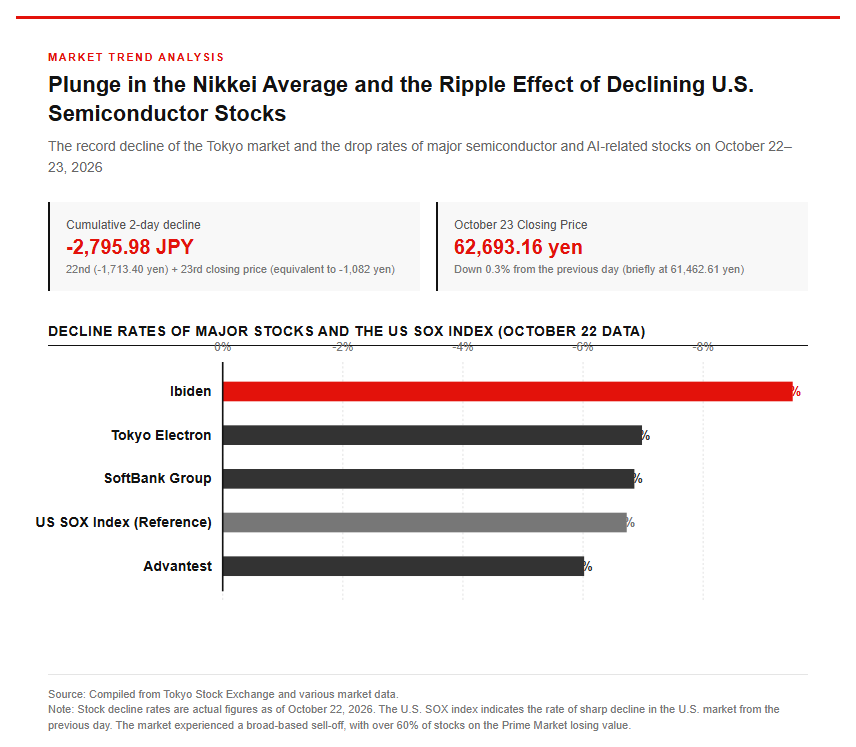
In the Tokyo stock market on October 23, 2026, the Nikkei Stock Average sharply declined at one point, falling by over 1,400 yen (2.3%) from the previous day to 61,462.61 yen. Although the closing price settled down 0.3% from the previous day at 62,693.16 yen, a significant drop of 1,713.40 yen (down 2.65%) had also been recorded on the previous day, the 22nd, bringing the cumulative two-day decline to 2,795.98 yen. The Tokyo Stock Price Index (TOPIX) also fell to 3,924.70 by the morning session, resulting in a broad-based market decline with more than 60% of all stocks on the Prime Market dropping in value. Selling was particularly concentrated in high-priced semiconductor and AI-related stocks that had been driving the market, leading to heavy selling of major issues such as Tokyo Electron, Advantest, Ibiden, and SoftBank Group. On the previous day, the 22nd, the decline rates had reached 6.01% for Advantest, 6.99% for Tokyo Electron, 9.49% for Ibiden, and 6.86% for SoftBank Group. This was a direct blow from the plunge in the U.S. market the previous day, where the Philadelphia Semiconductor Index (SOX) plummeted by 6.72%, causing investors’ risk-aversion stance to surge all at once. The stock price movements illustrating this market turmoil are as follows.
The Ripples Caused by Meta and Lam Research’s Earnings
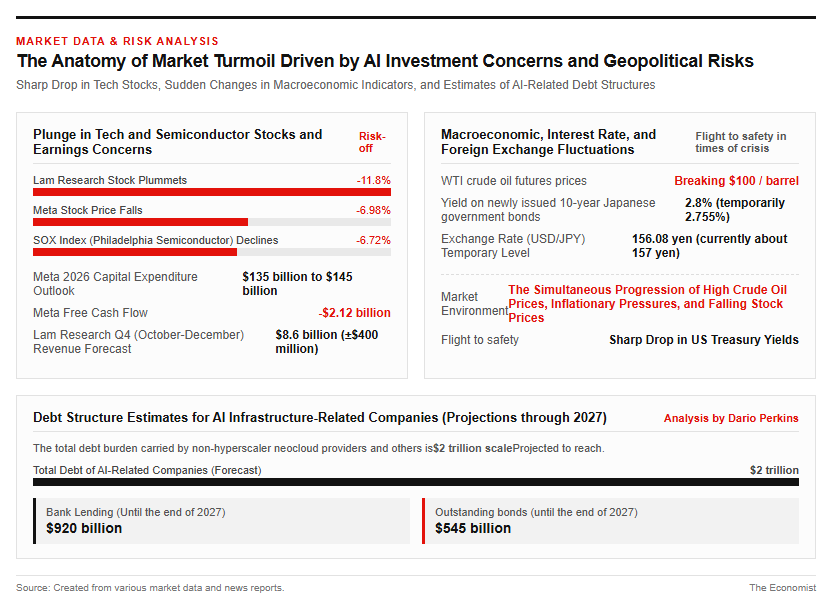
The direct trigger for the sharp decline in stock prices was uncertainty surrounding the profitability and return on AI investments by major U.S. tech companies. Meta Platforms (Meta) reported its July–September financial results on October 21, showing that revenue increased by 26% year-on-year to $64.6 billion, beating market expectations. However, by revising its 2026 capital expenditure outlook upward to $135 billion–$145 billion, its free cash flow plunged to a negative $2.12 billion, and caution regarding fundraising surged rapidly, with 5-year CDS spreads reaching a record high. As a result, Meta’s stock plummeted by 6.98%. Meanwhile, major semiconductor manufacturing equipment maker Lam Research announced strong earnings, but its revenue outlook for the October–December quarter ($8.6 billion ± $400 million) fell short of the market’s high expectations, causing its stock price to plunge by 11.8%. The prospect of shipment delays worth approximately $300 million to $400 million due to component shortages also weighed on sentiment. This indicates that strong financial performance alone is no longer enough to sustain stock prices, signaling that we have entered a phase where concrete revenue recovery scenarios commensurate with massive investments are being strictly scrutinized.
Deteriorating Middle East Situation and Surge in Crude Oil Prices Fuel Risk-Off Sentiment
In addition to skepticism toward high-tech stocks, heightened geopolitical risks stemming from the worsening situation in the Middle East amplified market uncertainty. Amid expanding conflict in Saudi Arabia and elsewhere that resulted in fatalities, a global risk-off trend accelerated. In the oil market, benchmark WTI crude oil futures broke through the $100-per-barrel mark once again, and North Sea Brent crude also surged significantly. In response to these emergency developments, capital fled to government bonds, which are considered safe-haven assets, causing the U.S. 10-year Treasury yield to drop sharply and Japan’s newly issued 10-year government bond yield to fall to 2.8% (temporarily touching 2.755%). In the foreign exchange market, risk-driven yen buying caused the yen to rapidly appreciate to a temporary high of 157.08 yen to the dollar, but after that buying subsided, the exchange rate hovered and traded around the 157 yen level. As inflationary pressures from soaring oil prices and declines in the stock market hit simultaneously, investors are being forced to adjust their portfolio positions.
Vulnerabilities in the AI Investment Structure and the Risk of a Bubble Collapse
The Hidden Risks of Neoclouds and Massive Debt
Behind the AI frenzy, the financial vulnerabilities of players other than Big Tech are coming to the surface. Following the plunge in corporate bonds of CoreWeave, a neocloud provider that rents out computing resources such as GPUs (the “CoreWeave shock”), fears of default and credit anxiety have surged rapidly. Furthermore, reports that Microsoft has withdrawn from a UK data center construction project it was advancing with British neocloud provider Nscale have raised doubts about delays in infrastructure development and the sustainability of the business model. According to an analysis by economist Dario Perkins (TS Lombard), the scale of debt incurred by AI-related companies is expected to reach the $2 trillion level by 2027. Cloud providers and model developers other than hyperscalers rely heavily on borrowing, with estimates reaching $545.0 billion in outstanding bonds and $920.0 billion in bank loans by the end of 2027. If sluggish business performance or order cancellations occur, there is growing concern of a risk that credit shocks will ripple outward from these companies. Please refer to the diagram below regarding the capital circulation and debt structure surrounding AI infrastructure.
The Trillion Impact Indicated by the Capital Expenditure Sudden Stop Scenario
TS Lombard has released estimates regarding the market impact if AI capital expenditures were to grind to a halt by early 2028. According to the projections, a stall in AI capex would cause the S&P 500 to plunge by 30% and technology stocks to drop by 40%, wiping out a combined market capitalization of approximately $20 trillion (roughly 3,136 trillion yen). In addition, it estimates that $125 billion to $190 billion in credit losses would be generated, dragging down U.S. GDP by about 2 percentage points and resulting in the loss of approximately 800,000 data center-related jobs. Crucial here is the “second derivative problem.” The mechanism is such that even if the absolute amount of AI capital spending does not decline, a mere deceleration in its growth rate will place intense pressure on the financial system and corporate earnings. A growth structure dependent on “capex recycling”—where funds are circulated within the ecosystem—constantly harbors the risk of a correction unless genuine revenue from end users expands.
Market Transformation, Future Outlook, and Key Points to Watch
Sustained Demand for Physical Infrastructure and the Semiconductor Supply Chain
In contrast to short-term fluctuations in the stock market, demand for physical infrastructure such as semiconductor manufacturing and data centers is operating strongly based on medium- to long-term plans. According to analysis by Federal Reserve staff, U.S. data center-related spending is estimated to exceed $500 billion in 2025. Demand remains robust for advanced packaging technologies such as the 2-nanometer (N2) process and CoWoS promoted by TSMC, as well as ASML’s EUV lithography systems, driving the expansion of physical infrastructure, including power supply and cooling facilities. Furthermore, the restructuring of supply chains within allied nations is progressing due to U.S. Export Administration Regulations (EAR/FDPR) and Japan’s restrictions on 23 items of manufacturing equipment. Japanese materials and equipment companies specializing in photoresists, abrasives, and back-end processing equipment are positioned as core players supporting quality and yields, backed by sustainable demand that goes beyond a mere temporary theme.
Shift from an Expectation-Driven Market to a Performance-Driven Market
The Nikkei Stock Average reached the 60,000 range for the first time during trading hours on April 23, 2026, and on April 27, it broke through the major 60,000 milestone on a closing basis as well. However, the benefits of the index’s rise have not been distributed evenly across the entire market, increasingly taking on the appearance of a K-shaped market where buying is skewed toward a handful of large-cap tech stocks. The market environment has completely transitioned from a phase of broad-based buying driven by vague expectations around the theme of AI to a stage of rigorously screening individual corporate performance. Macro-level uncertainties remain deeply entrenched, including the Bank of Japan’s monetary policy, the Federal Reserve’s interest rate cut trends, and movements surrounding data center regulations tied to the US midterm elections. The single greatest focus in the future stock market will be whether massive investments in AI-related areas actually materialize into concrete net sales, operating income, and free cash flow. Investors are now required to look beyond the mere framework of being “AI-related stocks” and adopt an attitude of identifying companies with substantial earnings-generation capabilities and sound financial structures.
Reference page
- [Dai-ichi Life Asset Management Economic Research Institute] https://www.dlri.co.jp/report/asset/598310.html
[#NikkeiAverage #AIPainvestment #SemiconductorStocks #MiddleEastSituation #StockMarket]


コメント