On October 23, 2026, the government cabinet-approved and submitted to the Diet an amendment to the Important Land Use Survey Act that introduces a system of government pre-approval for land transactions around security-critical Self-Defense Forces bases and remote border islands. Behind this are new security threats associated with the advancement of drone technology, as well as institutional limitations stating that current ex-post use regulations cannot fundamentally deter foreign powers and others from establishing bases.
- Overview of the Cabinet-Approved Amendment Bill to the Important Land Use Investigation Act
- The Threat of Drone Attacks and the Background Behind Stricter Regulations at the Acquisition Stage
- Transformations in Important Matters Explanations and Contractual Special Provisions in Real Estate Practice
- Identification of Beneficial Owners (BO) for Corporations and the Corporate Compliance Burden
- Collateral Valuation and Economic Impact on the Real Estate Distribution Market
- Arguments Concerning Consistency with International Commitments and the Principle of Internal-External Non-Discrimination
- Key Focal Points of Diet Deliberations and Future Trends Companies Should Prepare For
Overview of the Cabinet-Approved Amendment Bill to the Important Land Use Investigation Act
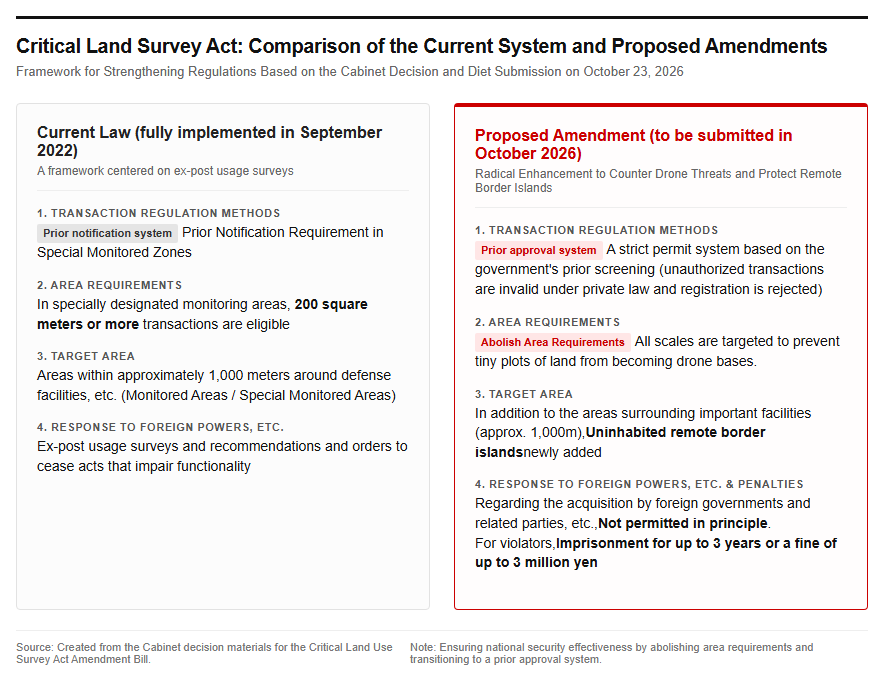
On October 23, 2026, the government approved a Cabinet decision on an amendment bill to the Important Land Use Investigation and Regulation Act, which strengthens regulations on the acquisition of land crucial for national security, and submitted it to the House of Representatives. The current law, enacted in 2021 (Reiwa 3) and fully implemented in September 2022 (Reiwa 4), designated areas around defense facilities and other locations within a range of roughly 1,000 meters as monitored areas or special monitored areas, and was limited to investigating land use statuses and requiring prior notification for transactions of 200 square meters or more in special monitored areas. The primary pillar of the latest amendment bill is to newly designate areas within approximately 1,000 meters of important facilities such as the Self-Defense Forces and the Japan Coast Guard, as well as uninhabited remote border islands, as restricted areas, and to introduce a permit system based on government pre-screening for land ownership transfer transactions.
Under the permission criteria, a policy has been established to, as a general rule, prohibit land acquisition by foreign governments, foreign military personnel, individuals obligated to cooperate with foreign governments, and corporations substantially controlled by them. Furthermore, to ensure effectiveness, land transactions conducted without government permission will be void under private law, and applications for the registration of ownership transfer will also be rejected. Severe criminal penalties are included for violators who engage in unpermitted transactions, subjecting both the seller and the buyer to up to three years of imprisonment or a fine of up to 3 million yen.
The Threat of Drone Attacks and the Background Behind Stricter Regulations at the Acquisition Stage
The primary background behind the necessity for a pre-approval system at the acquisition stage lies in the new methods of warfare utilizing drones and other technologies that have become apparent since Russia’s invasion of Ukraine. In the modern security environment, if an operational base is secured in the immediate vicinity—just a few hundred meters to one kilometer around critical facilities—there is an extremely high risk that attack drones could be secretly accumulated and launched, paralyzing defense and radar functions. Because establishing drone accumulation and launch bases is fully feasible even on small plots of land of less than 200 square meters, the proposed amendment eliminates the area requirement that existed in the current law.
In addition, on uninhabited border islands, which are out of public view, it is extremely difficult to ascertain in advance large-scale terrain modifications or the installation of structures near low-tide lines related to territorial sea baselines. Under the framework of current laws, which rely on ex-post usage surveys and discontinuation recommendations or orders against function-impeding acts, it is impossible to adequately address the irreversible risks that arise once land has been acquired and secretly turned into a base. The transition to a prior-permission system that halts the validity of land acquisition itself is positioned as an effective measure to protect national security and the lives of citizens. Please refer to the figure below.
Impact on the Economy, Business, and Real Estate Transaction Practices
Transformations in Important Matters Explanations and Contractual Special Provisions in Real Estate Practice
If this bill is passed and enacted in the Diet, it will have an extremely significant impact on actual real estate transaction practices. Because mandatory laws will be established making unauthorized transactions legally void, building lots and buildings transaction brokers will be charged with strict confirmation obligations comparable to the regulatory zones under the Agricultural Land Act and the National Land Use Planning Act. In actual real estate sales, it will be essential to precisely cross-check and investigate whether the target real estate falls under the regulatory zones published by the Cabinet Office prior to contracting. In the explanation of important matters based on Article 35 of the Building Lots and Buildings Transaction Business Act, in addition to whether the property falls under a regulatory zone, it must be explicitly stated and explained that permission is a requirement for the transfer of ownership to take effect, that unauthorized contracts will be void, and that penalties exist.
Furthermore, a fundamental review will also be required in the preparation of sales contracts (Article 37 documents). Regarding the contract format, similar to agricultural land transactions, it will be essential to conclude a sales contract subject to the condition precedent of obtaining permission from the Prime Minister. In practice, the following special provisions are expected to become standardized.
- A clause making the contract effective subject to the condition precedent that permission under the Critical Land Survey Act is obtained.
- The obligation of both the seller and the buyer to promptly prepare the documents necessary for the permit application and cooperate with each other.
- A clause providing that if permission is not obtained byцвет the due date or if the denial of permission is finalized, the contract shall be rendered null and void, and the deposit shall be refunded in full without interest.
- Penalties for cases where permission is denied due to false declarations or unjustified non-cooperation by one party
Because the period from contract conclusion to obtaining permits, ownership transfer registration, and final payment settlement is prolonged, the redesign of transaction schedules and the management of brokerage fee billing timing become extremely important.
Identification of Beneficial Owners (BO) for Corporations and the Corporate Compliance Burden
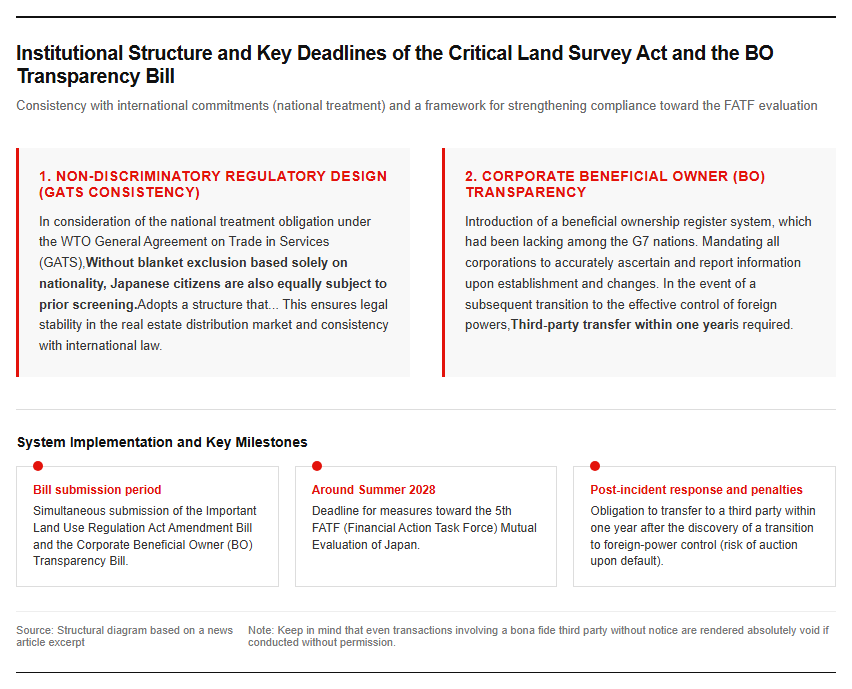
Submitted alongside the amendment to the Critical Land Use Survey Act is the Corporate Beneficial Owner (BO) Transparency Bill. This legislation aims to prevent situations where foreign capital establishes paper companies or dummy corporations in Japan and acquires critical land while concealing the true owners through the use of nominees or complex capital structures. The new bill requires all corporations to ascertain and report accurate and up-to-date information regarding their beneficial owners upon establishment or whenever changes occur, and also mandates that trustees of trust transactions ascertain information concerning related parties.
Consequently, this will significantly increase the burden of legal and compliance checks not only for real estate transactions within regulated zones, but also across companies generally engaged in general real estate investment, logistics facility development, the acquisition of renewable energy land, and corporate acquisitions (M&A). Japan lacks a corporate beneficial ownership registration system among the G7 nations, and this measure is also a response in preparation for the 5th mutual evaluation of Japan by the Financial Action Task Force (FATF), an international anti-money laundering body, scheduled for around the summer of 2028. If a corporation subsequently falls under the substantive control of foreign powers due to a merger or changes in its equity ratio, it is required to notify the government and transfer ownership to a third party within one year. Because there is a risk that a petition for auction will be filed if it fails to comply, tightening corporate governance will be essential.
Collateral Valuation and Economic Impact on the Real Estate Distribution Market
The introduction of the prior permission system may also have a structural impact on the functioning of the real estate distribution market and financial markets within the target areas. Due to the time required for screening and restrictions on eligible buyers, there are concerns about the risk that the liquidity and marketability of land and buildings located within the regulated areas will decline. In the practice of real estate-secured lending by financial institutions, considering the possibility of constraints on auction disposal during debt recovery, there is a possibility that collateral valuation multipliers will be lowered and loan screening will be tightened.
Furthermore, since nullification under this Act is interpreted as absolute nullification intended to protect the public interest of national security, even a bona fide third party who is unaware of the fact of the unpermitted transaction cannot acquire ownership. Even at the registry office, registration applications submitted without the attached permit are rejected, meaning that even the appearance of a right is not protected. Institutional investors and trust banks structuring real estate securitizations or project financings will be forced to raise their due diligence standards regarding the rights relationships of target properties higher than before. For manufacturing and infrastructure-related companies with business locations surrounding defense facilities, this will become a factor increasing uncertainty in asset value preservation and facility expansion plans.
Challenges of the System and Future Developments
Arguments Concerning Consistency with International Commitments and the Principle of Internal-External Non-Discrimination
One of the biggest legal issues is consistency with various international commitments, including the General Agreement on Trade in Services (GATS) of the World Trade Organization (WTO). When Japan joined the WTO in 1995, it did not reserve its national treatment obligations regarding real estate acquisition, meaning that newly introducing discriminatory acquisition regulations that treat foreigners differently from Japanese nationals could violate the treaty. For this reason, the current legislative amendment bill adopts a non-discriminatory institutional design that does not uniformly exclude individuals based solely on nationality, but instead equally subjects everyone, including Japanese citizens, to prior screening. Please refer to the figure below.
However, because foreign governments, military personnel, and corporations controlled by them are listed as substantive criteria for denial, it is necessary to scrutinize whether the security exception under international law (GATS Article XIV bis) can be legitimately applied. In addition, some of the bilateral investment treaties (BITs) concluded by Japan promise national treatment regarding land acquisition, making theoretical clarification essential to ensure they are not deemed discriminatory restrictions against foreign investors. The challenge is how to build an effective defense foundation while avoiding the hindrance of direct investment in Japan and complying with obligations under international law.
Key Focal Points of Diet Deliberations and Future Trends Companies Should Prepare For
During parliamentary deliberations, the balance between the public interest of ensuring national security and the property rights and freedom of economic activities guaranteed by the Constitution of Japan will be a major point of discussion. The Japan Federation of Bar Associations and other organizations have expressed concerns since the enactment of the current law regarding the restriction of private rights and invasions of privacy due to ambiguous requirements, as well as the fragility of legislative facts due to the lack of clear infringement cases. Discussions are also expected to take place regarding the newly established on-site inspection authority and the transparency of permission criteria in the current amendment proposal.
Meanwhile, the infrastructure for understanding actual conditions in administrative operations is steadily progressing. On October 5, 2026, a ministerial ordinance partially amending the Real Estate Registration Regulations came into effect, initiating the collection of owners’ nationality information in registration procedures. The government plans to incorporate this information into the real estate base registry developed by the Digital Agency to strengthen information sharing among administrative agencies. Companies and real estate professionals need to make the following preparations in anticipation of the enactment and promulgation of the bill.
- Comprehensive inspection of whether company-owned or leased properties fall under regulated areas
- Establishment of an internal management system for beneficial owner information, including shareholding ratios and executive composition
- Standardization of Conditional Approval Clauses in Real Estate Sales Contracts and Factoring in Review Delay Risks
Reference page
- [Important Land Use Investigation Act | Cabinet Office] https://www.cao.go.jp/tochi-chosa/
- [Recommendations on the Ideal Approach to Rules Regarding the Acquisition, etc., of Land Important for National Security | Cabinet Secretariat] https://www.cas.go.jp/jp/seisaku/symbiotic_society/gaikokujin_tochishutoku/kaisai-jokyo/dai5/teigen.pdf
- 【Solidifying National Security: Toward Amending the Important Land Use Investigation Act and Establishing a New BO Bill | Liberal Democratic Party】https://www.jimin.jp/news/information/214436.html
- [Handling of Real Estate Registration Affairs Due to the Enforcement of the Ministerial Ordinance Partially Amending the Real Estate Registration Regulations (Notice) | Ministry of Justice] https://www.moj.go.jp/content/001470076.pdf
- 【About the Expert Meeting on the Ideal State of Land Acquisition and Use, etc. | Ministry of Land, Infrastructure, Transport and Tourism】https://www.mlit.go.jp/totikensangyo/content/002017996.pdf
[#Economy #RealEstateBusiness #ImportantLandUseRegulationAct #NationalSecurity #LegalCompliance #BeneficialOwner #RiskManagement]


コメント