bajji, Inc. has launched “AI Rebuild,” a service that rebuilds long-operated existing systems with an AI-native approach. Behind this initiative are delays in leveraging AI caused by increasing complexity from repeated modifications, heightened attack risks, and fixed maintenance costs.
- Key points of the service announcement and the goal of AI-native reconstruction
- The Complexity and Security Risks Facing Existing Systems
- A 4-Step Construction Methodology from Diagnosis to Handover
- A Human-AI Collaborative Development and Operations Structure and Four Automated Verification Features
- The 2.1 Trillion-Yen Modernization Market and ROI Optimization
- Future Developments in the AI Era and the Future of Existing Systems
Key points of the service announcement and the goal of AI-native reconstruction
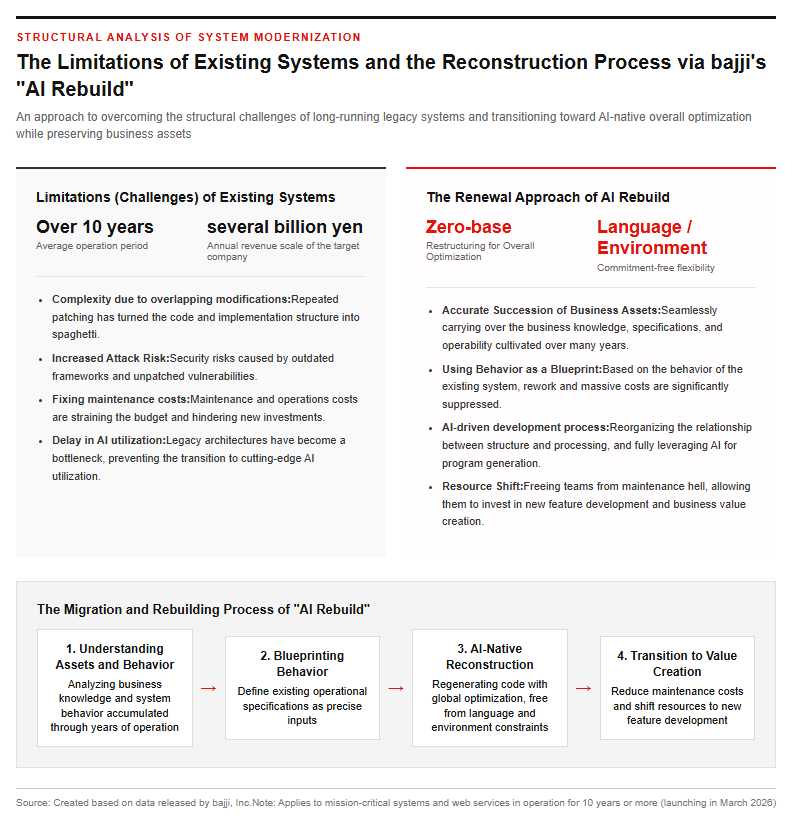
On October 19, 2026, bajji, Inc. announced “AI Rebuild,” an SI service that rebuilds long-operated existing business systems and web services from the ground up. The service has been available since March 2026, targeting primarily the core systems and web services of companies that have been in operation for over 10 years and boast several billion yen in annual revenue. The defining feature of AI Rebuild is that it uses AI to reconstruct complex internal code and implementation structures from a globally optimal perspective, while faithfully inheriting business assets accumulated in existing systems, such as valuable operational knowledge, data, specifications, and familiar user experience. Without being bound by restrictions on programming languages, frameworks, or cloud environments, it utilizes the behavior of the currently operating system itself as a blueprint, thereby significantly curbing the rework and massive costs incurred when redefining requirements from scratch. Rather than simply copying screens or code, it integrates AI into the programming and design processes to reorganize the relationship between the overall system structure and processing. By doing so, the service aims to strongly support companies in liberating development resources once tied up by legacy system maintenance, allowing them to shift investments toward creating new business value and developing new features.
The Complexity and Security Risks Facing Existing Systems
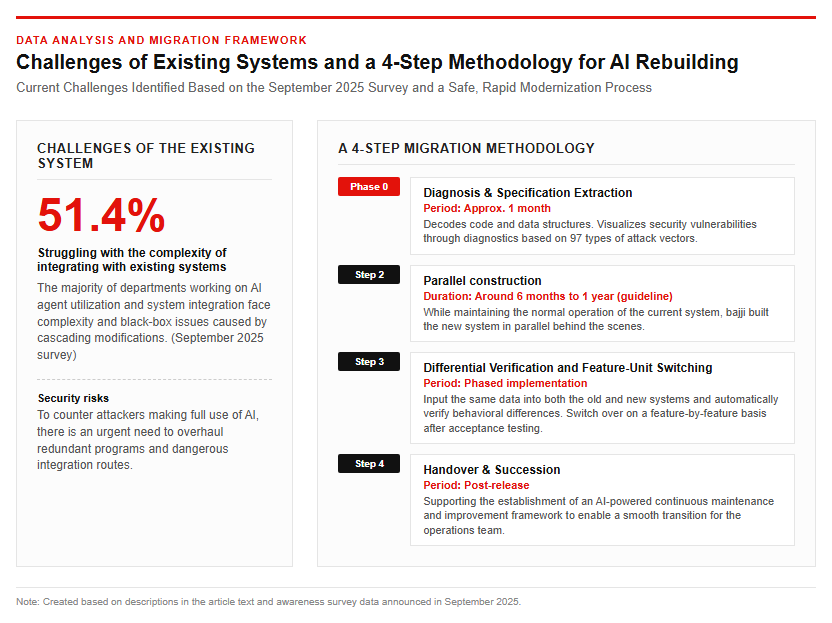
In many companies, business systems that have undergone repeated modifications for over a decade have accumulated unused, obsolete processes and complex exception handling, resulting in a “black box” state where understanding the specifications depends entirely on specific personnel. According to an awareness survey released in September 2025, 51.4% of departments working on AI agent utilization and system integration reported struggling with the complexity of integrating with existing systems. As the internal structure of systems becomes increasingly complex, it becomes impossible to predict the scope of impact when modifications are made, creating a vicious cycle where development budgets and human resources are locked into system maintenance. Furthermore, as an even more serious problem, unnecessary integration pathways and latent bugs created by a chain of modifications have become vulnerabilities exploited in cyberattacks. Recently, in particular, attackers are also leveraging AI technology to rapidly scan for structural gaps and vulnerabilities in systems to launch attacks, causing security risks to escalate rapidly if systems remain in an outdated state. Assuming this modern threat environment where attackers use AI, AI rebuilding simultaneously reduces maintenance burdens and enhances security strength by reassessing hazardous pathways and redundant programs.
Step-by-Step Migration Process in AI Rebuilding and AI-Native Infrastructure
A 4-Step Construction Methodology from Diagnosis to Handover
The AI rebuild migration process consists of four clear steps designed to safely modernize systems while minimizing the impact on existing operations. In the first step, “Diagnosis & Specification Extraction (Phase 0),” taking about one month, the code, data structure, and operational reality of the current system are deeply deciphered. Based on a diagnosis using 97 types of attack methods, security vulnerabilities are visualized, and after organizing the breakdown of maintenance man-hours and the risks of continued operation, the appropriateness of reconstruction is judged. Even if the diagnosis concludes that “maintaining the current system is optimal,” a visualized attack surface map is provided. In the second step, “Parallel Construction,” taking an estimated six months to one year, bajji builds the new system in parallel while the existing team continues normal operations of the current system in the background. In the third step, “Differential Verification and Feature-by-Feature Switching,” identical data is input into both the old and new systems to automatically verify behavioral differences, followed by user acceptance tests and phased switching on a feature-by-feature basis. In the final step, “Handover & Succession,” comprehensive support is provided up to the establishment of an AI-utilized continuous maintenance and improvement system, ensuring that the existing operations team can smoothly transition to becoming the operational entity after release.
A Human-AI Collaborative Development and Operations Structure and Four Automated Verification Features
“AI-native,” as defined by this service, goes beyond merely using AI to automatically generate source code. It refers to an advanced development and operations environment that makes everything—from specifications, design information, and test cases to past change histories—accessible and outputtable by both humans and AI, enabling the automatic verification of system changes. When the reconstructed system is handed over to the enterprise, four foundational mechanisms are incorporated to ensure that the operations team can continue autonomous improvements. Specifically, these include a management system for specifications and design information that can be commonly interpreted by humans and AI, acceptance testing and differential verification functions to compare the behaviors of the old and new systems, a checking mechanism that automatically detects the impact of program changes, and a system for recording past decision-making rationales and automatically updating specifications. The integrated operation of these four mechanisms prevents specifications from becoming dependent on specific individuals even if development personnel change, enabling safe and rapid functional modifications. What makes this extremely groundbreaking is that, rather than replacing the existing system operations team like traditional large-scale overhauls, the existing team acquires a modern development and operations foundation that can carry them through the next decade.
The 2.1 Trillion-Yen Modernization Market and Future Outlook
The 2.1 Trillion-Yen Modernization Market and ROI Optimization
The domestic IT modernization market continues to expand rapidly, even after passing the “2025 Cliff” warned of by the Ministry of Economy, Trade and Industry. According to market forecasts released by research firm IDC Japan in February 2026, Japan’s IT modernization services market reached 1.3044 trillion yen in 2025, is projected to grow at a compound annual growth rate of 10.2% from 2025 to 2030, and is estimated to reach 2.1234 trillion yen by 2030. Approximately 80% of large and mid-sized enterprises still retain legacy systems, and the impending end of mainframe sales and support by Fujitsu around 2030 is further driving the wave of modernization. While the primary objective used to be simply “prolonging the life” of aging systems, the purpose has shifted significantly toward becoming “AI Ready” (establishing infrastructure for the full-scale utilization of AI). To enhance the ROI (return on investment) of AI initiatives, companies are required to go beyond one-off modifications; they must minimize building and operational costs through common infrastructure and standardization while expanding the scope of automation across the entire organization. Approaches such as AI rebuilding serve as powerful options to compress bloated maintenance costs and secure competitiveness in the AI era.
Future Developments in the AI Era and the Future of Existing Systems
As pointed out in the “AI Business Guidelines (Version 1.1, March 2025)” formulated by the Ministry of Internal Affairs and Communications (MIC) and the Ministry of Economy, Trade and Industry (METI), the safe and secure social implementation of AI technology and the establishment of corporate governance have now become unavoidable management challenges. In traditional system development, it was common to maintain a built system as-is for a long time; however, in the modern era where generative AI and autonomous AI agents are rapidly evolving, shifting to an agile structure capable of adapting to change is indispensable. “AI Rebuild,” provided by bajji, presents an approach that protects the “true assets”—a company’s core operational knowledge and know-how cultivated over many years—while elevating the underlying technical framework to the latest AI-native environment. For companies that have been unable to take the plunge into traditional big-bang overhauls costing hundreds of millions of yen and taking several years, risk-mitigated phased transitions and the standardization of operations through AI offer a viable path toward breaking away from legacy systems. Moving forward, companies that reconstruct their existing systems into infrastructure with high affinity for AI are expected to rapidly establish a market advantage in operational efficiency and the creation of new services.
Reference page
- [bajji Inc. Official AI Rebuild Announcement] https://corp.bajji.life/ai-rebuild/
- 【Ministry of Internal Affairs and Communications and Ministry of Economy, Trade and Industry AI Guidelines for Business Operators】[suspicious link removed]
- [IDC Japan Domestic IT Modernization Market Research] https://www.idc.com/resource-center/blog/japan-it-modernization-race-21-trillion-yen/
【#AIRebuild #bajji #ITModernization #SystemReconstruction #SecurityMeasures #AIReady #GenerativeAI】
コメント