Google has announced updates and a multilingual rollout for its search feature “AI Mode.” Behind this move are the rapid evolution of generative AI technology and a strategic shift to transition user search behavior toward interactive, task-completing formats.
- [Key Event Summary] Functional overview and multilingual rollout of conversational search “AI Mode”
- The Transformation of the Search Experience Brought by Query Fan-Out and Multimodality
- Advances in Agent Capabilities That Automatically Handle Everything Up to Booking and Purchase
- Link Improvements and Personalization to Secure Referral Opportunities
- Copyright Friction with News Organizations and Concerns Over Zero-Click Searches
- [Future Outlook & Key Points] The Future of Integrated AI Search and the Direction of the Web Ecosystem
[Key Event Summary] Functional overview and multilingual rollout of conversational search “AI Mode”
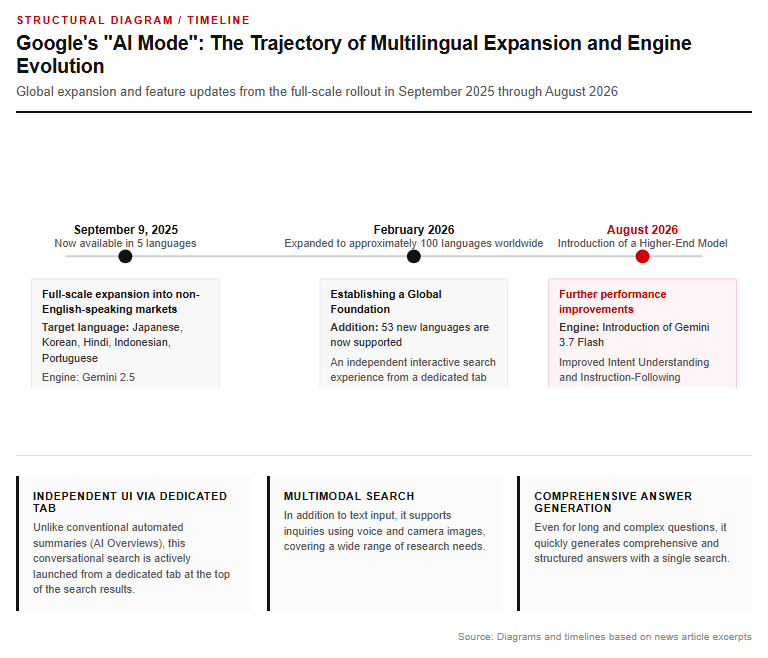
Google is accelerating the rollout of “AI Mode” as a new conversational interface within its search service. Unlike “AI Overviews,” the summarization feature that was previously automatically displayed at the top of search results pages, AI Mode is an independent interactive search experience actively launched from a dedicated tab at the top of search results. This feature was officially launched on September 9, 2025, in five languages—Japanese, Korean, Hindi, Indonesian, and Portuguese—marking its full-scale expansion into non-English speaking regions. Following a phased rollout, it added support for an additional 53 languages in February 2026, expanding into a global infrastructure available in approximately 100 languages worldwide. The response engine employs Gemini 2.5, which has been optimized for search, generating comprehensive answers in a single search even for long and complex questions. Furthermore, it supports multimodal searches using not only text input but also voice and camera images, and is designed to cover a wide range of needs from everyday inquiries to advanced research. The introduction of the advanced Gemini 3.7 Flash model has also been underway since August 2026, further improving intent understanding and instruction-following capabilities. Please refer to the figure below for an image of the screen layout and basic UI of AI Mode.
The Transformation of the Search Experience Brought by Query Fan-Out and Multimodality
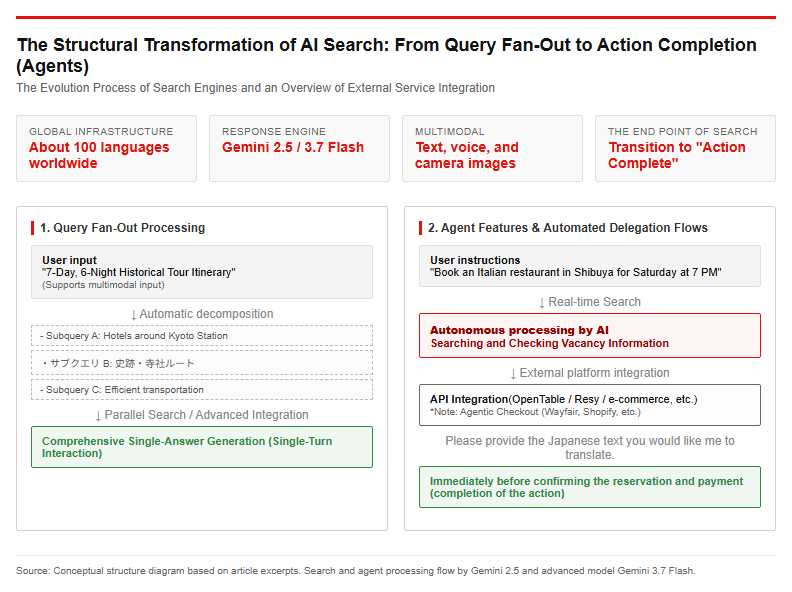
At the technological core of the AI mode is a search processing technology called “query fan-out.” When a user inputs an abstract and complex question such as, “Create a 6-night, 7-day historical tour travel plan starting from Kyoto Station,” the system automatically breaks the question down into multiple sub-queries. It then executes web searches in parallel for each sub-query, highly integrates the obtained information, and presents it as a single answer. This eliminates the need to sequentially click and compare the “ten blue links” that were the mainstream of conventional search engines, making it possible to cover information from diverse perspectives in a single interaction. Furthermore, a feature that allows photos and images taken with a smartphone camera to be used directly as search queries is also integrated. Operations such as taking a picture of a foreign language menu to ask for explanations of vegetarian dishes or photographing a building in the city to ask about its historical background are completed within the flow of a natural conversation. The greatest significance of this technological innovation is that search engines are transforming from mere keyword-matching tools into partners that understand user intent and autonomously perform research on their behalf.
Expansion of Agent Features and External Integrations
Advances in Agent Capabilities That Automatically Handle Everything Up to Booking and Purchase
The evolution of AI modes goes beyond mere information presentation, expanding into agentic capabilities that execute real tasks on behalf of the user. Features currently being rolled out early, primarily in the United States, have established systems that automatically handle restaurant and local service reservations as well as product purchase procedures within the conversational interface. For example, if you specify, “Book an Italian restaurant in Shibuya for 4 adults at 7 PM on Saturday,” the AI searches for availability in real-time, collaborates with reservation platforms such as OpenTable and Resy, and proceeds with the process up to the state just before confirmation. Furthermore, in the e-commerce sector, an Agentic Checkout feature has also been introduced, which allows the AI to automatically execute the checkout process upon detecting a price drop by setting a target price in advance. These are made possible through partnerships with Wayfair and participating merchants on Shopify, enabling users to complete tasks without visiting individual e-commerce or reservation sites. The endpoint of information retrieval is shifting from browsing websites to the “completion of actions,” entering a phase that impacts the very structure of web businesses. Please refer to the figure below for the overall flow of automated reservations and payments by agents.
Link Improvements and Personalization to Secure Referral Opportunities
As the generation of answers by AI becomes more widespread, concerns have grown over the increase in zero-click searches, where users leave without visiting the source websites. In response, Google has announced “five link improvement initiatives” designed to increase website referral traffic from AI mode and AI Overviews. Specific improvements include adding related topic suggestions and links at the end of answers, emphasizing news subscription links for journalistic content, clearly displaying the information of discussion posters on platforms like Reddit, placing inline links on related text within answer sentences, and displaying hover previews in desktop environments. These changes are designed to make it easier for users to visually verify the basis of generated answers and encourage direct visits to specific paragraphs and primary sources.
At the same time, the personalization of the search experience is also being advanced. A feature has been implemented that utilizes users’ past search history and Google Maps activity history to prioritize presenting stores and spots optimized for individual preferences. Furthermore, a feature has been provided that allows users to send chat logs themselves as shared links to family and friends, enabling multiple people to conduct collaborative research together. This is transforming search from an individual task into a collaborative experience.
Social and Legal Implications and Future Outlook
Copyright Friction with News Organizations and Concerns Over Zero-Click Searches
The rapid adoption of AI search services is causing serious legal and economic friction with content creators who produce primary information. On April 20, 2026, the Japan Newspaper Publishers and Editors Association issued a statement regarding AI search services, expressing strong concern over the current situation where news articles from media organizations are being used without authorization. In particular, they raised issues with Google’s AI search, pointing out that the controls for standard search crawlers and AI search crawlers are identical. They argue that the structural setup where opting out of AI search usage alone also results in removal from standard search results constitutes an “abuse of superior bargaining position” under the Antimonopoly Act, backed by a dominant position in the search market, and are demanding institutional improvements. Furthermore, it has been pointed out that the establishment of zero-click searches—where users are satisfied with just the AI’s answer and do not visit the original news site—threatens the financial foundation of media outlets that maintain reporting structures. In regulatory frameworks such as Europe’s Digital Services Act (DSA), evaluating the impact of generative AI systems on information access and democratic discourse has also become a critical issue, making the establishment of transparency and appropriate compensation-sharing rules an urgent global priority.
[Future Outlook & Key Points] The Future of Integrated AI Search and the Direction of the Web Ecosystem
The biggest point of interest moving forward is how the AI mode, provided as a separate tab, will integrate with the traditional search engine results page (SERP). Google CEO Sundar Pichai has positioned the AI mode as an experimental testing ground for advanced feature verification, indicating a policy to sequentially integrate elements that receive high user ratings into AI Overviews and standard search results. In the future, it is expected that “AI-powered search” will become the standard, where conversational UIs, summaries, comparison tables, and agent execution screens automatically launch according to the nature of the query, without users needing to be conscious of switching modes. Along with this, website operators and marketers will be required to shift from traditional search engine optimization (SEO) to “Generative Engine Optimization (GEO),” which involves providing accurate and structured data to generative AI engines to increase citation rates. Enhancing the reliability of primary information (E-E-A-T) and the precision of structured markup will be extremely crucial for securing exposure in the future integrated SERP. As AI search becomes established as infrastructure, the key to future sustainable development will be whether a healthy ecosystem can be built in which platforms and copyright holders can coexist.
Reference page
- [Google Official Blog: “AI Mode” now available in Japanese on Google Search] https://blog.google/intl/ja-jp/products/explore-get-answers/ai-mode-search/
- 【Statement Regarding AI Search Services – Japan Newspaper Publishers and Editors Association】https://www.pressnet.or.jp/statement/copyright/260420_16248.html
- 【Assessing Compliance for Generative AI Systems under the Digital Services Act – CEUR-WS】[suspicious link removed]
[#Google #AI_Mode #AI_Search #Generative_AI #SEO]
コメント