On November 17, 2026, NTT DATA Corporation launched “Clean Modernization™,” a service that redesigns legacy core systems built in languages such as COBOL into highly maintainable Java-based systems. This comes against the backdrop of the “2025 Cliff”—driven by aging core systems and a retiring engineer workforce—as well as the challenge of system complexity that cannot be resolved simply by replacing existing code.
- Business Specification Recovery Using Generative AI and Java Redesign Emphasizing Maintainability
- Proven metrics of a 40% reduction in development time and a 50% reduction in maintenance man-hours
- The 2025 Digital Cliff and Black-Boxing Due to Aging Engineers
- The JaBOL Problem Caused by Simple Code Conversion and AI Challenges
- Phased modernization from applications to infrastructure and organization
- Expansion into Financial and Public Sectors and a 50 Billion-Yen Business Target Over Three Years
Business Specification Recovery Using Generative AI and Java Redesign Emphasizing Maintainability
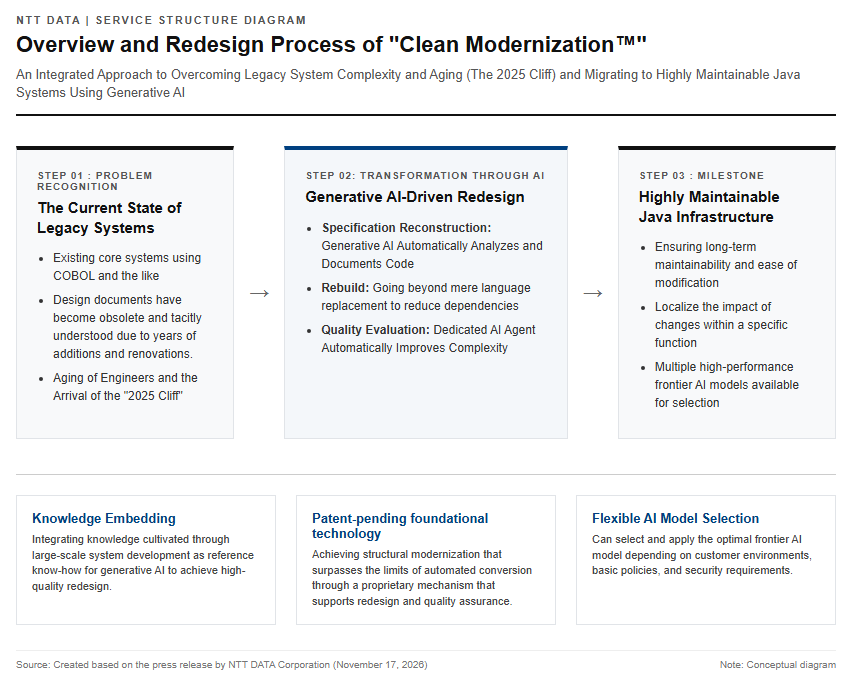
NTT DATA’s newly launched Clean Modernization™ is an integrated service designed to redesign core systems written in legacy languages such as COBOL into Java systems that ensure long-term maintainability and ease of modification. Generative AI automatically analyzes and restores business specifications—which have become tacit knowledge as design documents lost their practical meaning due to years of additions and renovations—and drives documentation forward. Rather than stopping at mere language replacement via automated conversion tools, it adopts a rebuilding approach that thoroughly organizes and reduces inter-functional dependencies. By incorporating large-scale system development expertise as reference know-how for the generative AI, it achieves an architecture that limits the scope of impact from modifications to specific functions. For the designs and program code output by the generative AI, a separate dedicated AI agent objectively evaluates code complexity and dependencies, introducing a mechanism that automatically identifies and improves areas of low maintainability. The foundational technology supporting this redesign and quality assurance has patents pending, and multiple high-performance frontier AI models can be selected based on the customer’s environment and basic policies. Please refer to the overall picture below.
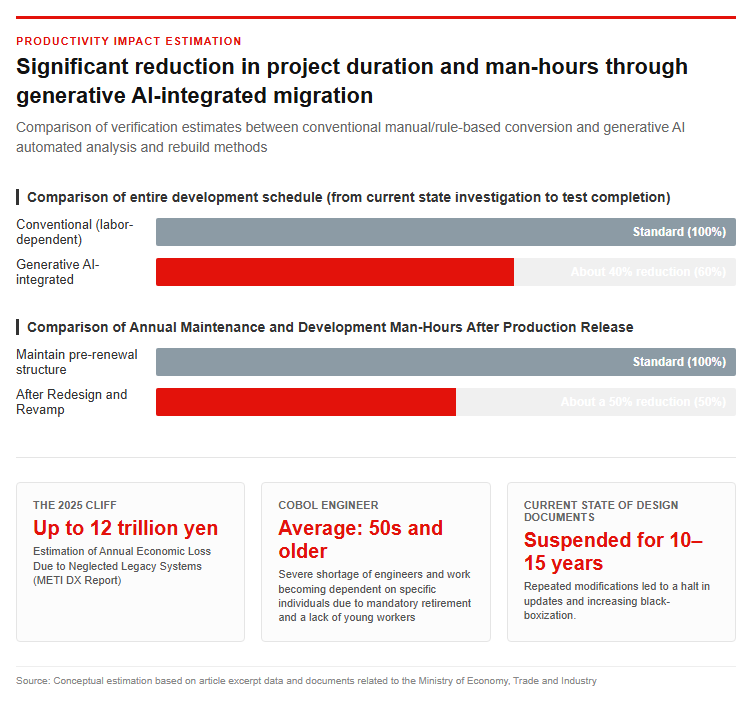
Proven metrics of a 40% reduction in development time and a 50% reduction in maintenance man-hours
In this service, generative AI is comprehensively applied to all development processes, ranging from current state analysis and business specification recovery to redesign, implementation, unit and integration testing, and acceptance testing. We estimate that this can reduce the overall development schedule by approximately 40% compared to conventional, human-dependent migration development. In addition, by restructuring the system into a loosely coupled architecture per functional unit, we significantly reduce the burden of change impact analysis and regression testing after production deployment. Estimates based on past similar projects and operational data indicate that post-modernization maintenance work hours can be reduced by about 50% compared to continuing maintenance while keeping the pre-modernization structure. Another major strength is that it prevents dependency on specific engineers, facilitating smooth business handovers and task sharing among development teams. For core system modernization—which traditionally required massive budgets and multi-year timeframes—this provides a realistic solution that achieves both reduced development costs and shortened migration periods.
Structural Challenges Hindering COBOL Migration and the Necessity of Redesign
The 2025 Digital Cliff and Black-Boxing Due to Aging Engineers
The “2025 Cliff” sounded by the Ministry of Economy, Trade and Industry’s DX Report estimates that leaving aging legacy systems unaddressed could result in annual economic losses of up to 12 trillion yen. In Japanese companies, core COBOL systems continue to operate on a scale of hundreds of billions of lines, primarily centered around financial institutions, government agencies, and major manufacturers. However, the average age of COBOL engineers has reached the 50s and above, making the retirement of engineers due to reaching retirement age and the shortage of training for young talent serious issues. Furthermore, due to the accumulation of modifications over decades, there are many cases where the final updates to design documents stopped 10 to 15 years ago, resulting in a black-box state where processing intentions and backgrounds rely on oral traditions or individual memories. The decline in veterans who understand the specifications leads to bloated system maintenance costs, significantly hindering companies’ promotion of DX and offensive IT investments.
The JaBOL Problem Caused by Simple Code Conversion and AI Challenges
Until now, rule-based automatic conversion tools have been used as a rewriting method to move away from COBOL. However, simply replacing the syntax mechanically leaves problems such as COBOL-specific fixed-length memory areas and file processing structures intact. This state is called “JaBOL”—it is the Java language, yet it requires specialized knowledge of both COBOL and Java, failing to lead to improved maintainability. On the other hand, even in code conversion utilizing the latest generative AI, there are risks of “silent failures,” where the program erroneously determines that it has completed successfully while causing a fatal internal error, as well as hallucinations in data type interpretation. Please refer to the following conversion structure comparison.
NTT Data is resolving the gap between “working code” and “maintainable design” by incorporating redesign guidelines and strict test harnesses to bridge the discrepancies between COBOL source code and Java specifications, and by clearly defining the division of roles between humans and AI.
Ripple effects on the entire system and future developments
Phased modernization from applications to infrastructure and organization
The scope of Clean Modernization™ goes beyond mere program code rewriting. It targets all four domains for evaluation: applications, infrastructure, operational procedures, and even the division of roles within development and operations organizations. It is promoted with two core pillars: “visualization,” which clarifies current system configurations and dependencies, and “changeability,” which localizes the impact of specification changes. By integrally implementing Infrastructure as Code (IaC) and the standardization and automation of operational workflows, it supports post-migration cloud infrastructure operations and improved agility. To avoid the business disruption risks associated with large-scale, all-at-once overhauls, it adopts a phased modernization process on a functional basis, enabling enterprises to achieve a secure system migration.
Expansion into Financial and Public Sectors and a 50 Billion-Yen Business Target Over Three Years
NTT DATA will roll out this service targeting primarily financial institutions, government agencies, local governments, and social infrastructure companies that have operated large-scale core systems for many years. The company has set a plan to achieve a cumulative total of 50 billion yen in sales over the three-year period from fiscal 2027 to fiscal 2029. By integrating collaborations with advanced U.S. frontier AI models such as OpenAI and its own advanced SI know-how, it is accelerating its shift toward a company-wide transformational SI business. As the end-of-support deadlines for mainframes rapidly approach one after another, this service—which ensures reliable business reproducibility and long-term maintenance quality—is expected to serve as a robust foundation for resolving technical debt and advancing digital transformation (DX) for Japanese enterprises.
Reference page
- [NTT DATA Corporation News Release] https://www.nttdata.com/global/ja/news/release/2026/111700/
- [Ministry of Economy, Trade and Industry DX Report (Summary)] https://www.meti.go.jp/shingikai/mono_info_service/digital_transformation/pdf/20180907_02.pdf
【#NTTData #GenerativeAI #COBOL #Java #CleanModernization #Modernization #2025Cliff】
コメント