
Taisei Corporation has decided to contract its largest loan line ever (commitment line) of 300 billion yen with Mizuho Bank and others. This is driven by the increase in refinancing funds associated with large-scale redevelopment projects and strategic financial management that enhances asset efficiency without holding excessive cash. ,
- Signed a commitment line contract worth 300 billion yen
- Expanding Funding Needs and Optimizing Asset Efficiency
- Sapporo’s Construction Defects and Management Responsibility
- Insider Trading Issues and Strengthening Compliance
- Toyo Construction as a Subsidiary and Strengthening the Civil Engineering Sector
- ROE improvement measures with capital cost in mind
- Earnings Outlook and Challenges for the Fiscal Year Ending March 2026
- Balancing Growth Investment and Shareholder Returns
Signed a commitment line contract worth 300 billion yen
On June 29, 2026, the Nihon Keizai Shimbun reported that Taisei Corporation plans to sign a commitment line contract worth 300 billion yen, the largest ever ever. This loan line is established with a group of financial institutions led by Mizuho Bank and others, allowing companies to flexibly receive loans within a predetermined amount when needed. This represents a significant renewal of the company’s existing lending capacity, with an official announcement scheduled for the following day, the 30th. In recent years, redevelopment projects centered on urban areas have become larger than ever before, resulting in enormous amounts of funds for material and labor costs borne by construction companies, as well as refinancing funds for supporting small and medium-sized subcontractors. This largest-ever funding facility is primarily aimed at ensuring financial flexibility to respond quickly and flexibly to the increasing demand for capital unique to the industry. Additionally, by holding large lending lines, we aim to establish a stable business continuity system that does not halt project progress even in the face of sudden market changes or unforeseen circumstances. ,
Expanding Funding Needs and Optimizing Asset Efficiency
The background behind this large-scale lending facility setting is not only to meet funding needs but also to optimize asset efficiency, which is part of the company’s ongoing management reforms. Taisei Corporation has set forth ‘management with an awareness of capital costs and stock prices,’ aiming to improve ROA (Return on Assets) and ROE (Return on Equity) without holding excessive cash on hand. , Previously, strengthening our financial structure was our top priority, pursuing ‘virtually debt-free management,’ but we are now transitioning to a phase of optimizing capital structure while maintaining our ratings. As specific financial KPIs, we have set goals to maintain a capital adequacy ratio of around 40% and comply with a net D/E ratio of 0.4x, and this loan facility will be an important tool for maintaining this balance. Instead of leaving large amounts of cash unused in deposits, you can withdraw funds from the loan line only when needed, slimming down your balance sheet and improving capital efficiency. Additionally, the secured funds are planned to be used for strategic investments in growth sectors such as data center construction and urban redevelopment. Thus, the record largest lending facility marks a symbolic shift for the company from “defensive finance” to “aggressive finance” focused on efficiency. ,
[Turning Point in Management] The Path to Overcoming Scandals and Restoring Trust
Sapporo’s Construction Defects and Management Responsibility
The reason Taisei Corporation is rushing such a large-scale financial restructuring is the aspect of a complete comeback from serious scandals that occurred in the past. In March 2023, the company announced that it had discovered inaccurate steel frames and false reports to the client in a large-scale 26-story mixed-use building under construction in Sapporo, Hokkaido. Specifically, numerous issues such as tilting of steel columns and insufficient floor concrete thickness were discovered, and it was revealed that construction workers had falsified the numbers to report out of concern for delays in the construction schedule. In response to this unprecedented situation, Taisei Corporation made the unusual decision to demolish all the above-ground parts that had already been constructed and rebuild from scratch. As a result, the completion was delayed by 28 months from the original schedule, pushing the project to the end of June 2026. , taking responsibility for this issue, the then head of the construction department and branch manager resigned to take responsibility, and trust in the company’s quality was shattered. The company commented, “We will do our utmost to restore credit to prevent a similar situation from happening again,” and the announcement of stable cash flow through securing the loan line also aims to demonstrate to the market and business partners the soundness of its management and its determination to make a comeback. ,
Insider Trading Issues and Strengthening Compliance
Further impacting the loss of trust due to construction defects was the insider trading incident involving employees uncovered in May 2025. , An inspection by the Securities and Exchange Surveillance Commission revealed that four employees of Taisei Corporation had sold off their own shares before the announcement of a significant fact that would significantly influence investment decisions, such as the reconstruction of a building in Sapporo. This scandal was harshly criticized as revealing the company’s internal control system and lack of corporate ethics. In response to these series of scandals, Taisei Corporation redefined thorough quality control, respect for human rights, and compliance as the most important foundation of its management in the “TAISEI VISION 2030.” , As concrete measures, we focus on improving productivity through a review of the education system, transparently utilizing IT in quality control processes, and earning trust through sincere dialogue with stakeholders. , This largest-ever lending facility is also a strategic move to build a robust financial backbone capable of handling future uncertainties alongside these governance enhancement efforts, and to demonstrate business continuity and transparency to investors. ,
[Growth Strategy and Finance] Fiscal Policy Demonstrating an ‘Offensive’ Approach
Toyo Construction as a Subsidiary and Strengthening the Civil Engineering Sector
To mitigate the negative impact of scandals, Taisei Corporation is accelerating aggressive investments aimed at expanding business scale and strengthening competitiveness. , The core strategy is to make Toyo Construction, a leading marine civil engineering company, a wholly owned subsidiary. Through the tender offer (TOB) that began in August 2025, the company aims to acquire all shares of Toyo Construction. Taisei Corporation already owns Taisei Rotech, the largest road paving company, and PS Construction, which specializes in PC bridge construction, within its group. By adding Toyo Kensetsu, which has extensive experience in marine civil engineering, we aim to build the “number one civil engineering company in Japan.” Once the acquisition is completed, the combined sales will approach that of Obayashi Corporation, the industry’s second-largest company, significantly elevating its ranking within the super general contractor. The newly established 300 billion yen loan line will play an important role as funding for such large-scale M&A settlements and as working capital for post-acquisition business integration. The civil engineering business is a segment within the company that consistently generates high profits, and by strengthening this area, the aim is to stabilize the company-wide revenue base. ,
ROE improvement measures with capital cost in mind
The core of Taisei Corporation’s current financial policy lies in the thorough pursuit of capital efficiency. In the previous medium-term management plan, the main reason for the ROE slump was the decline in profit margins in the domestic construction business, but currently, we are rebuilding our profit structure under the slogan of ‘appropriate acquisition and consumption.’ , In the financial results for the fiscal year ending March 2025, the construction business turned profitable due to the passing on of rising material costs, achieving significant increases in both revenue and profit. In the new medium-term management plan (2024-2026), we set a long-term goal to continuously maintain an ROE of around 10% and aim to raise the gross profit margin of the construction business to over 10%. We have also taken an extremely proactive stance on shareholder returns, maintaining a dividend payout ratio of around 30% and, for surplus funds after growth investments, we will promptly repurchase treasury shares up to a maximum of 100% of the total return ratio. We are also accelerating the reduction of our policy shareholdings, and are conducting additional sales as needed to achieve a target of less than 20% of consolidated net assets by the end of fiscal 2026. , This largest-ever lending facility provides the market with peace of mind that it can immediately raise funds needed for growth investments while implementing these proactive repayment measures, providing a strong backing for improving the PBR (Price-to-Book Ratio). ,
[Future Outlook] Recovery as a Super General Contractor and Key Points to Watch
Earnings Outlook and Challenges for the Fiscal Year Ending March 2026
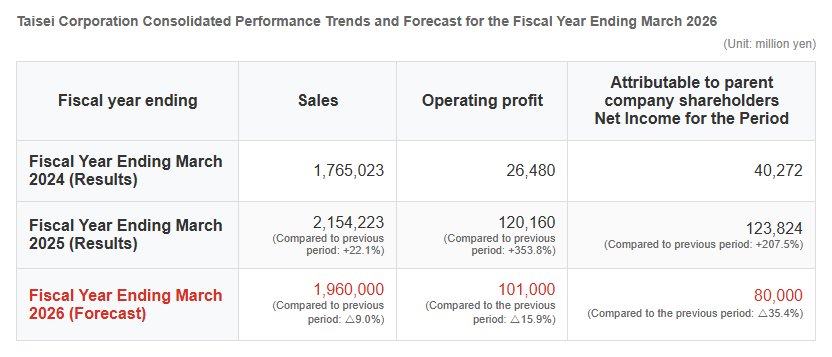
For Taisei Corporation to fully restore market confidence going forward, it is essential to steadily achieve the earnings forecasts it has disclosed. , Although we achieved significant profit growth in the fiscal year ending March 2025, our consolidated earnings forecast for the fiscal year ending March 2026 is expected to result in sales of 1.96 trillion yen (down 9.0% year-on-year) and net profit of 80 billion yen (down 35.4% year-on-year), reflecting a rebound from the strong performance of the previous fiscal year. Whether it can deliver results that exceed these conservative expectations will determine how analysts and investors evaluate it. , In particular, the multi-purpose building in Sapporo, where construction defects have occurred, is scheduled for completion at the end of June 2026, and completing this delayed project without accidents or defects is a testament to our technical capability and reliability. , Market analysts expect the company’s growth to accelerate, and predict that its revenue will improve at a pace exceeding the industry average after 2027. Furthermore, whether the allocation of management resources to high-demand sectors such as data centers, logistics facilities, and urban redevelopment will begin to contribute to revenue as planned will be a major focus going forward. Please refer to the diagram below.
Balancing Growth Investment and Shareholder Returns
Addressing labor shortages caused by the “2024 problem” facing the entire construction industry and the pressure to raise wages to secure workers are also important management challenges going forward. Taisei Corporation is strengthening its investment in human resources, including deciding to raise the starting salary for university graduates to 300,000 yen by March 2025. At the same time, we are accelerating efforts to improve on-site productivity through DX and robotics technologies, as well as strengthening research and development through the construction of next-generation technology laboratories. Furthermore, with an eye toward realizing a carbon-neutral society, we have made investments in floating offshore wind power and low-carbon technologies a pillar of our growth strategy. The record-high 300 billion yen loan facility serves as a powerful financial infrastructure to balance these medium- to long-term technological innovations with proactive shareholder returns in the current state. Whether the company can settle the “negative legacy” of scandals and achieve transformation into a new business model (such as expanding O&M business) backed by large-scale financial strength will be key to rebuilding its solid position as a super general contractor. Whether a management approach that sincerely faces capital costs and becomes profitable will determine future stock prices and corporate value. ,
[#大成建設 #ゼネコン #コミットメントライン #資産効率 #再開発 #信頼回復 #東洋建設 #建設業界]


コメント