API management giant Kong has announced Volcano, a new platform that comprehensively supports the development and operation of AI agents. This comes against the backdrop of challenges such as the increasing complexity of building distributed infrastructure and ensuring operational governance in production environments.
- Key Points and Background of the Event
- Traditional Infrastructure Challenges and Volcano’s Goals
- Robust execution environment and branchable database
- Authentication, hosting, and real-time synchronization features
- Strengthening Governance through Integration with Kong Konnect
- Future Developments and Key Focus Areas of Agent-Driven Development
Key Points and Background of the Event
Kong Inc. and Kong Japan have announced “Volcano,” an AI-native platform that integrates the infrastructure required for the development, deployment, and operation of AI agents and modern web applications into a single solution. This announcement was made in conjunction with Kong’s annual event, the “API + AI Summit.”
Traditionally, operating AI agents in a production environment required preparing a wide variety of components beyond simple LLM calls, including computing environments, databases, authentication infrastructure, storage, and access control. Developers had to combine multiple service providers, which significantly complicated configuration, billing structures, and troubleshooting when issues occurred. Volcano adopts a “batteries-included” approach that integrates these elements into a single foundation, providing an environment where developers can focus on creating next-generation AI experiences without being burdened by infrastructure building.
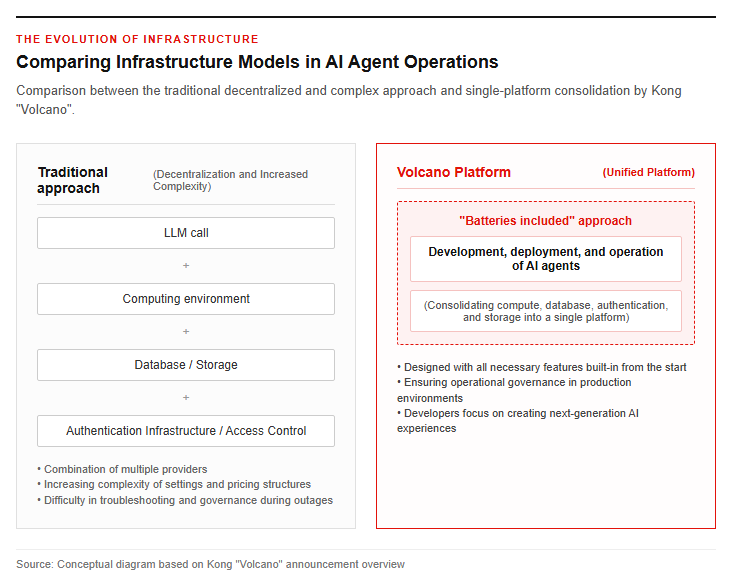
This platform supports advanced integration with cutting-edge AI coding tools such as Claude Code, OpenAI Codex, and Cursor, making it possible to complete everything from agent creation to production deployment with just a single prompt.
Traditional Infrastructure Challenges and Volcano’s Goals
The adoption of generative AI in enterprises is rapidly shifting from simple chatbots that answer questions to autonomous AI agents that automatically execute multiple tasks. However, when autonomous agents operate in production environments, they require long-running session execution and complex state management, which differ from short-term request processing. Because autonomous agents suddenly generate massive amounts of API calls and database queries, traditional API gateways and network infrastructure have faced increased loads and security threats. Specifically, operational risks such as fragmented access control policies across different providers, sudden surges in costs associated with token consumption, and data loss due to crashes mid-process have become severe challenges. Designed as a completely new integrated platform distinct from the “VolcanoSDK” provided as an open-source SDK in 2025, Volcano standardizes the foundational architecture for agent execution. By concealing infrastructure complexity, its aim is to significantly reduce the development delays and security risks faced by enterprise companies.
Volcano’s Architecture and Key Features
Robust execution environment and branchable database
One of the core technological components of Volcano is “Durable Workflows and Jobs,” which is designed for long-running processes. It is equipped with a mechanism that automatically saves checkpoints at each step of the processing, so even if a system failure or waiting state occurs during execution, the process can safely resume from the last completed step without having to start over from the beginning. A single workflow execution can be maintained for up to 366 days, and it supports Node.js (versions 22 and 24) and Python (versions 3.13 and 3.14) as handler languages. In addition, it features the “Branchable PostgreSQL Databases” capability, which allows you to duplicate copy-on-write database branches in a matter of seconds with PostgreSQL 16 as the standard.
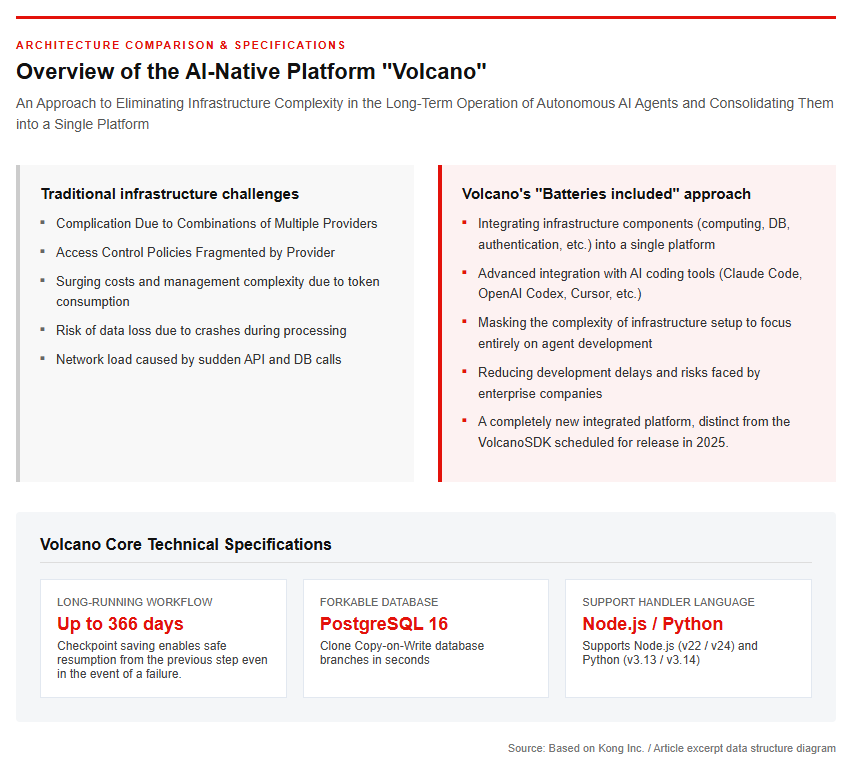
This enables safe verification under a connection string that isolates the production environment’s data structures and row data. Additionally, it comes standard with the pgvector extension, powerfully supporting high-speed searches of vector embedding data and the construction of AI-oriented data infrastructure.
Authentication, hosting, and real-time synchronization features
Volcano provides a comprehensive range of peripheral features necessary for development. “Edge Functions” enables edge code execution equipped with auto-scaling and geofencing capabilities across eight regions worldwide. The “Frontend Hosting” feature securely deploys Next.js applications via a global CDN, featuring automatic protection against DDoS attacks and a fail-safe architecture that prevents failed builds from affecting the existing production environment. For authentication, it provides “Authentication and SSO as a Service,” which can be used without limits on the number of users or monthly active users. It standardizes support for third-party SSO integrations such as Google, GitHub, Microsoft, and Apple, as well as anonymous sign-up. In addition, “Real-time Services” enables real-time detection of database events, message delivery, and presence tracking, smoothly coordinating collaborative work by multiple AI agents. It also allows for the integration of “Global File Storage” where SQL-format access control policies can be set, as well as distributed locks, queues, and human-in-the-loop approval steps.
Application to Enterprise Systems and Future Prospects
Strengthening Governance through Integration with Kong Konnect
Volcano is not limited to a standalone development platform, but also features high compatibility with “Kong Konnect,” Kong’s comprehensive cloud platform. When large enterprises deploy large-scale AI agent networks, maintaining unified security policies and governance becomes a top priority. By integrating with Kong Konnect, users can utilize “Token Vault” for token management in inter-agent communications, “Context Mesh” for automatic discovery of backend services, and cost visualization features that track model context window usage and API token consumption in real time. Partner companies, including Hitachi, Ltd., are also advancing the provision of AI agent integration solutions utilizing Kong products. This enables integration with existing authorization servers (such as Keycloak) to prevent users and agents from holding excessive permissions, building a secure communication infrastructure compliant with the OAuth 2.1 standard. By centrally applying CORS control, prompt guards, and automatic sanitization of personally identifiable information (PII) at the gateway layer, secure enterprise AI utilization is achieved.
Future Developments and Key Focus Areas of Agent-Driven Development
With the explosive proliferation of AI agents, the focus of enterprise IT infrastructure is shifting from traditional API management to the governance of inter-agent communication and distributed processing. Kong plans to continue gradually advancing Volcano’s feature enhancements across the computing, data infrastructure, application services, and agent infrastructure domains. Computing capabilities for sandboxes are also expected to be rolled out sequentially. The emergence of an integrated platform that unifies distributed databases, edge computing, and durable workflows—rather than being a mere LLM wrapper—has the potential to drastically transform the future of software development. In an era where autonomous agents automatically execute business processes, the importance of infrastructure foundations that balance reduced development costs with advanced security governance is ever-increasing. Future developments will be closely watched to see whether the AI-native integrated approach presented by Volcano establishes itself as a new industry standard in enterprise AI development.
Reference Page
- [Volcano Official Platform] https://www.volcano.dev
- [Volcano SDK GitHub Repository] https://github.com/kong/volcano-sdk
- [Kong Official Press Release] https://konghq.com/company/press-room/press-release/kong-announces-volcano-agentic-infrastructure-for-the-ai-era
【#Kong #Volcano #AIAgents #AIGateway #DeveloperTools #CloudInfrastructure #MCP】

コメント