On November 17, 2026, Microsoft announced its developer-focused AI models, “MAI Code 2” and “MAI Code 2 Flash.” Amid growing challenges regarding surging corporate token costs, the models aim to provide programming capabilities comparable to expensive top-tier models at a fraction of the traditional cost.
- Background of the Announcement and Key Points of the “MAI Code 2” Series
- Division of Roles Between the Two Models According to Development Tasks
- Performance Comparison with Competing Models on Major Benchmarks
- Estimation Structure of Token Unit Price and Cost per Task
- GitHub Copilot Integration and Enterprise Customization Examples
- Future Outlook and Guidelines for Problem Isolation in Development
Background of the Announcement and Key Points of the “MAI Code 2” Series
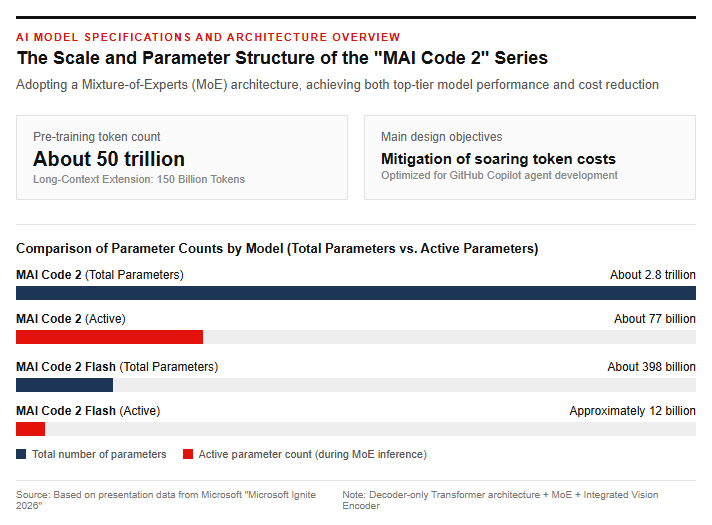
On November 17, 2026, at its annual event “Microsoft Ignite 2026,” Microsoft announced “MAI Code 2” and “MAI Code 2 Flash,” the new-generation programming models of its proprietary AI model family, “Microsoft AI (MAI).” Mustafa Suleyman, Head of AI who leads the development, revealed that many enterprise customers have voiced urgent concerns that “token costs associated with AI agents and development automation are skyrocketing,” emphasizing that a drastic overhaul of cost performance was the motivation behind this development. Regarding the internal structure of the models, they incorporate a Mixture-of-Experts (MoE) layer and an integrated vision encoder into a decoder-only transformer architecture. MAI Code 2 boasts a total parameter count of approximately 2.8 trillion (with about 77 billion active), while the lightweight version, MAI Code 2 Flash, boasts a total parameter count of approximately 398 billion (with about 12 billion active). Built through pre-training on approximately 50 trillion tokens and long-context extension of 150 billion tokens, they are optimized for agentic development workflows through GitHub Copilot. The vision for full-scale deployment in development environments is as shown in the figure below.
Division of Roles Between the Two Models According to Development Tasks
Microsoft adopts a design philosophy that clearly divides model roles according to the difficulty and frequency of development tasks. Their flagship model, MAI Code 2, excels at investigating deep bugs where causes are complexly intertwined across multiple files, performing refactoring that takes the entire repository into consideration, and implementing new features spanning multiple files. It is optimized with the goal of generating output of such quality that code maintainers reviewing it would want to merge the fixes as-is. On the other hand, the lightweight and fast model, MAI Code 2 Flash, is designed for high-frequency tasks that occur on a daily basis, such as explaining the meaning of code, making corrections limited to specific functions or conditional statements, and repeating routine fixes. The model card also lists explicit limitations, announcing that at the time of release, it is optimized for English code generation and is intentionally not tuned for foundational scientific research or long-term, fully autonomous agent tasks without human supervision.
Verification of Performance Metrics and Overwhelming Cost-Effectiveness
Performance Comparison with Competing Models on Major Benchmarks
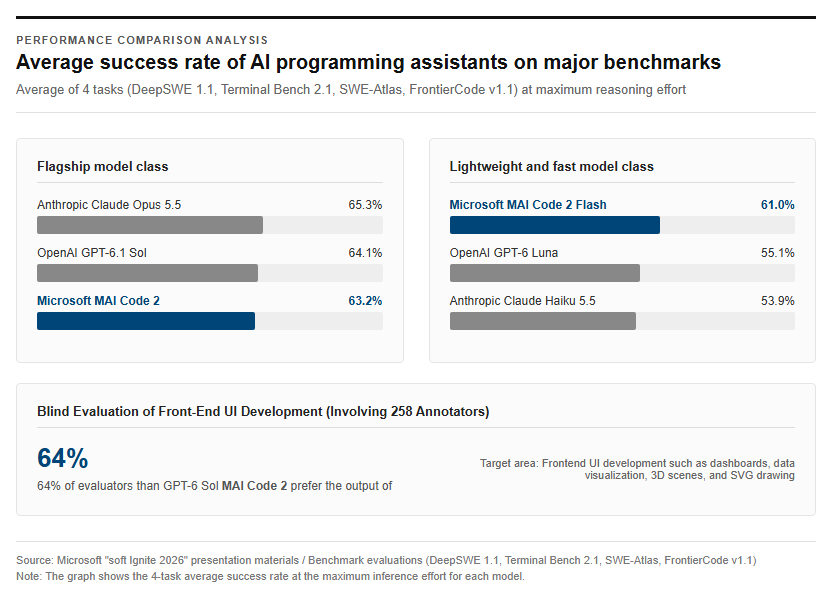
To objectively verify programming capabilities, Microsoft published evaluation results using major benchmarks (DeepSWE 1.1, Terminal Bench 2.1, SWE-Atlas, and FrontierCode v1.1). In terms of the average success rate across the four tasks at maximum inference effort, MAI Code 2 recorded 63.2%, demonstrating exceptionally high performance that rivals competitors such as OpenAI’s GPT-6.1 Sol (64.1%) and Anthropic’s Claude Opus 5.5 (65.3%). Furthermore, in a blind evaluation by 258 annotators targeting front-end UI development—such as dashboards, data visualization, 3D scenes, and SVG rendering—it was reported that 64% of the evaluators preferred MAI Code 2’s output over GPT-6 Sol. Additionally, the lightweight version, MAI Code 2 Flash, achieved an average success rate of 61.0%, recording superior results that surpassed same-class models like GPT-6 Luna (55.1%) and Claude Haiku 5.5 (53.9%). The performance comparison data for each benchmark is as follows.
Estimation Structure of Token Unit Price and Cost per Task
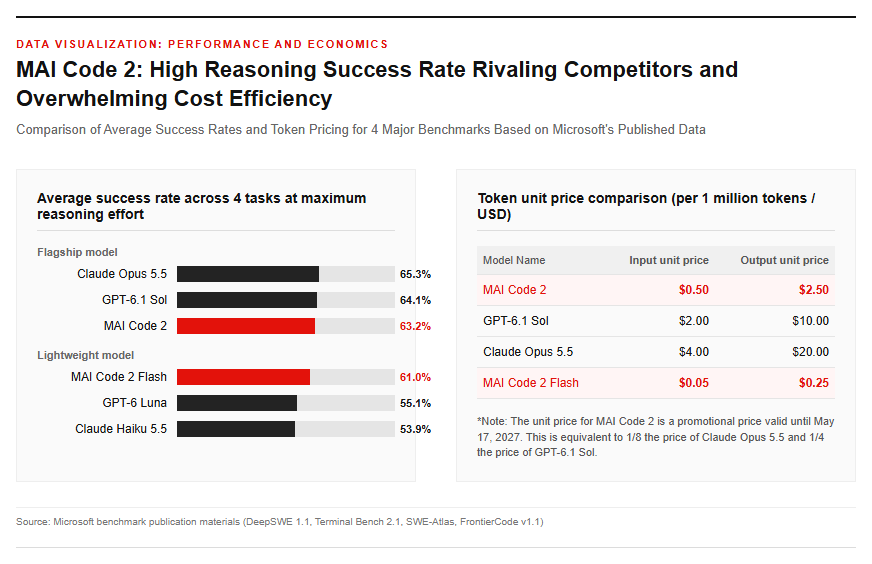
The biggest highlight of this announcement is its overwhelming cost-efficiency compared to competing models. Under the promotional pricing valid until May 17, 2027, the token pricing for MAI Code 2 is set at $0.50 per 1 million input tokens and $2.50 per 1 million output tokens. This corresponds to 12.5% (one-eighth) of Claude Opus 5.5 ($4.00 input / $20.00 output) and 25% (one-quarter) of GPT-6.1 Sol ($2.00 input / $10.00 output) in terms of token unit price. Furthermore, looking at the average cost per task—which takes into account token consumption efficiency until task completion—MAI Code 2 achieves exceptionally low processing costs of about 40% of GPT-6.1 Sol and about 5% of Claude Opus 5.5. As for MAI Code 2 Flash, with pricing set at $0.05 for input and $0.25 for output, it has successfully reduced task costs to about 20% of Haiku 5.5 and about 65% of Luna, dramatically driving down the costs associated with high-volume routine fixes.
Benefits of Enterprise Adoption and Future Operations & Key Points to Watch
GitHub Copilot Integration and Enterprise Customization Examples
Both models are generally available (GA) through GitHub Copilot starting on the day of the announcement, and can be selected from model pickers in major editors such as VS Code, Visual Studio, Copilot CLI, JetBrains, and Xcode. They support a vast context window of 1,050,000 tokens, and their reasoning effort levels can also be flexibly adjusted. In addition, MAI Licensed Weights will be provided, allowing enterprises to fine-tune the models to match their own repositories and development standards, and run them securely within the Azure environment. As an actual early adoption example, AT&T achieved higher accuracy than GPT-6.1 Sol in 5G network analysis at 1/50th of the cost. In automated driving development at Woven by Toyota, they successfully and automatically generated mergeable code at less than 1/10th of the cost in 44% of cases involving MISRA standard compliance where human intervention was previously required in the previous top-tier model. The operational image in an enterprise environment is as follows.
Future Outlook and Guidelines for Problem Isolation in Development
With the advent of MAI Code 2, the selection criteria for AI programming tools are shifting from a mere competition for peak performance to optimal deployment based on workload weight and the maximization of cost-effectiveness. As a realistic operational guideline for development organizations, a two-tiered hierarchical operation is recommended: routine tasks such as code explanation and small-scale bug fixes should first be assigned to MAI Code 2 Flash, while multi-file feature implementations and complex bug analyses should use MAI Code 2. On the other hand, for tasks involving fully autonomous agents that run for hours or core module modifications where the cost of rework in the event of failure is extremely high, continuing to use conventional models such as Claude Opus 5.5 or GPT-6.2 in combination remains the practical solution for the time being. Since promotional pricing is scheduled to end on May 17, 2027, and token unit prices are set to double, it is important to conduct cost estimations that factor in the standard pricing when formulating medium- to long-term development budget plans.
Reference Page
- 【GitHub Changelog】MAI Code 2 and MAI Code 2 Flash in GitHub Copilot https://github.blog/changelog/2026-11-17-mai-code-2-and-mai-code-2-flash-in-github-copilot/
- 【Microsoft AI Official Announcement】Seven new world class models at scalable price-performance https://microsoft.ai/news/microsoft-ignite-2026/
- 【Microsoft Official Blog】Ignite 2026: Building the frontier ecosystem https://blogs.microsoft.com/blog/2026/11/17/ignite-2026-building-the-frontier-ecosystem/
【#Microsoft #MAICode2 #GitHubCopilot #GenerativeAI #AICoding #Ignite2026 #DXPromotion】
コメント