Bank of Japan Governor Kazuo Ueda stated at the House of Councillors Committee on Financial Affairs that the bank intends to maintain its policy path toward interest rate hikes. This stance is driven by the aim to appropriately adjust the accommodative financial environment and achieve a balance between price stability and economic growth, as the underlying inflation rate approaches the 2% target.
- Reaffirmation of maintaining the interest rate hike path at the House of Councillors Committee on Financial Affairs
- Factors Behind Declining Personal Consumption and the Polarized Reality of Household Finances
- Burden on Corporate Earnings from Rising Borrowing Rates and Price Pass-Through
- Margin Expansion in the Financial Sector and Disparities in the Impact Across Industries
- Increase in Government Bond Interest Payments and the Risk of Reduced Fiscal Flexibility
- Future Focus and Key Points to Watch Toward Monetary Policy Normalization
Reaffirmation of maintaining the interest rate hike path at the House of Councillors Committee on Financial Affairs
On November 19, 2026, Bank of Japan Governor Kazuo Ueda attended the House of Councillors Committee on Financial Affairs and outlined the semi-annual report on monetary policy. Governor Ueda reiterated his stance that, against the backdrop of underlying inflation moving toward the 2% target, the Bank will continue to raise the policy rate and appropriately adjust the degree of monetary accommodation. At the Monetary Policy Meeting held in September 2026, the BOJ raised the target for the uncollateralized overnight call rate by 0.25 percentage points to around 1.25%. This is the highest interest rate level in approximately 31 years, since 1995. Governor Ueda explained that even after implementing gradual rate hikes, real interest rates remain in negative territory, and financial conditions are accommodative overall, sufficiently supporting economic activity. He also indicated that, regarding the future pace of rate hikes, rather than pre-setting a specific schedule, the Bank will make decisions by examining economic and price developments as well as risk factors at each Monetary Policy Meeting.
Factors Behind Declining Personal Consumption and the Polarized Reality of Household Finances
In the recent Diet deliberations, a focal point was that private consumption in the preliminary July–September gross domestic product (GDP) figures dropped 0.3% from the previous quarter, marking the second consecutive quarter of contraction. Governor Ueda stated that this decline was within the range of prior expectations, expressing the view that there is no change in the economy’s underlying recovery trajectory itself. However, at the same time, he showed a sense of caution regarding the uneven impact across different income types and age groups. Particularly among pensioners and elderly households, who struggle to benefit from wage hikes, a trend toward curbing consumption due to declining purchasing power driven by high prices has become conspicuous. Meanwhile, wage increases centered on the working-generation and rising deposit rates are acting as positive factors for household finances. As shown in the conceptual diagram below, a multifaceted analysis of structural changes in households and the market environment is required.
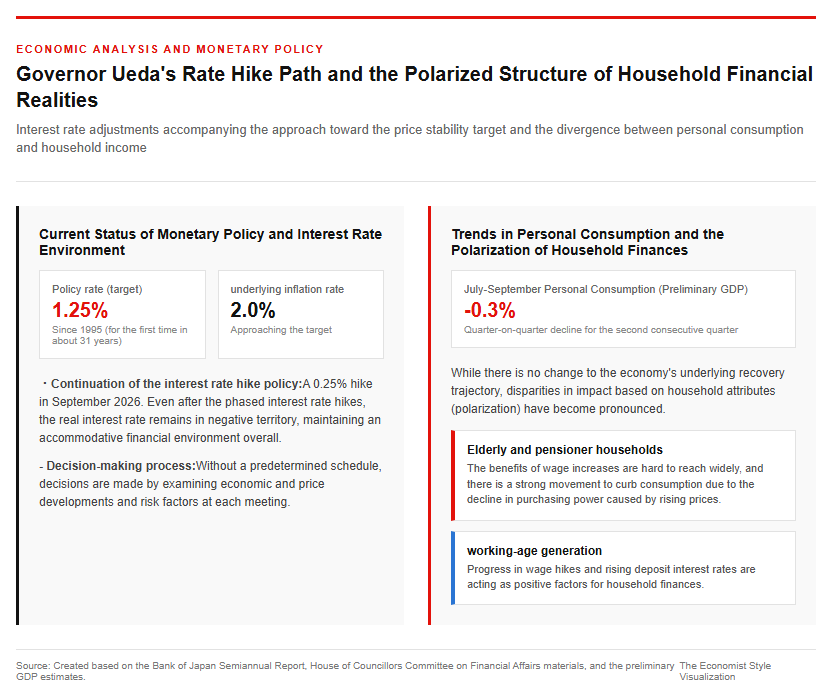
Additionally, regarding the planned consumption tax rate reduction on food and beverages scheduled for April 2026, while it is expected to have the effect of supporting households’ real purchasing power, a cautious approach has been indicated to carefully assess its impact on underlying price trends.
The Impact of Interest Rate Hikes on Financial Markets and Corporate Management
Burden on Corporate Earnings from Rising Borrowing Rates and Price Pass-Through
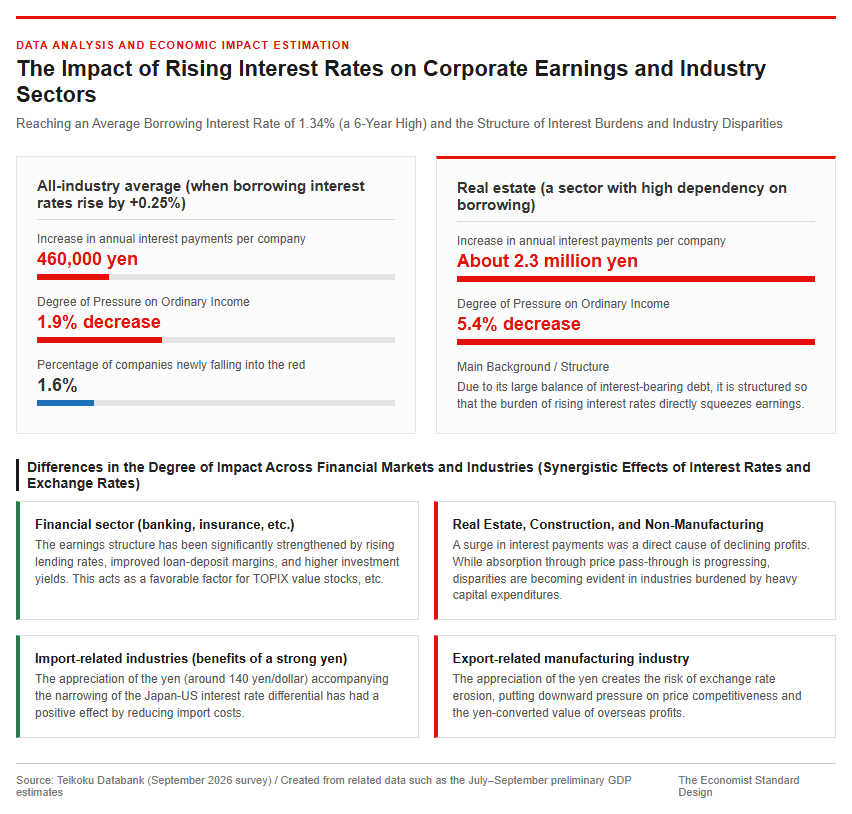
With the full-scale transition to a world of interest rates, the rise in corporate financing costs is becoming a reality. According to a survey conducted by Teikoku Databank in September 2026, the average corporate borrowing rate for fiscal 2025 reached 1.34%, hitting a six-year high. Estimates show that if borrowing rates were to rise by 0.25% from current levels, the average interest payment burden for Japanese companies would increase by 460,000 yen per company annually, dragging down ordinary profits by an average of 1.9%. Due to this increase in interest expenses, an additional 1.6% of companies risk falling into an ordinary loss. The impact varies significantly by industry: in the debt-dependent real estate sector, the burden is projected to increase by an average of about 2.3 million yen per company annually, compressing ordinary profits by 5.4%. Meanwhile, many companies are working to pass on increased costs to the prices of products and services, and a growing trend is emerging to absorb the burden of rising interest rates by improving profitability.
Margin Expansion in the Financial Sector and Disparities in the Impact Across Industries
In a rising interest rate environment, the disparity in benefits and disadvantages across sectors is becoming clear. Financial sectors such as banking and insurance are industries whose profit structures are significantly strengthened by rising lending rates, improved loan-deposit margins, and higher investment yields. In the stock market as well, the TOPIX Value Index has shown an upward trend, with financials and value stocks performing strongly. In contrast, for real estate and construction companies with large interest-bearing debt balances, or non-manufacturing industries in general with heavy capital expenditure burdens, a surge in interest payments is directly driving down profits. Furthermore, if the exchange rate swings toward a stronger yen—moving to around 140 yen/dollar due to the narrowing interest rate differential between Japan and the U.S.—export-related manufacturing industries will face the risk of diminished returns, while it will positively affect import-related industries, where lower import costs can be expected. As the chart below shows, the synergistic effects of interest rates and exchange rates shape the dynamics that influence the performance of each industry.
Fiscal Sustainability and Medium- to Long-Term Economic Outlook
Increase in Government Bond Interest Payments and the Risk of Reduced Fiscal Flexibility
The continuous interest rate hikes by the Bank of Japan also pose serious challenges to the Japanese government’s fiscal management. Japan holds the world’s largest public debt relative to GDP, and the increase in government bond interest payments accompanying rising interest rates will be the main driver of fiscal pressure. As the “interest rate bonus”—where long-term interest rates remained below the nominal economic growth rate during the era of unprecedented monetary easing—disappears, primary fiscal deficits are highly likely to directly translate into a rising debt-to-GDP ratio. The average remaining maturity of ordinary government bonds has extended to 9.4 years as of the end of fiscal 2023, meaning the impact of rising interest rates will manifest gradually over the next few years to a decade. According to estimates by think tanks and other organizations, if long-term interest rates rise to around 1.65%, net interest payments by the national and local governments will increase by a scale of 3 trillion yen year-on-year. As a result, much of the increase in tax revenue will be offset by interest payments, raising concerns that the government’s fiscal policy flexibility will be severely compromised.
Future Focus and Key Points to Watch Toward Monetary Policy Normalization
The primary focus in future monetary policy management is whether the virtuous cycle mechanism, in which wages and prices mutually influence each other while rising moderately, can be stably maintained. Governor Ueda has cited the momentum of wage increases leading up to the 2027 Shunto (spring labor-management wage negotiations) and the degree to which corporate pricing behavior has taken root as extremely crucial criteria for judgment. Furthermore, according to analyses by financial experts, there is a persistent view that, from the perspective of Japan’s fiscal structure and interest payment burdens, the upper limit of the policy interest rate (terminal rate) is likely to remain around 1.0% to 1.25%. This is because it has been pointed out that if the policy rate rises above 1.5%, there is a risk that fiscal leeway to respond to economic shocks would be lost. As for the Bank of Japan, it is required to steer carefully to avoid excessive economic cooling while closely examining external risks such as concerns over a global economic slowdown, sudden fluctuations in exchange rates, and the situation in the Middle East.
Reference Page
- [Bank of Japan] Report on Currency and Monetary Control (Semi-Annual Report)
- [Teikoku Databank, Ltd.] Survey on the Impact of the Bank of Japan’s Additional Rate Hike on Businesses (September 2026) https://www.tdb.co.jp/report/economic/20260918-riage26y9/
- 【Mizuho Research & Technologies】The Japanese Economy Stepping into a “World with Interest Rates”
- [UBS SuMi TRUST Wealth Management] How much of an interest rate hike can Japan’s public finances withstand?
- [Mitsubishi UFJ Asset Management] Special Report | Bank of Japan Raises Policy Interest Rate to 0.75%
[#KazuoUeda #BankofJapan #MonetaryPolicy #RateHike #PersonalConsumption #JapaneseEconomy]

コメント