
Saint Marc Holdings has announced the absorption merger of its wholly owned subsidiary, Saint Marc Cafe. This decision is driven by profit compression stemming from soaring raw material and labor costs, with the goal of promoting the integration of management resources and swift decision-making through a transition to a directly managed system.
- Decision on the Absorption Merger of a Wholly-Owned Subsidiary and the Legal and Organizational Framework
- Business Challenges Caused by Financial Performance Trends and Surging Costs
- The Trajectory of Responding to Store Network Contraction and Changes in the Market Environment
- Comparative Analysis of Directly Managed Multi-Store Models and Franchise Models
- Synergy Through a High-Value-Added Product Strategy and Multi-Brand Expansion
- Accelerating Decision-Making through Organizational Integration and Mid-to-Long-Term Growth Scenarios
Decision on the Absorption Merger of a Wholly-Owned Subsidiary and the Legal and Organizational Framework
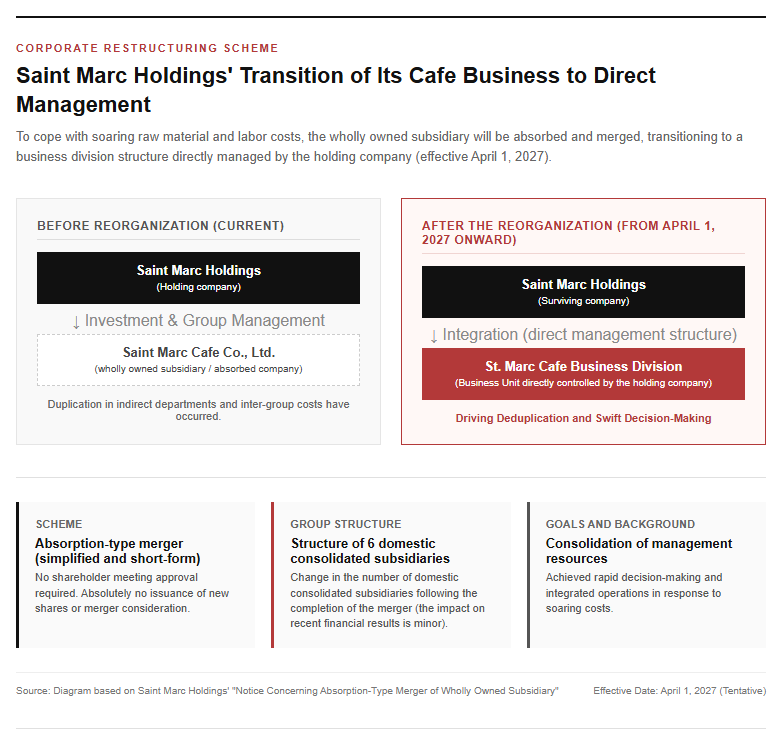
On November 18, 2026, St. Marc Holdings Co., Ltd. announced that it has decided to conduct an absorption-type merger of its wholly owned subsidiary, St. Marc Cafe Co., Ltd. This merger will be carried out with St. Marc Holdings as the surviving company, while St. Marc Cafe, as the disappearing company, will be dissolved. The effective date is scheduled for April 1, 2027. Regarding the procedures under the Companies Act, the surviving company will employ a simplified merger pursuant to Article 796, Paragraph 2 of the Companies Act, and the disappearing company will employ a short-form merger pursuant to Article 784, Paragraph 1 of the Companies Act. Consequently, both companies will execute the merger without going through the approval procedure by a general meeting of shareholders. Furthermore, because this is an absorption-type merger of a wholly owned subsidiary, no new shares will be issued, and no merger consideration will be paid.
The main points of this organizational restructuring are as follows.
- Organizational Restructuring: Transitioning to a direct divisional structure under the holding company as the Saint Marc Cafe Division.
- Changes in the number of subsidiaries: The number of domestic consolidated business subsidiaries will be organized into a six-company structure following the completion of the merger.
- Impact on consolidated financial results: Since this is an integration between consolidated subsidiaries, the impact on recent consolidated financial results is minor.
The goal is for the holding company to directly handle operations, thereby eliminating conventional inter-group costs and the duplication of indirect departments, while achieving the concentration of management resources and swift decision-making. Please refer to the structural diagram below.
Business Challenges Caused by Financial Performance Trends and Surging Costs
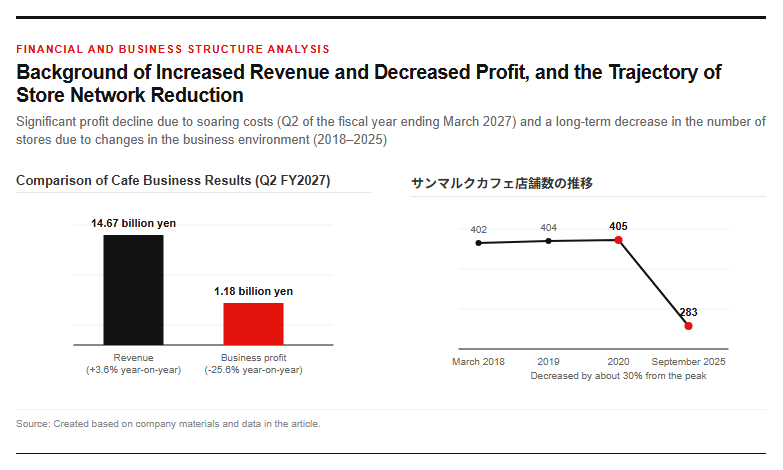
Behind this organizational restructuring at Saint Marc Cafe lies the severe cost inflation and profit compression surrounding the restaurant industry. Looking at Saint Marc Cafe’s coffee shop business performance in the second-quarter financial results for the fiscal year ending March 2027, net sales secured 14.671 billion yen, a 3.6% increase year-on-year. However, business profit suffered a significant decline, dropping 25.6% year-on-year to 1.176 billion yen. While a business profit margin of 8.0% is by no means a low level, the management team has determined that a swift turnaround is necessary in response to the rapid pace of profit decline.
The main cost factors weighing down profitability are the following items.
- Rise in raw material costs: The soaring procurement prices of key ingredients such as coffee beans and flour continue.
- Increase in store labor costs: There is a remarkable increase in labor cost burdens driven by hourly wage hikes due to hiring difficulties and efforts to resolve labor shortages.
- Burden of logistics and utility costs: Compounded by an increase in delivery and store maintenance costs associated with rising energy costs.
On a group-wide level, Sanmaru HD expects its full-year earnings forecast for the fiscal year ending March 2026 to show net sales of 81 billion yen (up 14.3% year-on-year) and operating profit of 4.5 billion yen (up 23.5% year-on-year). At the same time, it is forecasting a final net profit of 2 billion yen (down 21.3% year-on-year), resulting in a net profit decline. Because improvement efforts at store locations alone are no longer able to fully absorb cost pressures, the company is hastening structural reforms through a holdings-led transition to direct management.
Saint Marc Cafe’s Structural Challenges and Competitor Comparison
The Trajectory of Responding to Store Network Contraction and Changes in the Market Environment
St. Marc Cafe opened its first store in Ginza, Tokyo, in 1999 and achieved rapid growth, primarily around urban train stations, through the combination of its in-store-baked “Chokukuro” chocolate croissants and low-priced coffee. However, after reaching 402 stores in March 2018, its growth slowed, entering a period of stagnation with 404 stores in 2019 and 405 stores in 2020. Twenty years after the brand’s inception, a divergence from consumer trends had begun to emerge.
The main factors that brought about the contraction of store networks and environmental changes are as follows.
- Rise of competing products: Novel dessert beverages such as tapioca drinks rapidly gained popularity around urban train stations, triggering a competition for snack-time demand.
- Hit hard by the COVID-19 pandemic: A store network heavily weighted toward locations in front of urban train stations backfired, with customer foot traffic plummeting due to voluntary stay-at-home requests and the widespread adoption of remote work.
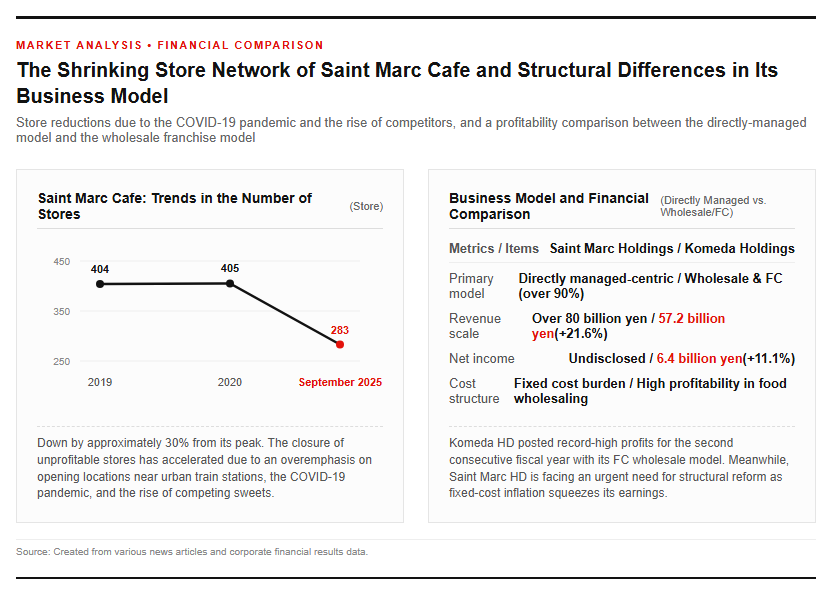
- Closure of unprofitable stores: The closure of stores, particularly those with low profitability, has progressed, and as of September 2025, the number of stores stood at 283, a decrease of about 30% from its peak.
Under these challenging conditions, there was a pressing need to break away from the conventional sole focus on low prices. Please refer to the figure below.
Comparative Analysis of Directly Managed Multi-Store Models and Franchise Models
To understand the differences in profit structures within the café and restaurant sector, comparing the business models of Saint Marc Holdings and Komeda Holdings offers profound insights. Saint Marc HD employs a business model centered on directly managed stores, operating multiple dining brands such as Saint Marc Cafe and Kamakura Pasta. Because store sales are directly reflected in the headquarters’ revenue, the scale of sales tends to be large; however, it bears the risk of shouldering all fixed store costs, such as rent and labor expenses, on its own.
The differences between the two companies’ business models and latest financials are as follows.
- Komeda Holdings’ wholesale franchise (FC) model: Over 90% of all stores are franchise locations, and the headquarters secures high profit margins by wholesaling ingredients such as bread and coffee manufactured in its own factories to the FC stores. In its full-year financial results for the fiscal year ending February 2026, it recorded revenue of 57.2 billion yen (a 21.6% increase year-on-year) and a net profit of 6.4 billion yen (an 11.1% increase), marking record-high profits for the second consecutive fiscal year.
- Saint Marc HD’s directly-operated model: Although it exceeds 80 billion yen in sales scale, inflation in store fixed costs directly squeezes earnings, resulting in a high break-even point structure.
For St. Marc HD, which primarily operates direct-managed stores, an urgent priority will be to streamline headquarters functions through organizational integration, thereby reducing store operating costs and driving operational efficiency.
V-Shape Recovery Strategy for Profitability Improvement and Future Outlook
Synergy Through a High-Value-Added Product Strategy and Multi-Brand Expansion
While streamlining unprofitable stores, Saint Marc Cafe is advancing a shift in its product strategy aimed at raising average transaction values and enhancing customer experience. In its “Rich”-themed seasonal lineup rolled out from April to July 2026, the chain offered items such as the Premium Rich Matcha Choco Cro—developed in collaboration with Kyoto’s long-established Japanese tea specialist Gion Tsujiri—and a 720-yen Rich Peach Smoothie that highlights the texture of white peach pulp. The company is shifting away from its roots as a budget cafe toward becoming a destination where customers can enjoy high-quality products and spend quality time in-store.
Additionally, the history of past organizational restructuring and M&A strategies across the entire Saint Marc Group is as follows.
- Integration of the Restaurant Business: In July 2022, three wholly owned subsidiaries—Saint Marc, Hakodate Ichiba, and Baqet—were absorbed through a merger, and the business model was restructured as the Restaurant Business Division.
- Integrating external brands: In October 2024, the company made G Holdings, which operates beef cutlet specialty restaurants such as “Kyoto Katsugyu,” a subsidiary, thereby promoting the development of new business formats and capturing inbound demand.
By bringing the cafe business under direct management, the sharing of intra-group logistics networks and store property information will be further accelerated, and the creation of cross-brand cost synergies is expected. Please refer to the structural diagram below.
Accelerating Decision-Making through Organizational Integration and Mid-to-Long-Term Growth Scenarios
Through the planned absorption merger scheduled for April 1, 2027, transitioning to a direct management structure under the holding company as the St. Marc Cafe Business Division will serve as a stepping stone for the future re-expansion of the store network. By eliminating the independent organizational hierarchy as a subsidiary, the speed of decision-making by management will dramatically increase, enabling swift store conversions and product rollouts tailored to market changes.
The main scenarios for medium-to-long-term re-growth can be summarized in the following points.
- Focused allocation of management resources: Centralizing overlapping administrative personnel and system assets into the holding company, and redirecting surplus resources toward store DX and strengthening on-site training.
- Re-expansion of the store network and transition to a net increase: Resuming new store openings from areas with improved profitability to chart a growth trajectory toward a sustainable increase in the number of stores.
- Operating Leverage in Action: As a strength of the directly managed model, once unprofitable stores are pruned and cost structure reforms are achieved, the business transforms into a structure where profits surge steeply alongside the expansion of sales.
San Marc Holdings aims to enhance the corporate value of the entire group through drastic reforms of its cafe business, while retaining its traditional strengths as a diversified restaurant chain.
Reference page
- [Saint Marc Holdings IR Disclosure Materials] [suspicious link removed]
【#SaintMarcHoldings #SaintMarcCafe #AbsorptionMerger #RestaurantIndustry #BusinessStrategy #OrganizationalRestructuring #VShapedRecovery】

コメント