Nidec announced that it will not be able to obtain an “unqualified opinion” from its auditing firm for its securities report for the fiscal year ending March 2026 within October 2026. The background to this includes the time required for additional investigations into executives involved in accounting irregularities and the tightening of Tokyo Stock Exchange reviews for stocks under special attention.
- Key Points of the Event: Abandoning the acquisition of an unqualified opinion and the shock of an announcement within the month
- Additional Investigation Requested by the Audit Firm and the Hurdle of Executive Suitability
- Nagamoriism’s Excessive Pressure and Over 1,000 Cases of Improper Accounting
- Responsibility of Successive Management Teams and a ¥27.6 Billion Claim for Damages
- The Review Structure and Delisting Risks for Securities Under Supervision
- Future Outlook and Key Points: The Reconstruction Process and Market Evaluation
Key Points of the Event: Abandoning the acquisition of an unqualified opinion and the shock of an announcement within the month
On October 28, 2026, major motor manufacturer Nidec announced that it would not be able to obtain an “unqualified opinion” (adverse/unqualified audit opinion) from its accounting auditor, PwC Japan LLC, regarding its securities report for the fiscal year ending March 2026 within the month of October 2026. On October 28, 2025, the company was designated as a “Securities Under Supervision (Improvement Required)” by the Tokyo Stock Exchange due to the need to improve its internal management system. It had been proceeding with investigations aiming to submit a corrected securities report accompanied by an unqualified opinion by October 28, 2026, which marks one year since the designation. However, the additional investigations requested by the audit firm could not be completed in time, resulting in the submission of an internal management system confirmation document to the TSE on October 30, 2026, without resolving the disclaimer of opinion status. This “disclaimer of opinion” by PwC Japan marks the third consecutive time following the securities report and semi-annual report for the fiscal year ended March 2025, sending a strong shock through the market. The figure below shows the timeline regarding stock price fluctuations and listing reviews following major announcements.
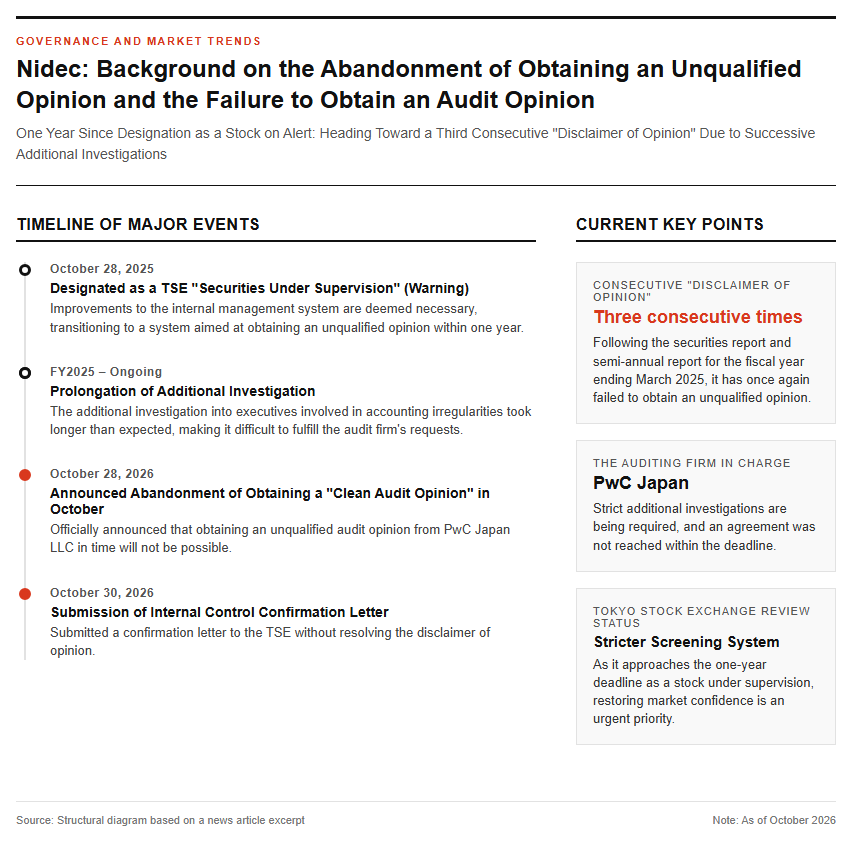
Following this announcement, awareness of delisting risks grew in the stock market, and in the afternoon session of the Tokyo Stock Exchange on October 28, 2026, Nidec’s shares plummeted by 402 yen (17.1 percent) from the previous day to 1,953 yen, marking the largest percentage decline on the Prime Market of the Tokyo Stock Exchange.
Additional Investigation Requested by the Audit Firm and the Hurdle of Executive Suitability
The primary factor behind the delay in obtaining an unqualified audit opinion was the demand by the audit firm for extensive additional investigations regarding the treatment of executives involved in accounting irregularities and the verification of audit evidence. PwC Japan raised concerns that executives who had been involved in past accounting irregularities remained in the same responsible positions as before, and that the probative value of the confirmation documents was insufficient. In response, although Nidec proceeded with large-scale personnel reassignments, from mid-October 2026 onward, it was additionally requested to conduct review investigations, such as checking email records, targeting 132 officers and employees who would newly sign financial closing-related documents. At a press conference held on October 28, 2026, Masataka Kubota, Representative Executive Officer of PwC Japan, emphasized that it is essential to verify the integrity and reliability of the individuals signing the management representation letter. Nidec President Motoo Kaida indicated his stance to complete the investigation work for the 132 individuals during November 2026 and do his utmost to obtain an audit opinion at the earliest possible date. However, the timing for the completion of the audit procedures remains undecided, and uncertainty continues to linger.
The Background of Accounting Irregularities and the Collapse of Corporate Governance
Nagamoriism’s Excessive Pressure and Over 1,000 Cases of Improper Accounting
Behind the accounting irregularities that had become routine at Nidec for many years lay the absolute concentration of power in the hands of founder Shigenobu Nagamori and excessive pressure to achieve performance targets. The investigation report by the third-party committee confirmed that inappropriate accounting practices exceeding 1,000 cases—such as the underreporting of cost of sales and the recording of fictitious sales—were systematically carried out across multiple business divisions. The management style symbolized by the slogan “Do it now, do it without fail, do it until it’s done,” which drove the company’s rapid growth, transformed into intense pressure as the enterprise expanded. Driven by severe reprimands for failing to meet targets and fear regarding personnel and compensation authority, a distorted structure took root in which frontline staff and managers were unable to report bad news and instead manipulated figures to gloss things over. As a result, corporate governance and internal audit functions became completely hollowed out, leading to a situation where an institutionalized culture of concealment was left unchecked for a prolonged period.
Responsibility of Successive Management Teams and a ¥27.6 Billion Claim for Damages
On October 20, 2026, Nidec released an investigation report by the Executive Responsibility Investigation Committee, holding five successive presidents—including Shigenobu Nagamori and former President Mitsuya Kishida—liable for their duties. According to the report, in prioritizing the achievement of operating profit targets, necessary loss processing and the recording of allowances had been postponed for many years. In particular, for the fiscal year ended March 2025, although then-President Kishida and others proposed booking 49.2 billion yen in structural reform expenses, Nagamori strongly demanded achieving an operating profit of 240 billion yen, resulting in the postponement of most of the necessary provisions. Based on the Companies Act, Nidec has decided to seek a total of 27.6 billion yen in damages from nine former executives, including the successive presidents. The following figure illustrates the transition of the governance structure from the discovery of accounting irregularities to the damage claims and the rebuilding of internal controls.
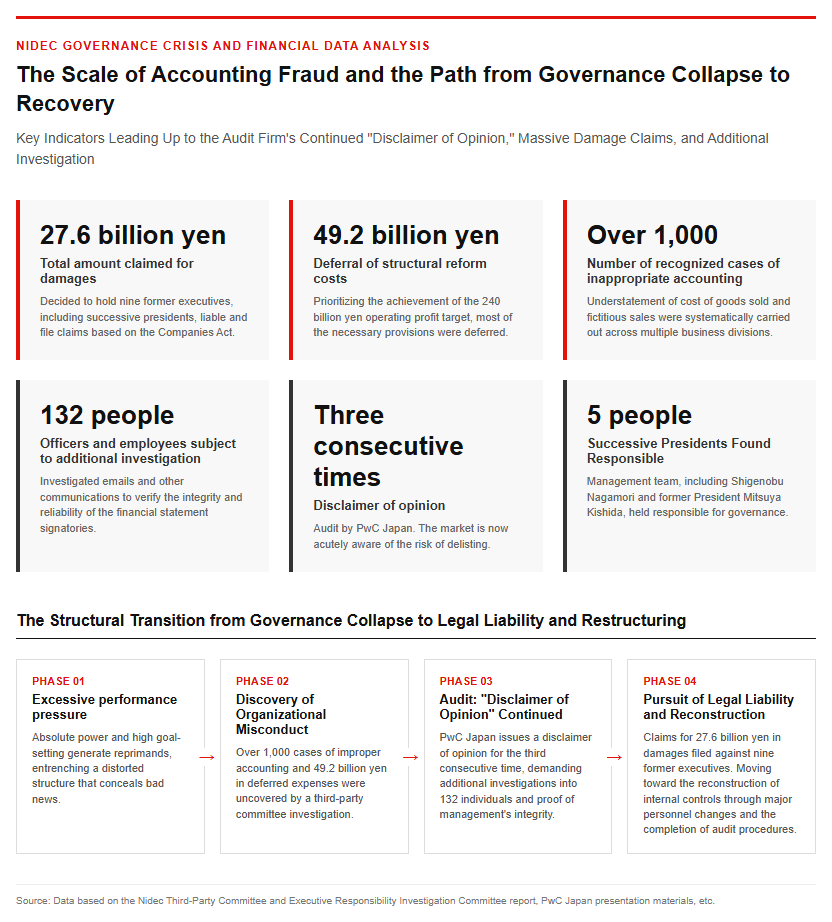
Furthermore, due to past revisions of financial statements, net assets as of the end of March 2025 decreased from 1.7436 trillion yen to 1.2667 trillion yen. In addition, an impairment loss of 632.1 billion yen will be recorded for the fiscal year ending March 2026, plunging the net profit/loss into a massive deficit of 564.6 billion yen.
Difficulty of Listing Maintenance Screening and Its Impact on the Stock Market and Business Performance
The Review Structure and Delisting Risks for Securities Under Supervision
The Tokyo Stock Exchange’s review for lifting the designation of securities on alert is handled by Japan Exchange Regulation, and typically takes about two to three months. During the review, a rigorous verification is conducted not only to check whether an internal control system to prevent fraud has been properly established, but also whether it is being operated with practical effectiveness. According to past TSE data, out of the 31 issues designated as securities on alert since 2019, 13 companies failed to show improvement and ended up delisted. Submitting a confirmation letter without obtaining an unqualified opinion from an auditing firm is highly unusual, and experts have pointed out that it is considered equivalent to a substantially adverse opinion and could serve as a trigger for delisting. If the TSE’s review determines that the establishment or operation of the system is insufficient, the company will be designated as a “security under supervision” with the risk of delisting, and if there is still no prospect of improvement, it will pass through the “security to be delisted” stage, awaiting a rigorous process that determines delisting.
Future Outlook and Key Points: The Reconstruction Process and Market Evaluation
For Nidec to maintain its listing and recover market trust, the future focus hinges on whether it can successfully complete the additional investigation of 132 individuals scheduled during November 2026 and obtain a clean audit opinion from the auditing firm. The company forecasts an operating profit of 200 billion yen for the fiscal year ending March 2027, and on the business front, it is advancing restructuring efforts to scale back low-profit automotive and home appliance businesses while concentrating management resources on strong areas such as energy and infrastructure, semiconductors, and machine tools. It is also seeking to shift from its conventional scale-expansion strategy to one emphasizing capital efficiency, as seen in the announced sale of its subsidiary, Nidec Components. However, cautious views remain regarding whether it can reform the long-cultivated “Nagamoriism” corporate culture under 70-year-old President Motoo Kajiuda and swiftly build an effective governance system. Along with the direction of the Tokyo Stock Exchange’s review, whether the new management team can maintain transparent corporate operations will be the primary point of focus moving forward.
Reference page
- 【Revision of Listing Rules for the Active Utilization of Securities on Alert, etc.】[suspicious link removed]
【#Nidec #AccountingFraud #SecuritiesUnderSupervision #ListingMaintenance #Governance】

コメント