David Noel N, a researcher and engineer, has released a fortune-telling app called “A Quantum Magic 8-Ball,” which uses his self-built quantum random number generator (QRNG). This project fuses advanced quantum physics principles with everyday fortune-telling toys, demonstrating new possibilities for the social implementation of quantum technology.
- David Noel N’s Challenge and Overview of the App
- The History of Magic 8 Balls and Its Impact on Pop Culture
- How the app operates and responds using quantum measurement
- Hardware configuration of a homemade quantum random number generator and photon behavior
- Data processing and statistical verification to improve the accuracy of random sequences
- Expanding Market Trends and Security for Quantum Random Number Generators (QRNG)
- The importance of science-based technology and the restructuring in 2026
David Noel N’s Challenge and Overview of the App
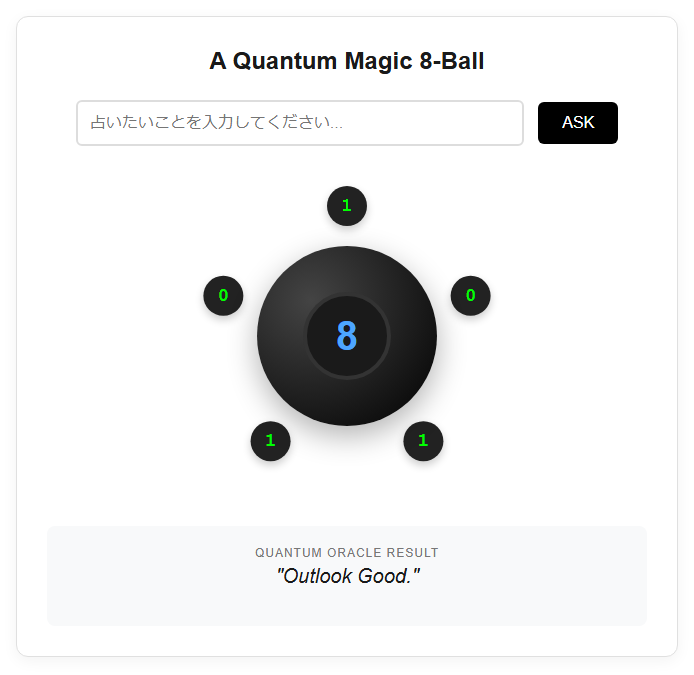
On June 29, 2026, researcher and engineer David Noel Ng announced a web application called “A Quantum Magic 8-Ball,” which uses a quantum random number generator he developed. This app works by allowing users to enter the information they want to divine and click “ASK.” Among five black spheres arranged around the central sphere, 0s and 1s flash, displaying answers based on quantum measurement results. Mr. Ng built a device that generates random numbers by exploiting the quantum mechanical uncertainty of which detector photons will reach, and integrated this technology into a web app. This device is named the “Universe Splitter” after the multi-world interpretation that the universe branches according to the results of quantum measurements. However, this is merely a theoretical expression with an awareness of the background, and does not actually branch off the physical universe. The diagram below is an image of the app’s operation screen.
The History of Magic 8 Balls and Its Impact on Pop Culture
The “Magic 8 Ball,” which inspired this app, is a historic fortune-telling toy invented in 1940s America by Albert C. Carter. Originally developed as a cylindrical fortune-telling device called the “Psycho Slate,” it quickly became popular in 1950 when a billiards maker in Chicago redesigned it as a promotional item in an 8-ball shape. Inside, 20-sided dice float, and when you shake the ball, 20 types of standard messages appear on the window, such as “It is certain” or “Very doubtful.” It has even appeared in the “Toy Story” film series and is cherished as a very popular pop culture symbol in America. Mr. N’s app continues this tradition, allowing players to randomly select one answer from 20 options.
How the app operates and responds using quantum measurement
The selection of fortune-telling results in “A Quantum Magic 8-Ball” is not based on analyzing the question content but purely through physical quantum random numbers. When a user inputs text into the input field and executes it, that operation triggers a processed random number from the device. Random numbers are generated in a 5-bit format consisting of 0 and 1, representing 32 different numbers from 0 to 31. Since Magic 8 Ball has 20 different answers, responses range from 0 to 19, and if a value of 20 or higher is obtained, the random number is read again, using a method called “rejection sampling.” This ensures that 20 different answers are selected with statistically equal probability. Mr. Ng also mentioned that, in the future, they are considering introducing mechanisms to answer more complex questions using natural language, beyond the current standard answers.
The physical foundation and technology supporting the “Universe Splitter”
Hardware configuration of a homemade quantum random number generator and photon behavior
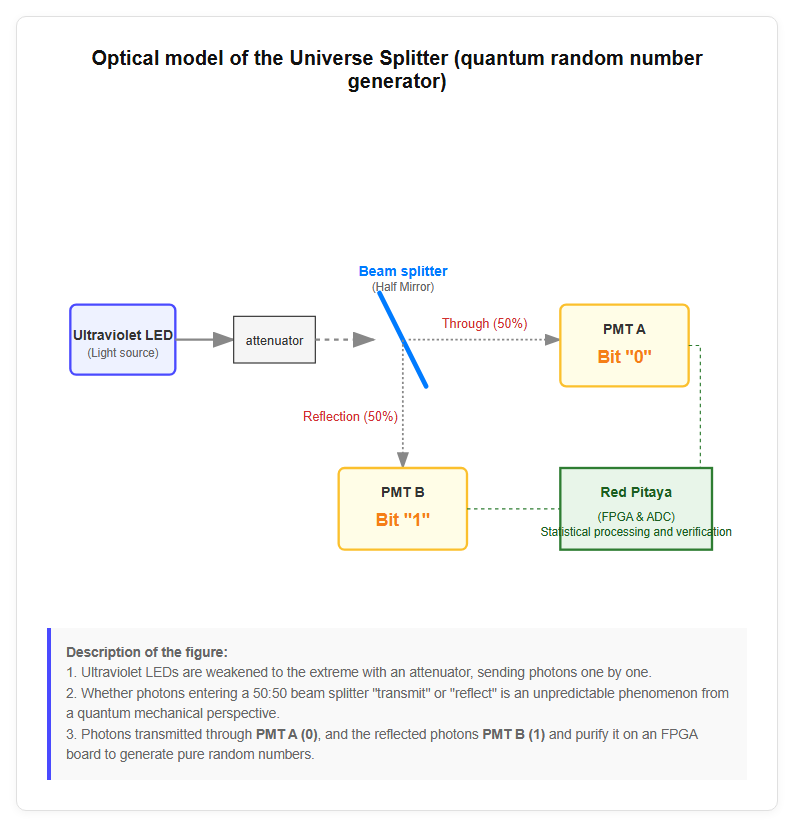
At the heart of the “Universe Splitter,” which generates random numbers, is the optical system that exploits the uncertainty of photon paths. Inside the device, the light emitted from the ultraviolet LED is sufficiently dimmed and irradiated onto a beam splitter (half mirror) with a 50:50 ratio. At this time, whether individual photons pass through or reflect through the mirror is quantum mechanically inherently random and unpredictable. The transmitted light reaches photomultiplier tube A (PMT), while the reflected light reaches PMT B; each is detected and recorded as a bit 0 or 1. Mr. N reused Hamamatsu Hotnics’ PMT taken from old equipment used for protein structural analysis to build his own unique optical system. It converts weak photon signals into electrical signals and processes them as digital data on a board called Red Pitaya, which is equipped with an FPGA. The diagram below simplifies the mechanism of this optical system.
Data processing and statistical verification to improve the accuracy of random sequences
Raw data output from physical devices can be biased due to differences in detector sensitivity or slight deviations in branch ratios. To address this, Mr. Ng applies multiple advanced algorithms. Specifically, it uses the von Neumann method to remove bit bias and the Peres method, which recursively utilizes information discarded during the process, and further suppresses correlation by compressing bit trains with a Toeplitz extractor. The generated random number sequences were verified using the statistical test suite of NIST (National Institute of Standards and Technology), and it was reported that no systematic issues were found even in tests targeting up to 1 billion bits. The final random number generation speed reaches about 2.28 kilobits per second, boasting enough performance to instantly determine answers for fortune-telling apps.
Social Implementation and Future Prospects of Quantum Technology
Expanding Market Trends and Security for Quantum Random Number Generators (QRNG)
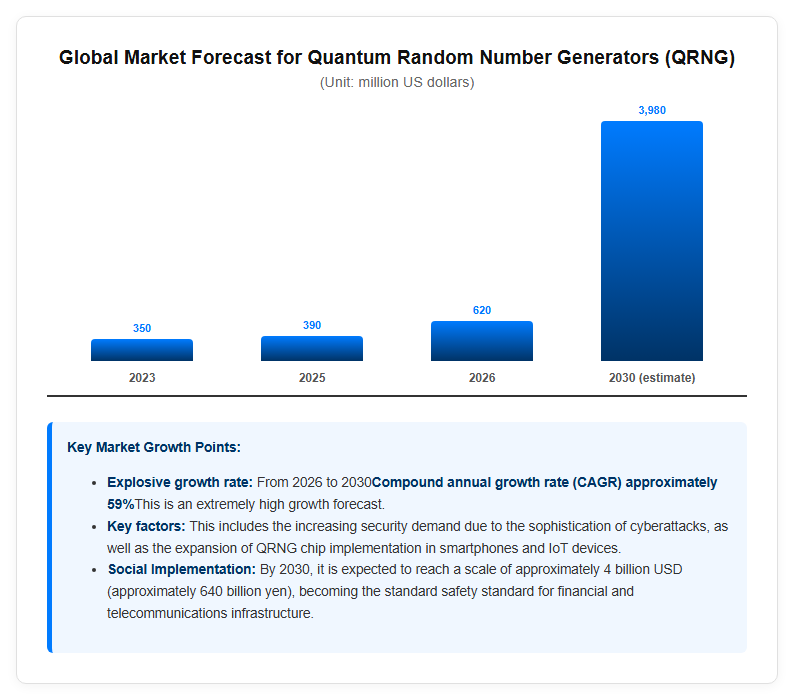
Quantum Random Number Generators (QRNG) have gone beyond simple fortune-telling apps and are attracting significant attention as next-generation security infrastructure. The QRNG market, valued at approximately USD 350 million in 2023, is projected to reach approximately USD 4 billion by 2036, with a compound annual growth rate (CAGR) expected to range from about 30% to nearly 60%. Implementation in smartphones and IoT devices is especially advanced, and it is expected to serve as a safer and more verifiable means of generating cryptographic keys to replace traditional pseudo-random number generators (TRNG). QRNGs have the advantage of being less affected by external attacks or biases caused by environmental changes because their randomness originates from a well-defined physical model. As the frequency of cyberattacks increases, protecting data through truly unpredictable random numbers is a critical key to safeguarding financial and telecommunications infrastructure. The chart below shows the growth forecast for the QRNG market.
The importance of science-based technology and the restructuring in 2026
The year 2026 is said to be a year of restructuring as quantum technology surpasses the “disillusionment period,” with practical benefits and research becoming separated. While the excessive expectations for quantum computers, which have long been described as a “magic wand,” are converging, there is a growing focus on technologies that deliver practical benefits for specific applications, such as QRNGs. On the other hand, it is also true that spiritual scams that abuse the term quantum mechanics and products without scientific basis coexist in the market. Mr. N’s project underwent scientific verification such as NIST’s statistical tests, setting it apart from such fake science. Furthermore, governance and competition at the national level are intensifying, with an executive order signed in the United States in June 2026 accelerating the development of quantum technology. Against this backdrop, the fact that individual engineers have brought quantum technology into a familiar form through a transparent scientific approach holds great significance in promoting the democratization and correct understanding of technology.
[#量子力学 #量子乱数生成器 #マジック8ボール #テクノロジー #サイバーセキュリティ #QRNG #物理学]


コメント