
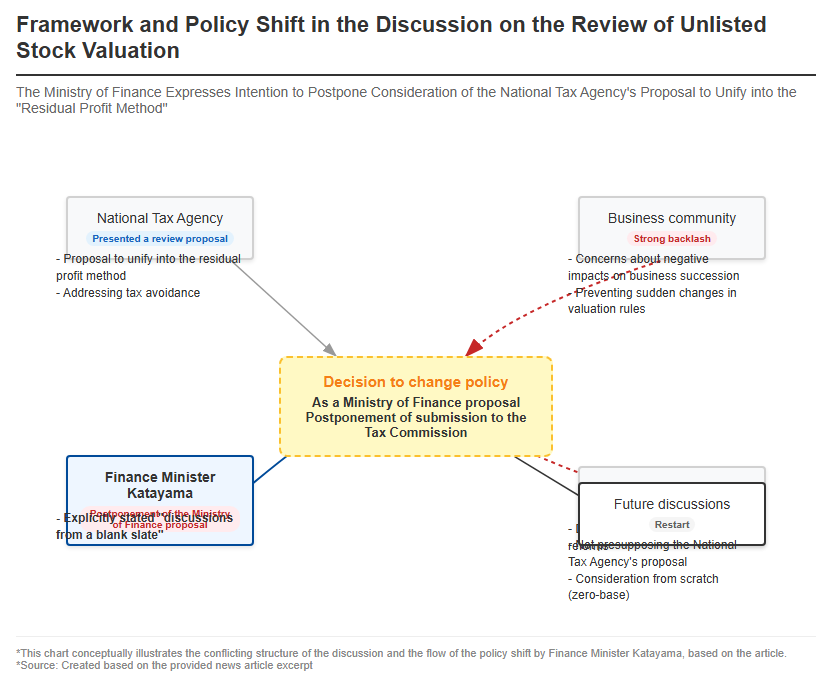
Finance Minister Katayama stated clearly that she has no intention of presenting the proposal for revising the valuation of unlisted stocks to the ruling party’s Tax Commission as a Ministry of Finance proposal. This decision is driven by strong backlash from the business community and the ruling party against the National Tax Agency’s revision proposal, as well as concerns about the negative impact on business successions.
- Key point of the event: Finance Minister Katayama’s announcement of “dropping the Ministry of Finance proposal”
- Growing backlash against the National Tax Agency’s “residual profit method” proposal
- Major reform proposals after about 60 years and concerns over soaring valuations
- Successive concerns and emergency resolutions by METI, business organizations, and the Liberal Democratic Party
- The background of how leadership shifted to the ruling party’s Tax Commission and the context of the political decision
- Future Outlook and Key Points: Practical Measures Management Should Take
Key point of the event: Finance Minister Katayama’s announcement of “dropping the Ministry of Finance proposal”
At press conferences on November 19 and 20, 2026, Minister of Finance and Minister of State for Special Missions Katayama clearly stated that the proposal to review inheritance tax valuations for unlisted stocks (stocks without quoted market prices), which had been considered by the National Tax Agency, “will not be submitted as a Ministry of Finance proposal,” and revealed the policy of forgoing its submission to the ruling party’s Tax Commission. Since the National Tax Agency established the “Expert Committee on the Valuation of Stocks without Quoted Market Prices” in April 2026, fundamental revisions to the valuation rules—the first in about 60 years—had been underway, but the Minister’s announcement effectively halted discussions and cemented a shift in policy. Explaining that the expert committee was not a statutory council and had not determined any definitive conclusion, Finance Minister Katayama stated that future discussions will not be based on the National Tax Agency’s revision proposal, but will instead start from a clean slate at the ruling party’s Tax Commission. Although concerns raised by the Board of Audit regarding valuation discrepancies and issues with certain tax avoidance schemes remain, the National Tax Agency-led proposal to consolidate into the residual profit method has been completely removed from the predetermined course. The following figure illustrates the framework of the revision discussions.
Growing backlash against the National Tax Agency’s “residual profit method” proposal
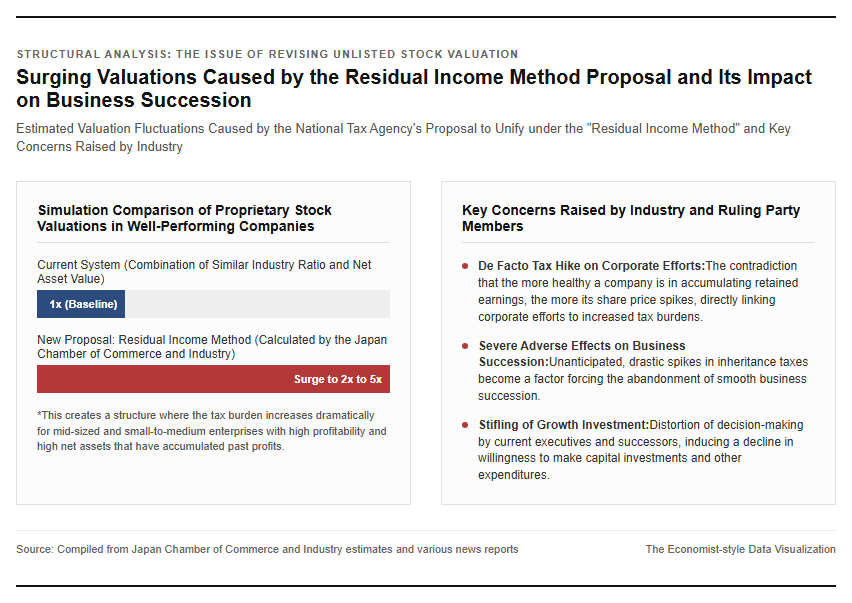
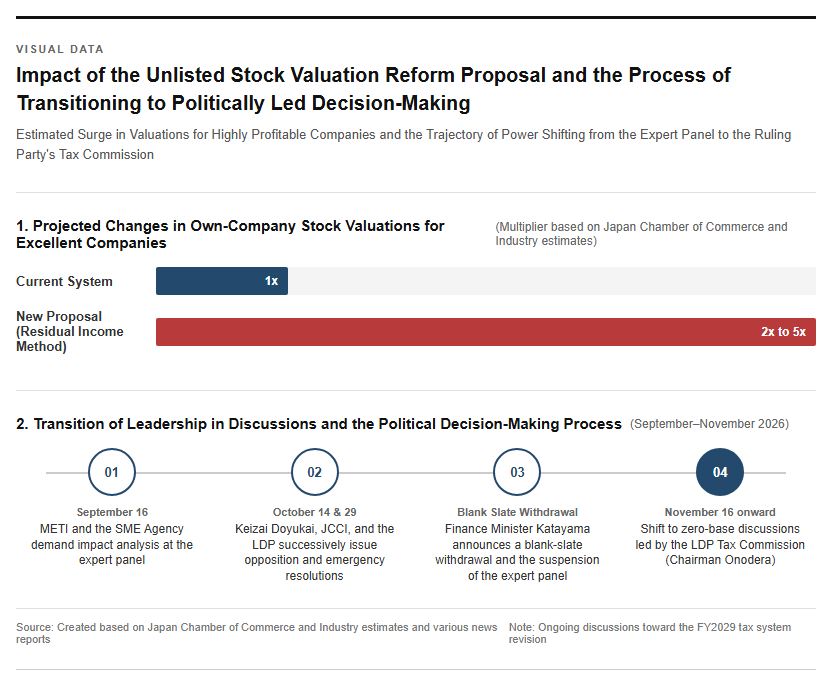
The background behind the widespread controversy surrounding this revision discussion is the National Tax Agency’s proposal, presented at the expert committee meetings in August and September 2026, to consolidate the valuation system into the “residual profit method.” Under the current system, the “comparable industry similarity method” and the “net asset value method” are used in combination depending on the size of the company. However, the new proposal eliminated company size classifications and presented a calculation model that adds excess earnings (residual profits) over the past five years to the book-value net assets at the end of the immediately preceding period. Nevertheless, according to calculations by the Japan Chamber of Commerce and Industry, it became clear that for high-profit, high-net-asset companies that have accumulated past earnings, the evaluated value of their own shares could surge from two to five times the current level. Outcries of concern erupted from the industrial sector, warning that a drastic and unexpected increase in the tax burden would severely distort the decision-making of current management and successors, and impede smooth business succession and growth investments such as capital expenditure for mid-sized and small-to-medium enterprises.
Valuation reform discussions after about 60 years and industry backlash
Major reform proposals after about 60 years and concerns over soaring valuations
The current valuation rules for unlisted stocks have been in operation for over 60 years since their introduction in 1964 (Showa 39). However, the Board of Audit pointed out in its fiscal 2023 settlement audit report that the median value of comparable industry similarity prices remained at only 27.2% of the median value of net asset values, and that for large companies, the ratio of declared valuation amounts to net asset values was 0.32 times, creating significant discrepancies between company sizes. In addition, issues such as asset transfers utilizing the group corporate tax system, the use of non-voting shares, and the prevalence of valuation compression schemes through temporary loss-making were also highlighted. In response, the National Tax Agency initiated a review aimed at tax fairness, but under the presented residual profit method, the more profits a sound company generated and the more retained earnings it accumulated, the higher its share price would jump. As a result, this led to criticisms that corporate efforts would directly translate into an increased tax burden, potentially dampening rather than encouraging management motivation. The following figure shows the discrepancies caused by different valuation methods.
Successive concerns and emergency resolutions by METI, business organizations, and the Liberal Democratic Party
As the details of the National Tax Agency’s calculations became clear, opposition movements from ministries, business organizations, and the political world rapidly intensified. At the 6th expert committee meeting on September 16, 2026, the Ministry of Economy, Trade and Industry and the Small and Medium Enterprise Agency submitted a written opinion stating, “The impact of valuation fluctuations on business succession should be carefully analyzed, and the revisions must not run counter to the national growth policy.” Subsequently, the Japan Association of Corporate Executives (Keizai Doyukai) also published an opinion on October 14 calling for comprehensive discussions, and the Japan Chamber of Commerce and Industry clearly expressed its strong opposition to the revision proposal. Furthermore, the Liberal Democratic Party’s Japan Growth Strategy Headquarters compiled an emergency resolution on October 29, declaring that “the National Tax Agency’s revision proposal is inconsistent with the growth-oriented stance of the government and the ruling party and cannot be accepted.” These coordinated efforts were decisive factors leading Finance Minister Katayama to announce a withdrawal of the proposal.
Transition to political leadership and future business succession practices
The background of how leadership shifted to the ruling party’s Tax Commission and the context of the political decision
With the de facto suspension of the expert panel led by the Ministry of Finance and the National Tax Agency, the initiative in institutional discussions has shifted to political leadership by the ruling party’s Tax Research Commission, centered on the LDP Tax Research Commission (chaired by Itsunori Onodera). The LDP Tax Research Commission began its work on November 16, 2026, and Chairman Onodera stated that the National Tax Agency’s proposal would not be treated as a prerequisite for consideration, but rather that discussions would take place “from a blank slate.” Additionally, the Japan Innovation Party submitted proposals to Finance Minister Katayama on November 19, calling for a careful, zero-base review—including whether the revision is even appropriate—and requesting that a conclusion be reached over a period of approximately three years, by the FY2029 tax reform. The political intervention was driven by a strong sense of crisis regarding the damage that strengthened taxation, which ignores the realities on the ground such as regional employment and small and medium-sized enterprise business succession, would inflict on local economies. Moving toward the year-end tax reform outline, the political focal point will be how to harmonize tax fairness with the stability of business succession. The diagram below illustrates the politically-led discussion process.
Future Outlook and Key Points: Practical Measures Management Should Take
The key point to keep in mind regarding future developments and points of attention is that the return of the National Tax Agency’s proposal to a blank slate does not mean the issues surrounding the valuation review have disappeared. Issues pointed out by the Board of Audit and responses to valuation-reduction schemes still remain, and there is a strong possibility they will be re-discussed in a different form a few years from now. Meanwhile, the “special measures for the corporate-version business succession tax system,” which reach their application deadline on December 31, 2027 (with the deadline for submitting the special succession plan being September 30, 2027), are proceeding completely independently of the discussions on revising share valuations. Rather than panicking excessively over the direction of valuation rules, management must first accurately grasp the valuation of their company’s shares based on the current Basic Directive on Property Valuation. Building on that, they are strongly urged to steadily advance practical measures that can be taken now, such as utilizing special measures, considering the gift tax-inheritance tax integration system (settlement at the time of inheritance), and executing early share transfers.
Reference Pages
- [Summary of Post-Cabinet Press Conference by Minister of Finance and Minister of State for Special Missions Katayama (November 20, 2026)] https://www.mof.go.jp/public_relations/conference/my20261120.html
- [Opinions on the Valuation Review of “Shares Without Quoted Prices” – Keizai Doyukai (Japan Association of Corporate Executives)] https://www.doyukai.or.jp/policyproposals/2026/261014.html
[#UnlistedShares #BusinessSuccession #MinisterOfFinanceKatayama #InheritanceTaxValuation #TaxReform]

コメント