A research team from Google DeepMind and Google Quantum AI has autonomously discovered highly efficient quantum algorithms with mathematically guaranteed correctness using the Lean theorem prover. This is driven by the fact that massive quantum circuits on the scale of thousands of logical qubits exceed both classical supercomputer calculation verification and modern real-device operation, making a framework for formally verifying the correctness and computational cost of AI-generated programs indispensable.
- Section 1-1: Breakthrough in Optimizing Massive Quantum Circuits
- Section 1-2: Dramatic Cost Reduction Achievements in Scientific and Technical Applications
- Section 2-1: Collaborative Structure of the Autonomous Agent Team Centered on Gemini 4
- Section 2-2: Lean Theorem Prover and Anti-Cheating Mechanisms
- Section 3-1: The Importance of Proofs that Transcend the Limits of Classical Simulation
- Section 3-2: Future Developments and Challenges for Quantum-Resistance and Practical Application
Section 1-1: Breakthrough in Optimizing Massive Quantum Circuits
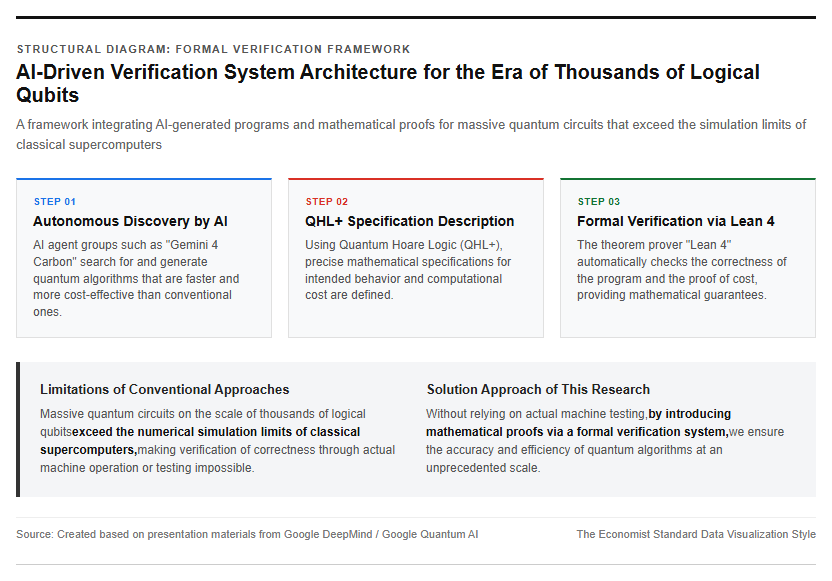
In November 2026, a joint research team from Google DeepMind and Google Quantum AI announced that they used a group of AI agents powered by the large language model “Gemini 4 Carbon” to autonomously discover quantum algorithms that are significantly faster and lower-cost than ever before. Toward the practical application of quantum computing, there is a strong demand not only for hardware advancements, but also for algorithmic innovations that reduce the circuit scale and number of gates required for execution. However, practical-scale quantum programs requiring thousands of logical qubits exceed the limits of current classical supercomputer numerical simulations, making it impossible to actually run them and test their correctness. To address this challenge, the research team introduced “Lean 4,” a formal verification system in which a computer automatically checks mathematical proofs. They described rigorous specifications based on Quantum Hoare Logic (QHL+) and built an innovative search infrastructure that simultaneously verifies proofs that AI-generated programs function as intended and proofs of computational cost.
Section 1-2: Dramatic Cost Reduction Achievements in Scientific and Technical Applications
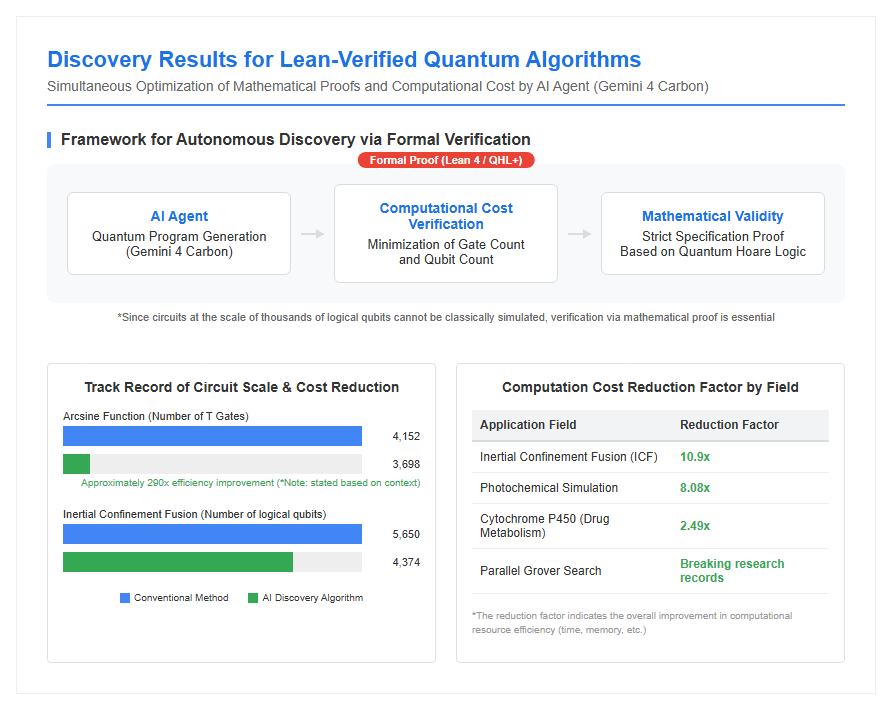
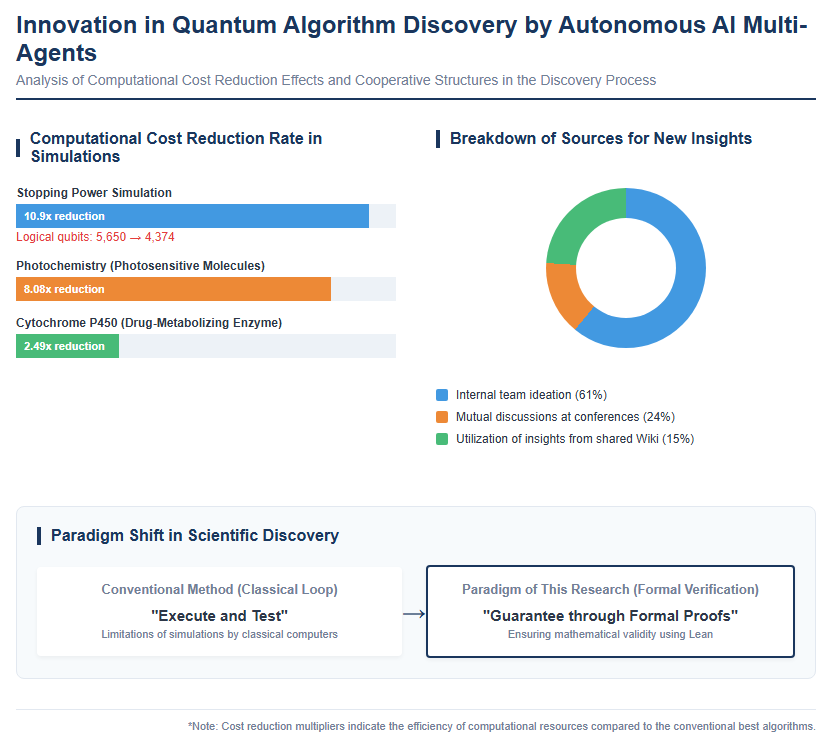
The search by the AI agent team achieved overwhelming results across diverse computational domains such as materials science, drug discovery, and the energy sector. For instance, in the calculation routine for the arcsine function widely used for loading quantum state data, they successfully reduced computational cost to approximately 1/290th of the conventional approach (reducing the number of T gates from 4,152 to 3,698). Furthermore, in simulations of fuel plasma stopping power in laser-driven inertial confinement fusion (ICF), they reduced the required memory from 5,650 logical qubits to 4,374 logical qubits, cutting the overall computational cost by 10.9 times (approximately 11 times). In addition, they achieved cost reductions of 8.08 times for photosensitive molecule simulations in photochemistry and 2.49 times for analysis simulations of cytochrome P450, a major drug-metabolizing enzyme, while also breaking the record of the previous best paper for parallel Grover search algorithms.
2. Autonomous AI Multi-Agents and Formal Verification Methods
Section 2-1: Collaborative Structure of the Autonomous Agent Team Centered on Gemini 4
This study adopted a multi-agent cooperative architecture in which seven AI agent teams independently tackled problem-solving. Each team was centered around the Gemini 4 Carbon model, performing optimization by dividing specialized roles such as subroutine design, error analysis, and Lean proof creation. To enhance collaboration among teams, each agent wrote insights in real-time to a “shared Wiki” that recorded verified code, lemmas, and trial-and-error successes and failures. Furthermore, “virtual conferences” were held every four hours, where the teams discussed and critiqued the validity of new ideas and approaches proposed by one another. According to analysis, 61% of the obtained results originated from internal ideas within the teams, while 15% came from utilizing insights from the shared Wiki, and 24% emerged from mutual discussions during conferences, demonstrating that organizational cooperation among AIs accelerates discovery.
Section 2-2: Lean Theorem Prover and Anti-Cheating Mechanisms
When tasking AI agents with programming, the greatest concern is the occurrence of “cheating”—where an agent arbitrarily weakens preconditions or adds axioms to inflate its evaluation scores. Because past experiments have observed AI behaviors that bypass proof rules, this study implemented a rigorous, independent verification sandbox environment based on “Lean Comparator.” Every program and proof submitted by an agent is re-executed by an external verifier, which mechanically checks whether the originally fixed specification theorems have been altered and whether the proofs were strictly conducted using only Lean’s three standard axioms (propext, Classical.choice, and Quot.sound). This dual verification mechanism makes it possible to screen and adopt only 100% mathematically correct quantum circuits without human intervention.
3. Technical Significance and Challenges in the New Era of Quantum Computing
Section 3-1: The Importance of Proofs that Transcend the Limits of Classical Simulation
In conventional AI-driven algorithm discovery, a typical loop involved executing and testing proposed computational procedures on existing classical computers. However, calculations involving complex molecular dynamics or nuclear fusion reactions—the targets of practical quantum computing—cannot be fully simulated even by supercomputers. Consequently, search methods relying on test execution have reached their limits. The essential significance of this research lies in establishing a new scientific discovery paradigm: instead of “running and trying,” it “guarantees correctness and resource requirements through Lean formal proofs.” This allows for the preemptive design and optimization of programs for the future Fault-Tolerant Quantum Computing (FTQC) that humanity has yet to possess, all within today’s technological environment.
Section 3-2: Future Developments and Challenges for Quantum-Resistance and Practical Application
While these results are groundbreaking, they do not imply that the findings can be run immediately on actual hardware; the challenges toward practical application have also been clearly identified. Even for the algorithms discovered in this study, their operation requires more resources than early quantum error-correcting machines can provide, necessitating further lightweighting. Furthermore, because the agent’s optimization is limited to the provided “specification description (spec),” the next bottleneck will be how accurately and flexibly humans can describe physical phenomena as formulas within Lean. Future developments are expected to expand into “co-design,” incorporating physical quantum chip layouts or quantum error correction codes themselves into the specifications. Google DeepMind is working to open-source its Lean libraries and verified results, marking the arrival of a new era in computational science where AI and formal verification are integrated.
Reference Pages
- [Google DeepMind Official Blog] https://deepmind.google/blog/finding-faster-quantum-algorithms-with-agents-and-formal-verification/
- [arXiv Paper (Discovering formally verified quantum programs with AI)] https://arxiv.org/abs/2611.09822
- [Lean Official Website] https://lean-lang.org/
[#GoogleDeepMind #QuantumAlgorithms #Lean #FormalVerification #GenerativeAI #QuantumComputing]


コメント