
Prodrone Co., Ltd., a developer of industrial drones, has completed a Series D funding round of 1.84 billion yen. This move is driven by a strategy to establish a stable supply system for domestically produced drones based on economic security, and to accelerate the social implementation of “Dual Use” technologies that serve both defense and civilian sectors.
- Raised 1.84 billion yen in Series D, bringing cumulative funding to over 4.5 billion yen
- Certification of the “Supply Assurance Plan” by the Ministry of Economy, Trade and Industry and a production system of 58,000 units per year
- Development of fully domestic drones in collaboration with local workshops in Aichi Prefecture
- Joint development of interceptor drones with Toshiba and deployment for both defense and civilian use
- “Flying Light Truck” and Diverse Aircraft Lineup
- Challenges and Future Prospects for the Domestic Drone Industry
Raised 1.84 billion yen in Series D, bringing cumulative funding to over 4.5 billion yen
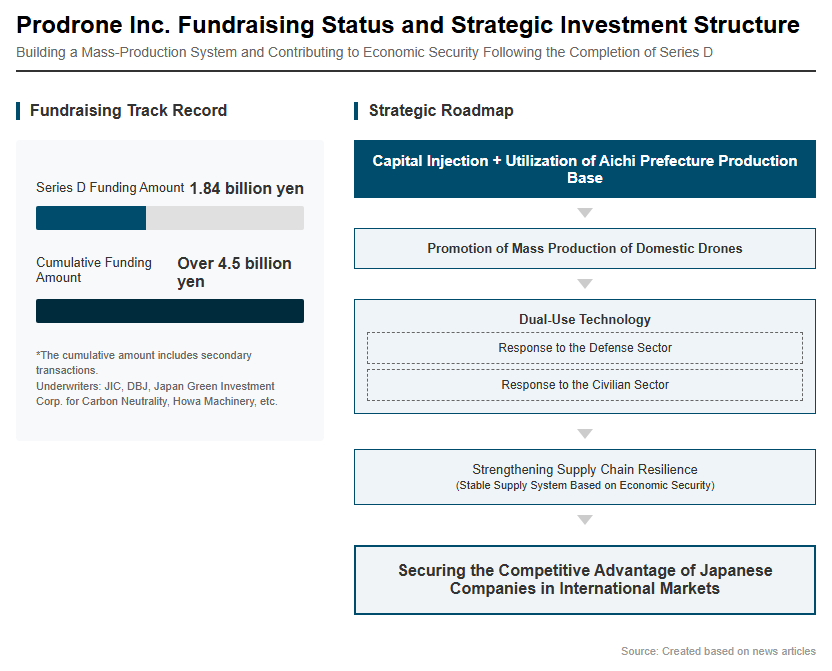
Industrial drone manufacturer Prodrone Co., Ltd. (Nagoya, Aichi Prefecture) announced on November 24, 2026, that it has completed a Series D funding round totaling 1.84 billion yen. This brings the company’s cumulative funding to over 4.5 billion yen, including secondary transactions. The subscribers for this third-party allotment include a diverse range of companies and institutions, such as the government-backed JIC Venture Growth Investments, Development Bank of Japan (DBJ), Decarbonization Support Organization, Tokai R&D Fund No. 1, Tokyo Century, Persol Venture Partners, Tamadic, Mobility Navi, and Howa Machinery. Since its founding in 2015, the company has independently developed advanced industrial drones ranging from single-rotor aircraft for long-distance transport and wide-area surveillance to multi-rotor aircraft for surveying and heavy-duty transport. The funds obtained through this large-scale financing will be used to promote the mass production of domestically produced drones, leveraging the production base in Aichi Prefecture. The plan aims to strengthen the resilience of the entire supply chain and ensure the competitive advantage of Japanese companies in the international market. Please refer to the following configuration diagram.
Certification of the “Supply Assurance Plan” by the Ministry of Economy, Trade and Industry and a production system of 58,000 units per year
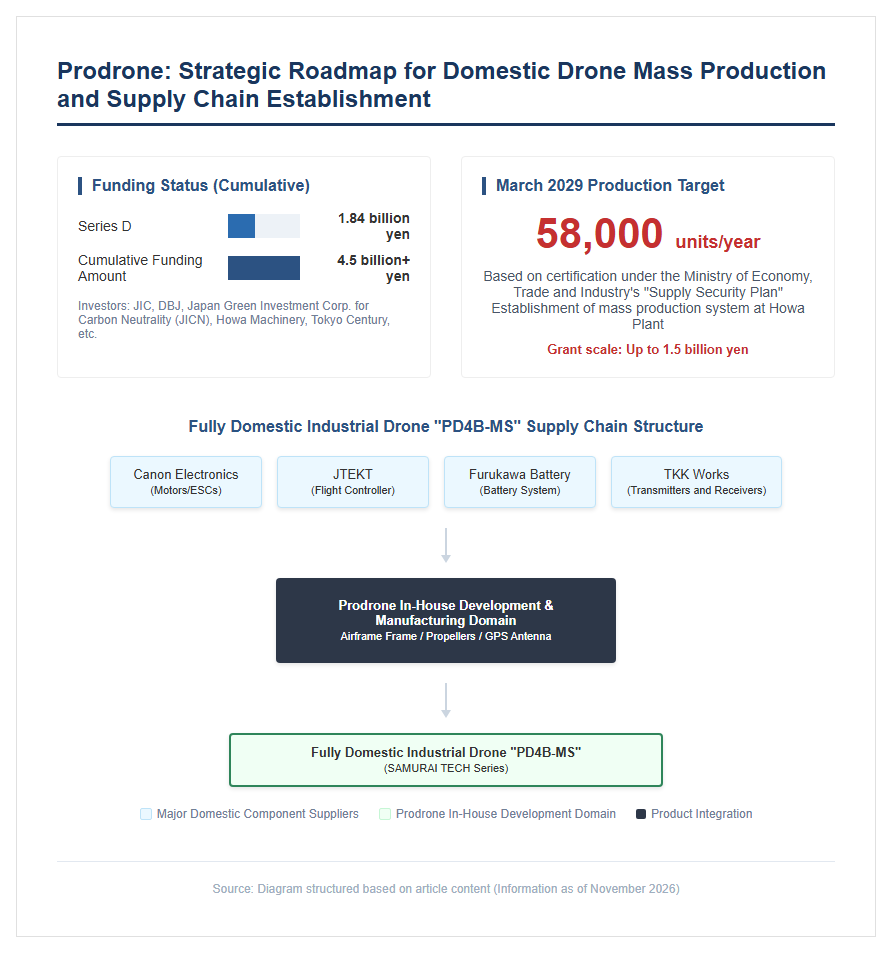
In September 2026, Prodrone received certification from the Minister of Economy, Trade and Industry regarding a stable supply assurance plan for “unmanned aerial vehicles,” a designated critical material under the Economic Security Promotion Act. With this certification, a subsidy of up to 1.5 billion yen has been decided, and the company has set a goal to establish an annual production and supply capacity of 58,000 units by March 2029. The company is establishing and equipping its first mass-production factory, the “Prodrone Howa Factory,” on the premises of Howa Machinery within Aichi Prefecture, and is proceeding with the introduction of new production lines and verification equipment. Domestic demand for drones is surging across a wide range of fields, including infrastructure inspection for bridges and power lines, construction site surveying, logistics, agriculture, and disaster response. While overseas manufacturers previously occupied the majority of the market, there has been an urgent need to build an advanced domestic procurement network to mitigate economic security risks and improve cybersecurity in critical infrastructure sectors. Through production technology development and factory establishment utilizing subsidies, the company aims to realize a stable supply base for unmanned aerial vehicles that is fully contained within Japan.
Strengthening the supply chain and promoting Dual Use technology
Development of fully domestic drones in collaboration with local workshops in Aichi Prefecture
Prodrone upholds the philosophy of “Made in Japan is back,” through the convergence of a local supply chain starting from “Aichi’s local workshops.” As a concrete result, they announced the prototype of “PD4B-MS” (SAMURAI TECH series), Japan’s first fully domestic industrial drone composed entirely of major Japanese-made parts. The PD4B-MS utilizes products from Canon Electronics for its motors and Electronic Speed Controllers (ESCs), JTEKT for its flight controller, Furukawa Battery for its battery system, and TKK Works for its transmitter and receiver. Prodrone itself handles the development and manufacturing of the airframe, propellers, and GPS antennas. By bringing together the technologies of Japan’s core industries—such as electronics, precision machinery, and battery technology—without relying on a single company, the company is reducing the risk of dependence on overseas supply chains. Close collaboration with domestic suppliers also serves as a major strength in terms of maintenance response, after-sales service, and the speed of parts procurement. For a detailed breakdown of the supply chain structure, please refer to the following illustration.
Joint development of interceptor drones with Toshiba and deployment for both defense and civilian use
As global uncertainty increases, the development of “Dual Use” (civilian and military) technologies that can be utilized in both the defense and civilian sectors is being emphasized. In July 2026, Prodrone began joint development and technical collaboration with Toshiba Corporation for unmanned systems in the defense sector. This partnership integrates Toshiba’s long-cultivated expertise in radar systems, air defense systems, and command and control systems with Prodrone’s advanced airframe design and autonomous flight control technologies. In light of the frequent use of drones in modern conflicts, including the situation in Ukraine, the collaboration aims to create domestic interceptor drones to deal with intruding aircraft. By applying design and manufacturing technologies cultivated in the civilian sector to the defense domain, it becomes possible to develop aircraft that combine cost competitiveness with mass-producibility. Furthermore, the company is actively advancing technological development that contributes to humanitarian aid and international security, such as conducting demonstration experiments for landmine-detecting drones in Ukraine.
Social implementation of industrial drones and medium-to-long-term outlook
“Flying Light Truck” and Diverse Aircraft Lineup
The technical characteristic of Prodrone lies in its diverse lineup of large aircraft tailored to specific applications. Its representative development project, the “Flying Light Truck,” aims for performance capable of carrying a 50kg payload and flying 50km. In normal times, it is planned to function as a delivery method to mountainous areas and remote islands with sparse logistics infrastructure, and in the event of disasters such as a massive Nankai Trough earthquake, it is designated to handle the transport of pharmaceuticals and emergency relief supplies. Additionally, the company deploys the large aircraft “PD6B-CAT3,” capable of supporting Level 1 to Level 3 operations, as well as the unmanned helicopter “Prodrone GT-M,” which achieves long-distance flight of over 50km per liter of gasoline. Promoted with investment from the Japan Investment Corporation for Decarbonization (JICDE), the GT-M is an eco-friendly aircraft aiming to balance greenhouse gas (GHG) reduction with industrial advancement. Furthermore, the company focuses on proving the reliability of its operational technologies through logistics demonstration experiments at Level 3.5 anticipating manned areas within Tokyo, and achieving 19 consecutive victories in the FA/F3C Japan Championship with its competitive aircraft “PDH-02C Evo.”
Challenges and Future Prospects for the Domestic Drone Industry
This 1.84 billion yen financing and certification under the Ministry of Economy, Trade and Industry’s “Supply Security Plan” symbolize that Japan’s drone industry has transitioned into a phase of full-scale mass production and self-reliance. However, achieving the annual mass-production target of 58,000 aircraft is indispensable for acquiring and developing specialized human resources with advanced aircraft manufacturing know-how, automating mass-production lines, and further strengthening quality control systems. Prodrone is advancing the reinforcement of talent recruitment and development through a partnership with the Persol Group. Moreover, drones are no longer merely aerial photography tools; they are evolving into physical AI terminals that integrate artificial intelligence (AI), edge computing, and autonomous navigation technology. Through advanced packaging with domestic communication equipment, flight control systems, semiconductors, and batteries, the expansion of exports to overseas markets where security is prioritized is also in sight. The development of the entire industrial ecosystem in coordination with AI and robotics infrastructure is anticipated.
Reference Pages
- [METI Certification of “Supply Security Plan” ~ Promoting Stable Supply of Domestic Drones ~ | PRODRONE] https://www.prodrone.com/jp/news/
- [JTEKT Corporation News Release] https://www.jtekt.co.jp/news/2023/003053.html
[#Prodrone #DomesticDrone #Fundraising #EconomicSecurity #DualUse #SupplyChain #DroneMassProduction]

コメント