
The Ministry of Internal Affairs and Communications (MIC) has concluded a memorandum of cooperation (MOC) in the information and communications field with the government of Chile. The background to this includes promoting the overseas expansion of NTT’s next-generation optical communications technology, IOWN, and strengthening the supply chain for critical minerals.
- Key Points of the Event and Full Scope of the Agreement
- The Impact of Next-Generation Optical Communications IOWN and Remote Operation of Copper Mines
- Integration of Critical Mineral Supply Chains and Communication Infrastructure
- Deployment of Japanese Communication Standards in Latin America and Market Trends
- ICT Solutions Expanding to Disaster Prevention, Medical Care, and Cyberspace
- Future Developments, Key Points of Focus, and Global Competitiveness
Key Points of the Event and Full Scope of the Agreement
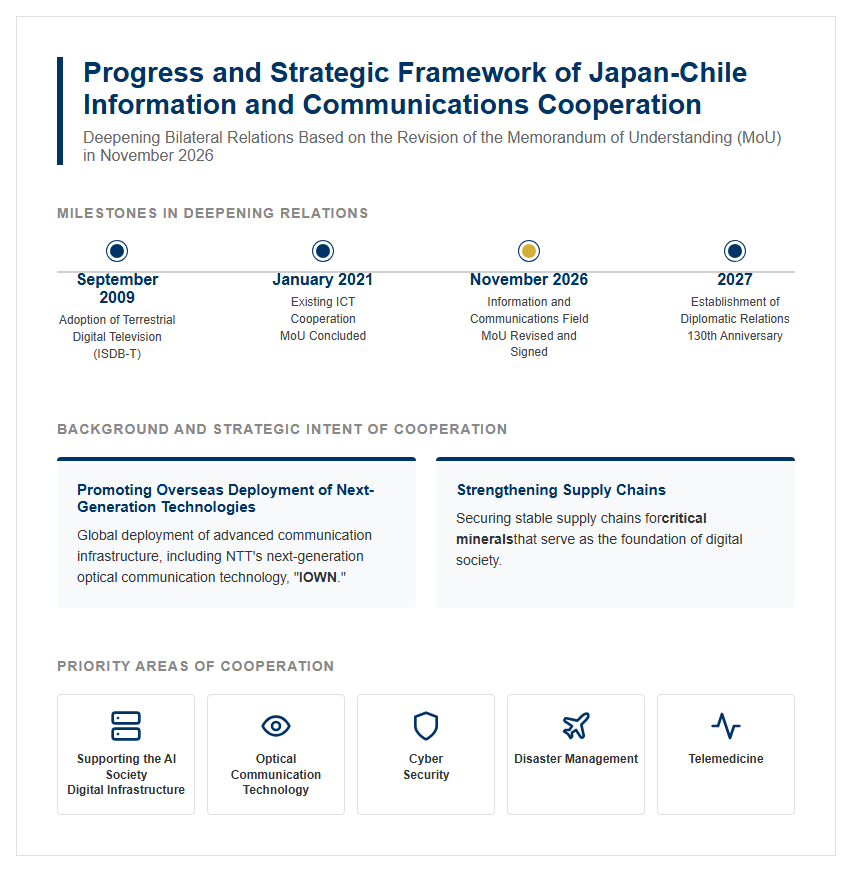
On November 24, 2026, the Ministry of Internal Affairs and Communications announced that it had revised and signed a memorandum of cooperation in the field of information and communication technology with the government of Chile. The memorandum was signed on November 20, 2026, between Japan’s Minister for Internal Affairs and Communications Fujii and Chile’s Minister of Transport and Telecommunications de Grange, to coincide with the visit to Japan of Chile’s President José Antonio Kast List. The two countries have built a close relationship since September 2009, when Chile adopted Japan’s ISDB-T system for terrestrial digital television broadcasting. The purpose is to update the existing ICT cooperation memorandum concluded in January 2021 and comprehensively deepen bilateral cooperation further toward the 130th anniversary of the establishment of diplomatic relations in 2027. The recent agreement clarifies priority areas such as the development of safe and reliable digital infrastructure to support the AI society, optical communications technology, cybersecurity, and ICT solutions including disaster management and telemedicine.
The Impact of Next-Generation Optical Communications IOWN and Remote Operation of Copper Mines
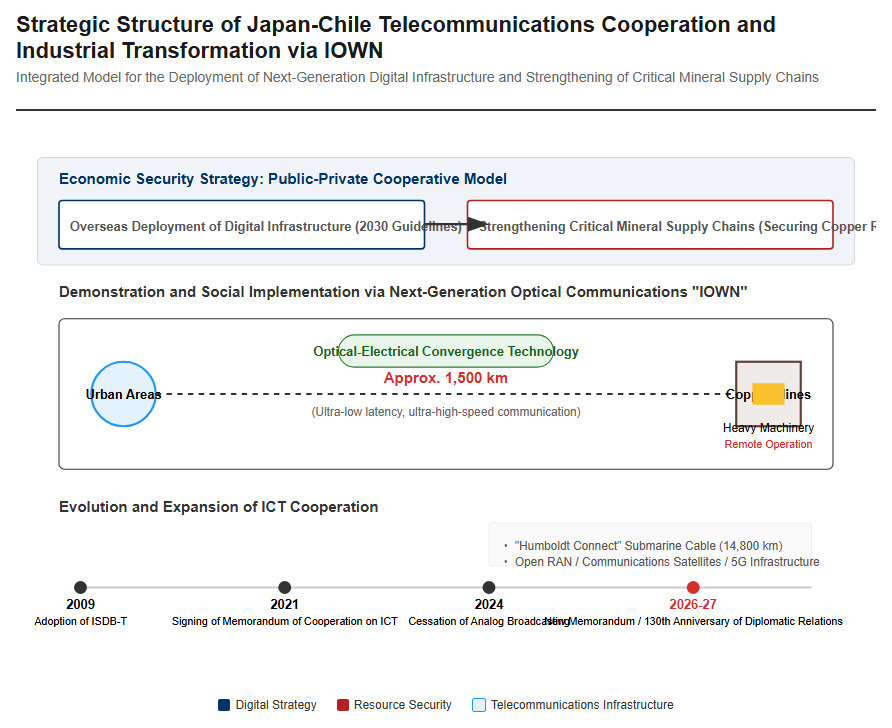
One of the major highlights of this memorandum is the full-fledged overseas demonstration and promotion of “IOWN” (Innovative Optical and Wireless Network), a next-generation optical communication technology being developed by NTT. In Chile’s copper mines—among the world’s leading copper producers—a joint demonstration project utilizing IOWN to remotely operate heavy machinery inside the mines from urban areas approximately 1,500 kilometers away has been moving into full swing since 2026. Based on photoelectric fusion technology that shifts from conventional electronic processing to optical transmission, IOWN achieves ultra-high-speed, large-capacity, and ultra-low-latency communication while significantly curbing power consumption. It is expected to ensure operational safety in harsh and hazardous mining environments and drastically improve production efficiency, and the policy is to accelerate the introduction and standardization of IOWN technology at major industrial sites in Chile through this memorandum.
Management and Strategic Background and Economic Security
Integration of Critical Mineral Supply Chains and Communication Infrastructure
Communication cooperation with Chile goes beyond mere technical support, being deeply tied to Japan’s economic security strategy. At the summit meeting held on November 20, 2026, between Prime Minister Sanae Takaichi and Chilean President Kast, the strengthening of cooperation toward securing the supply chain of critical minerals, including copper, was confirmed. Chile is a major international supplier of copper resources indispensable for electric vehicles and renewable energy equipment, and pouring Japan’s cutting-edge communication technology into making its mining development more efficient and automated holds significant strategic benefits for both sides. Amid growing uncertainties in international supply chains, a public-private cooperative model combining next-generation communication infrastructure and critical resource procurement serves as an important guideline for Japan’s overseas expansion of digital infrastructure (Comprehensive Strategy for Overseas Digital Expansion 2030).
Deployment of Japanese Communication Standards in Latin America and Market Trends
ICT cooperation between Japan and Chile is built on a long-standing track record. After adopting the Japanese digital terrestrial broadcasting system in 2009, Chile advanced its infrastructure development and completed the analog switch-off nationwide in April 2024. Building on this success story, the Ministry of Internal Affairs and Communications has expanded the scope of ICT cooperation in the Latin American region from broadcasting to communications in general. Within Chile, large-scale digital infrastructure investments are underway, such as the implementation of 5G frequency auctions and “Humboldt Connect,” an international submarine cable project spanning approximately 14,800 kilometers that connects South America and the Asia-Pacific. The Japanese side is promoting the entry of Japanese communication vendors and operators in fields such as Open RAN (Open Radio Access Network), optical submarine cables, and communication satellite technologies.
Future Outlook and Social/Industrial Ripple Effects
ICT Solutions Expanding to Disaster Prevention, Medical Care, and Cyberspace
The latest memorandum of cooperation also highlights strengthened collaboration in solution areas that directly impact the safety and peace of mind of citizens’ daily lives, not just industrial infrastructure. Like Japan, Chile is a country prone to natural disasters such as earthquakes, tsunamis, and volcanic eruptions, and the operation and management of Early Warning Systems (SAE) and Cell Broadcast Systems (CBS), as well as the utilization of Earthquake Early Warning technology, are progressing. Furthermore, the consideration of introducing smartphone telemedicine systems for rural and isolated areas in Chile’s geographically vast territory, and space-transmission wireless power transfer (wireless power supply system) technology using radio waves, is included. Information exchange in the cybersecurity field to protect critical infrastructure and cooperation in formulating multilateral rules in international organizations such as the International Telecommunication Union (ITU) have also been incorporated.
Future Developments, Key Points of Focus, and Global Competitiveness
Looking ahead, the focus will be on rolling out Japan-origin telecommunications infrastructure to other Latin American countries and global markets, using the implementation of IOWN at a copper mine in Chile as a model case. The Ministry of Internal Affairs and Communications (MIC) is leveraging public-private support tools such as the “Digital Platform for Developing Infrastructure overseas (JPD3)” and the Japan Fund for Information and Communication Technology (JICT) to strongly back Japanese companies’ overseas demonstration projects and project formation. Toward the 130th anniversary of the establishment of diplomatic relations between Japan and Chile in 2027, multi-layered cooperation is progressing between the two countries—including the creation of a policy consultation mechanism and the deepening of defense cooperation—with the telecommunications sector playing a core role. Attention will be focused on the results of upcoming demonstrations and the progress of local deployment to see whether Japanese optical technology and open communication standards can become the de facto standard in major South American countries.
Reference Page
- [Press Release | Signing of the Memorandum on Cooperation in the Field of Information and Communication Technology with the Ministry of Transport and Telecommunications of the Republic of Chile – Ministry of Internal Affairs and Communications] https://www.soumu.go.jp/menu_news/s-news/01tsushin08_02000215.html
[#MIC #Chile #IOWN #TelecommunicationsInfrastructure #EconomicSecurity #CriticalMinerals #ICTGlobalExpansion]


コメント