On the November 24, 2026 Tokyo stock market, the Nikkei Stock Average rebounded sharply, surging 2,207.98 yen from the previous weekend. This was driven by a strong wave of short-covering centered on AI- and semiconductor-related stocks, following a high-tech rally in the U.S. market triggered by the return of Nvidia CEO Jensen Huang.
- Market Trends on November 24, Marking a 2,207-Yen Surge
- Jensen Huang’s Return as CEO and the Surge in U.S. Tech Stocks
- Intense Short-Covering in Semiconductor and AI-Related Stocks
- The Impact of Futures Short-Covering and Speculative Trading
- PER Levels on the TSE Prime Market and the Reality of Corporate Earnings
- Entrenched Inflation and the Medium-to-Long-Term Stock Price Outlook
Market Trends on November 24, Marking a 2,207-Yen Surge
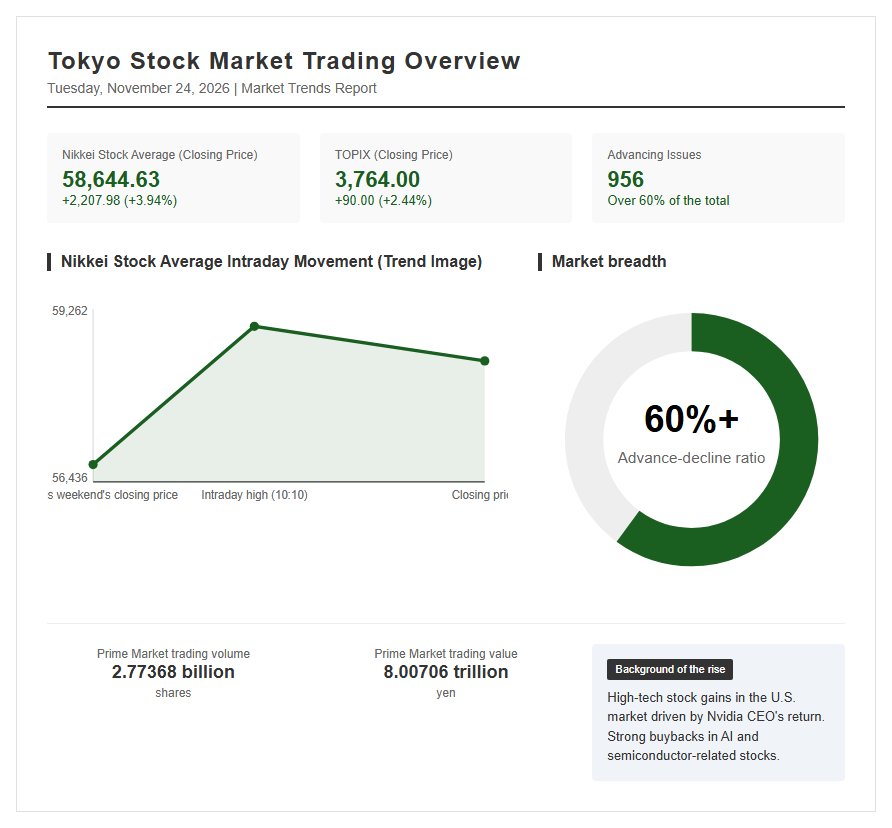
On the Tokyo stock market on November 24, 2026, the Nikkei Stock Average closed significantly higher, rebounding by 2,207.98 yen from the previous weekend to 58,644.63 yen. The Tokyo Stock Price Index (TOPIX) also rose by 90 points from the previous weekend to 3,764 points. In the Tokyo market following the weekend holiday, broad-based buying entered right from the opening bell. At 10:10 a.m., the gains temporarily reached 2,825 yen, touching the milestone level of 59,262 yen. The Tokyo Stock Exchange Prime Market saw heavy trading, with volume reaching 2.77368 billion shares and a trading value of 8.0707 trillion yen. Major semiconductor stocks dominated the trading value rankings, and advancing issues totaled 956, accounting for over 60% of the total. Please refer to the figure below for market conditions.
Behind the sudden surge in stock prices were the easing of short-term selling pressure driven by recent concerns over AI overinvestment and geopolitical risks, alongside a rapidly strengthening risk-on stance prompted by rising U.S. stock prices.
Jensen Huang’s Return as CEO and the Surge in U.S. Tech Stocks
The primary catalyst driving the dramatic turnaround in the Tokyo market was the sharp rebound of the three major U.S. stock indices in the U.S. stock market on the previous day, November 23, 2026. U.S. semiconductor giant Nvidia announced the sensational return of Jensen Huang as Chief Executive Officer (CEO), causing its shares to skyrocket by 31.48% to $165.05. The board of directors determined that his return posed no national security risks, significantly easing uncertainty regarding the company’s management outlook.
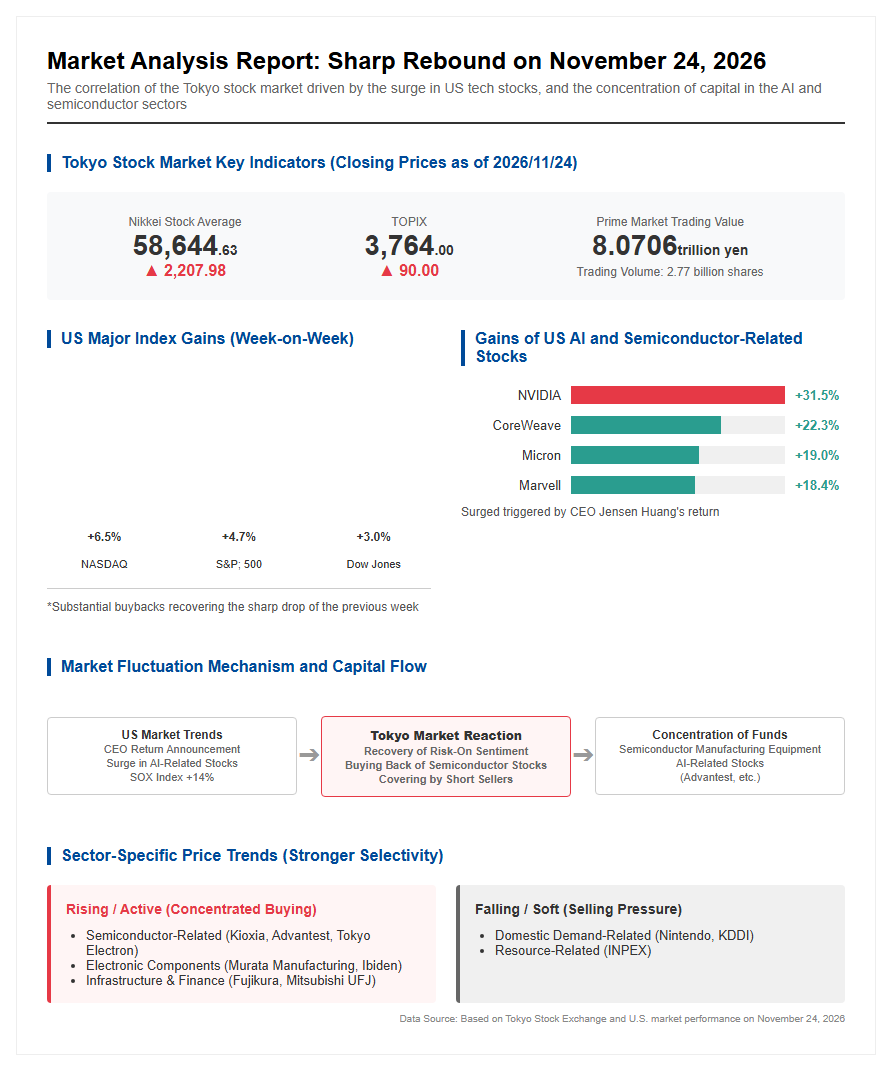
In response, the U.S. market saw a comprehensive wave of buying centered on high-tech stocks. The Nasdaq Composite Index rose by 6.5%, the S&P 500 Index by 4.7%, and the Dow Jones Industrial Average by 1,447.98 points (3.0%), completely erasing the sharp drop from November 20. Gains in AI-related stocks powerfully propelled the overall market, with Micron Technology surging 19.0%, Marvell Technology up 18.4%, and CoreWeave jumping 22.3%. This surge in U.S. stocks dramatically improved investor sentiment in the Tokyo market following the holiday.
Major Stocks Driving the Market Rally and the Mechanics of Futures Trading
Intense Short-Covering in Semiconductor and AI-Related Stocks
In the Tokyo market on November 24, spurred by a sharp 14% surge in the U.S. Philadelphia Semiconductor Index (SOX), semiconductor manufacturing equipment and AI-related stocks were flooded with short-covering. Among individual issues, Kioxia Holdings <285A>, which dominated trading value by a wide margin, saw massive short-covering. High-priced semiconductor stocks such as Advantest <6857>, Tokyo Electron <8035>, and Lasertec <6920> also experienced brisk trading, significantly pushing up the Nikkei Stock Average.
Furthermore, Murata Manufacturing <6981> was bought up to its daily limit-high, while Ibiden <4062> and Wacom <6727> were similarly bought up to their daily trading limits, dominating the top gainers on the Prime Market. Electric wire giants Fujikura <5803> and Furukawa Electric <5801>, as well as mega-bank Mitsubishi UFJ Financial Group <8306>, also attracted buying. On the other hand, domestic demand and resource-related stocks such as Nintendo <7974>, KDDI <9433>, and INPEX <1605> faced selling pressure, highlighting a selective market where capital was conspicuously concentrated around AI and semiconductors. Please refer to the figure below for details on price movements.
The Impact of Futures Short-Covering and Speculative Trading
It has been pointed out that short-term speculative trading through Nikkei 225 futures and options amplified market volatility during this sharp rebound and the preceding sudden plunge. Overseas speculative players, such as foreign funds and Commodity Trading Advisors (CTAs), had built up short positions in Nikkei futures amid recent concerns over stagnant AI investment and rising geopolitical risks. However, the powerful bullish catalyst of Jensen Huang’s return as CEO triggered a massive wave of futures short-covering aimed at unwinding high-priced short positions.
The Nikkei 225 index constituents are concentrated in companies with high weightings in specific Asian and global demand as well as semiconductor-related sectors. This creates a structure where futures-driven trading causes the NT ratio—which indicates the Nikkei’s outperformance relative to the TOPIX—to spike significantly. Despite no rapid changes in real economic fundamentals, short-covering activity in the derivatives market combined with liquidity imbalances acted as the catalysts for a historic rebound exceeding 2,200 yen in a single day.
Corporate Fundamentals and Medium-to-Long-Term Stock Market Outlook
PER Levels on the TSE Prime Market and the Reality of Corporate Earnings
While stock prices have experienced short-term volatility, the fundamentals of Japanese companies remain resilient. Following a decline in stock prices driven by a series of “AI shocks” and concerns over rising interest rates, the forward Price-to-Earnings (PER) ratio of the TSE Prime market fell to 14.7x as of November 6, down from the 20x level seen at the start of the year. This PER level is in a zone that suggests significant undervaluation compared to historical trends, providing a foundation for a reassessment of the health of corporate earnings.
Looking at the earnings summaries of listed companies, a majority have secured increases in ordinary profit, and many are presenting robust plans for increased revenue and profit based on their company forecasts. During the past Lehman shock, the financial crisis and a global recession progressed simultaneously, leading to a wave of companies falling into the red. In contrast, the current market turbulence is primarily centered on an adjustment of excessive expectations regarding the growth pace of semiconductor and AI investment; the earning power of Japanese companies as a whole has not collapsed. Because corporate earnings provide a floor, the stock price correction is functioning as a dissipation of temporary market overheating.
Entrenched Inflation and the Medium-to-Long-Term Stock Price Outlook
Regarding the medium-to-long-term outlook for the Japanese stock market, market participants anticipate a continuation of the long-term upward trend. A key factor supporting the sustainability of rising stock prices is the penetration of inflation accompanying the exit from deflation. While rising prices lead to a depreciation in currency value, an economic principle is at work where rising prices boost corporate revenue and nominal profits, thereby driving up stock prices as relative asset values.
Earnings per share (EPS) for companies listed on the TSE is estimated to grow at an average annual rate of approximately 6.7%, driven by the expansion of overseas business earnings, the penetration of inflation, and the reduction in the number of shares outstanding through share buybacks. According to the outlook from Nomura Securities strategists, in a main scenario, the Nikkei 225 is expected to reach 63,000 yen by the end of 2026 and 68,000 yen by the end of 2028; an upside scenario also suggests it could break into the 70,000 yen range by the end of 2026. It is crucial to maintain a perspective that looks toward structural growth through time diversification rather than being distracted by short-term price fluctuations.
Reference Page
- 【Research Institute of Economy, Trade and Industry (RIETI)】https://www.rieti.go.jp/jp/publications/nts/25e084.html
【#Nikkei225 #StockMarket #Nvidia #AIStocks #JapaneseEconomy】


コメント