SB Intuitions, a subsidiary of SoftBank, is accelerating the next-generation rollout of its domestic large language model (LLM) series “Sarashina.” Behind this is a development strategy aimed at trillion-parameter models, strong joint research on safety technologies with the National Institute of Information and Communications Technology (NICT), and a public-private partnership to adopt government AI.
- Development Roadmap Toward a Trillion-Parameter Scale
- The Significance of ‘Sarashina mini’ Supporting Practical Work and Distillation Technology
- Fusion of Leading Domestic Language Resources and Security Technology
- Development of ‘Guardrails’ Reflecting Japan’s Unique Ethical Standards
- Adoption at the Digital Agency ‘Gennai’ and Acceleration of Administrative DX
- Sovereign AI Protecting Data Sovereignty and Enterprise Deployment
- Milestones in the First Year of AI Social Implementation
- Sustainable Growth and the Path to an ‘AI Sovereignty Nation’
Development Roadmap Toward a Trillion-Parameter Scale
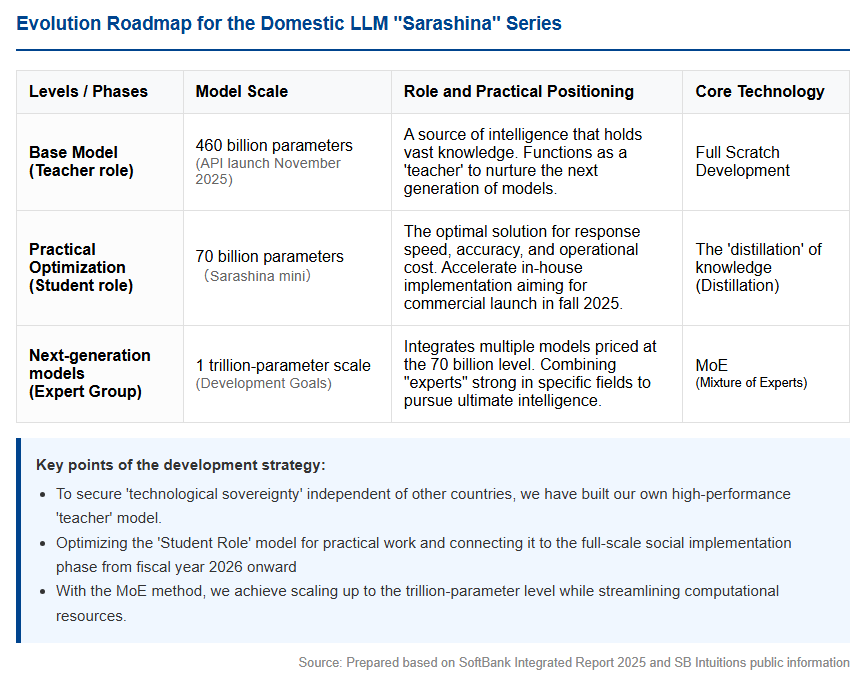
The domestic LLM “Sarashina,” which SoftBank Group is fully committed to, is positioned as a crucial foundation supporting the future of AI development in Japan. In November 2025, commercial API provision for a large-scale foundation model with 460 billion parameters will begin. This large-scale model functions as an AI that acts as a “teacher” in development, serving as a source for passing on its vast knowledge to lighter and faster models.
Currently, the development team is setting the next milestone for building an LLM with a “trillion-parameter scale.” To achieve this goal, a MoE (Mixture of Experts) architecture is adopted, which combines multiple models with 70 billion parameters of different areas of expertise, functioning as a so-called “expert collective.” This approach enables dramatic performance improvements in a short period while efficiently utilizing computational resources compared to simple scaling. SoftBank prioritizes this trillion-parameter development to maintain its unique AI ecosystem independent of foreign models for the long term. Please refer to the diagram below.
The Significance of ‘Sarashina mini’ Supporting Practical Work and Distillation Technology
If large-scale foundational models are the “teachers,” then in actual operations at companies and local governments, it is AI that optimizes that knowledge to act as the “student.” A prime example is the “Sarashina mini,” which has 70 billion parameters. This model is developed using an advanced technology called “distillation,” which maximizes the high performance of the AI acting as the teacher while pursuing the ultimate balance between response speed, accuracy, and operational costs.
Large-scale internal trials of the Sarashina mini have been underway at SoftBank aiming for commercial launch in fall 2025. By receiving rigorous feedback from employees who regularly use cutting-edge overseas AI, we have steadily improved our satisfaction in our work by updating almost every week. The model, refined through this on-site development process, aims to establish itself as a “domestic AI that can be used in practical work,” deeply understanding Japan’s unique culture and customs, going beyond mere text generation.
The Foundation of ‘Trustworthy AI’ Brought by Joint Research with NICT
Fusion of Leading Domestic Language Resources and Security Technology
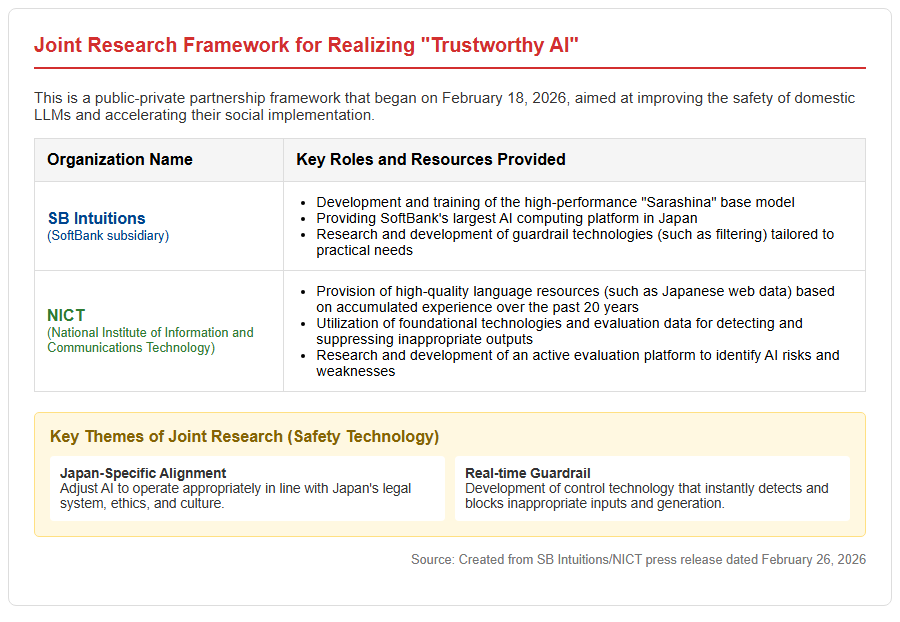
On February 18, 2026, SB Intuitions began joint research with the National Institute of Information and Communications Technology (NICT) on safety technologies for high-performance LLMs. At the heart of this collaboration lies NICT’s unparalleled high-quality language resource: over 70 billion pages of Japanese web data, accumulated over nearly 20 years. In the development of domestic LLMs, the quality and quantity of training data are decisive advantages, and utilizing these resources is expected to further enhance Sarashina’s Japanese proficiency.
The purpose of the research is not only to improve convenience, but also to ensure safety by suppressing ‘hallucinations’ where AI generates information that is inaccurate and preventing the output of inappropriate expressions. By combining NICT’s technology for detecting and suppressing inappropriate outputs with SB Intuitions’ advanced model construction expertise, we have established a system that seamlessly advances everything from data construction through learning, evaluation, and safety measures. This will accelerate the realization of “trustworthy AI” that companies and public institutions can confidently adopt. Please refer to the diagram below.
Development of ‘Guardrails’ Reflecting Japan’s Unique Ethical Standards
The standards for “guardrails” regarding what constitutes inappropriate expressions and what information should be controlled in the social implementation of generative AI vary greatly depending on the country, culture, and legal system. With overseas LLMs, there may be limitations in adapting to Japanese regulations, social norms, and even the delicate nuances unique to Japanese. This joint research focuses on developing “alignment” technologies that adjust AI to operate appropriately in line with Japanese ethics and values.
Specifically, research is underway on guardrail technology that detects inappropriate expressions in input and generated output in real time, and filters and blocks them. Additionally, developing evaluation indicators to objectively measure safety is also an important theme. Even just regarding copyright, the ability to provide detailed considerations based on Japanese laws and social norms is a unique strength of domestic LLMs. With this technical backing, Sarashina enables applications in highly confidential and reliable fields such as finance, healthcare, and government.
At the Forefront of Social Implementation: Government AI and Sovereign Cloud
Adoption at the Digital Agency ‘Gennai’ and Acceleration of Administrative DX
One of the biggest milestones in the social implementation of domestic LLMs is government adoption. On March 6, 2026, the Digital Agency announced the results of a public call for domestic LLMs to be piloted in the generative AI usage environment “Gennai” for government employees, selecting seven models including SB Intuitions’ “Sarashina2 mini.” This call received a total of 15 entries, and after a rigorous evaluation test of 50 questions and benchmark comparisons with major overseas models, Sarashina’s high practicality and suitability for administrative practice were recognized.
Sarashina’s trial within Genuto is scheduled to begin around August 2026. The government is strongly promoting digital transformation (DX) in administrative settings by utilizing domestically produced LLMs that fit Japanese vocabulary and expressions and respect Japanese culture and values. After trial implementation and evaluation verification during fiscal 2026, it is being considered that from fiscal 2027 onward, excellent models will be formally procured (for a fee) by the government as “Government AI,” and this is expected to serve as a stable foundation for generating demand for the development and strengthening of domestic AI.
Sovereign AI Protecting Data Sovereignty and Enterprise Deployment
SoftBank aims to build “sovereign AI” that enjoys the convenience of AI while maintaining domestic sovereignty over “technology,” “data,” and “operations.” Excessive reliance on overseas LLMs not only raises concerns about the unintended leakage of confidential corporate information abroad but also carries the risk of sudden restrictions on AI use due to international circumstances and changes in overseas regulations. To address this issue, SoftBank will sequentially begin offering generative AI services utilizing Sarashina on its cloud service “Cloud PF Type A,” in collaboration with Oracle, starting June 2026.
This service is provided under a “sovereign environment” managed and operated by SoftBank at data centers within Japan. Companies and local governments can confidently integrate their confidential data and internal knowledge with AI, enabling high-precision text proofreading, automatic report generation, and even building “AI agents” that autonomously perform tasks. Rather than simply providing generic tools, domestic AI with deep understanding of Japanese laws and business practices is gradually establishing a system that safely protects the core of client companies’ businesses.
Future Developments and Key Points: AI Social Implementation in the Second Half of 2026
Milestones in the First Year of AI Social Implementation
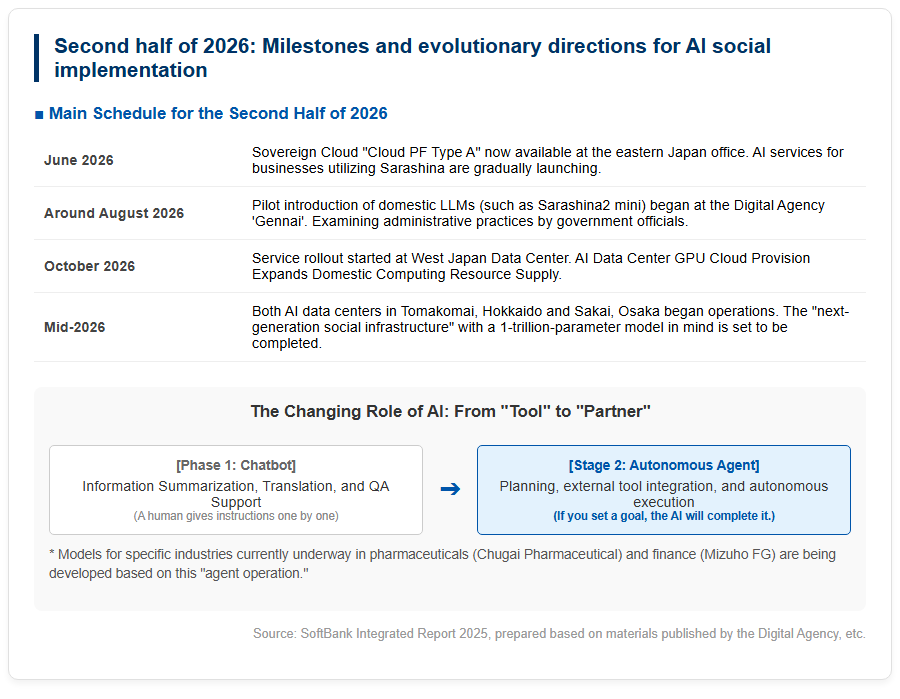
2026 is positioned as the “first year of AI social implementation,” marking the transition from the demonstration phase of domestic LLMs to full-scale social implementation. In addition to the trial introduction of the government AI “Gennai” scheduled for summer 2026, cloud services utilizing Sarashina are also scheduled to be rolled out in data centers in western Japan in October 2026. With these infrastructure developments, geographic redundancy and large-scale data processing capabilities are ensured, creating an environment where companies and municipalities across Japan can benefit from domestic AI.
On the technical side, the decisive trend is evolving from chatbot-based use to “agents” where AI plans and autonomously performs tasks. SoftBank’s joint research and development results on LLMs specialized for the pharmaceutical and financial industries are also expected to be commercialized as concrete services within fiscal year 2026. By evolving AI not just as a supplementary tool but into a partner with specialized knowledge that handles complex tasks on its behalf, it is expected to directly contribute to solving the severe labor shortages faced by Japanese society. Please refer to the diagram below.
Sustainable Growth and the Path to an ‘AI Sovereignty Nation’
For the sustainable growth of domestic LLMs, it is essential to have a computing foundation that supports massive data processing and to meet power demands. SoftBank aims to complete and open the first phase of its largest “AI Data Center” in Tomakomai, Hokkaido, by fiscal year 2026, and plans to begin operations in Sakai City, Osaka Prefecture within 2026. These facilities are designed as ‘local production and consumption’ green data centers that maximize the use of local renewable energy, aiming to achieve both AI-coexistent and sustainable societies.
With investments totaling 3 trillion yen between public and private sectors underway, the question is whether Japan can establish itself as a “sovereign nation over AI.” Although competition with overseas players remains fierce, domestic LLMs are establishing a solid position through their unique competitive axes: specialization in Japanese, data security, and customization optimized for Japan’s industrial structure. The biggest focus going forward will be how much the achievements of the trillion-parameter model, which will emerge from late 2026 to 2027, will raise the value of domestic AI within this “coexistence strategy.”
[#国産LLM #Sarashina #ソフトバンク #生成AI #ガバメントAI #デジタル庁 #NICT #ソブリンAI]


コメント