Korean gaming giant KRAFTON has officially released “Raon-1 mini,” a 3-billion to 30-billion parameter open-source language model trained entirely from scratch in-house. The background of this release involves establishing a technical approach that balances reducing inference costs—driven by the expanding use of AI—with advanced instruction-following and agent-processing capabilities.
- Scrach Development and Open-Source Release of a 30B-Class Model
- The Philosophy of the AI Brand “Raon” and the Journey of Building Foundational Technology
- Fusion of a 28.8B MoE Structure and Proprietary Linear Attention (RDA)
- Reduction of KV Cache and Support for Ultra-Long Contexts Exceeding 262,144 Tokens
- Benchmark Demonstration in Instruction Adherence and Agent Capabilities
- Local Operation Requirements and Ripple Effects on the AI Industry and Game Development
Scrach Development and Open-Source Release of a 30B-Class Model
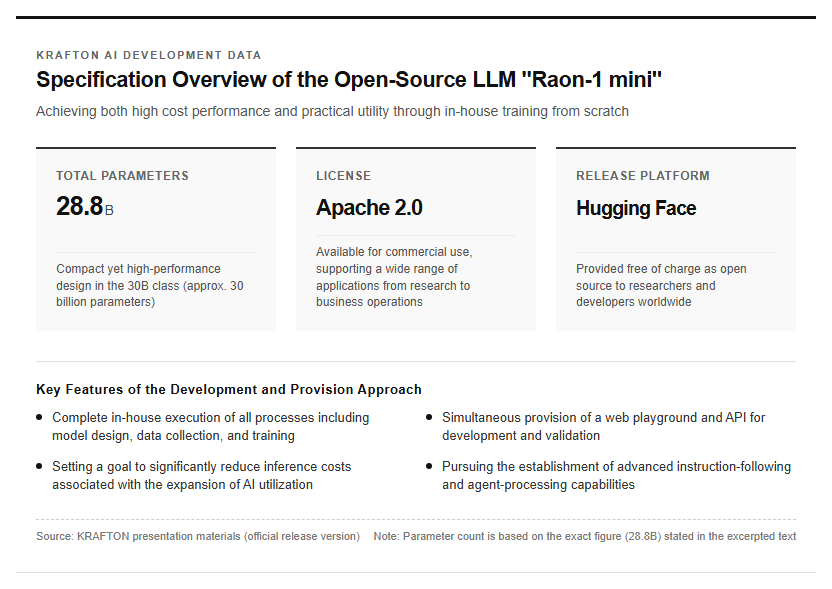
Following the release of a preview version on October 21, 2026, South Korean gaming company KRAFTON has announced the official version of Raon-1 mini, a large language model developed entirely in-house. A key feature of this model, which has a total parameter count of 28.8B (approximately 30 billion), is that the entire process—from model design to data collection and training—was conducted directly by the company. It adopts the Apache 2.0 license, which permits commercial use, and is available for free as open source to researchers and developers worldwide via Hugging Face. Additionally, a web playground and API for development verification are provided simultaneously, making it suitable for a wide range of applications from research and development to practical product integration. KRAFTON has set the core goal of providing a cost-effective language model, aiming to build an environment where high-precision natural language processing can be executed at a low cost.
The Philosophy of the AI Brand “Raon” and the Journey of Building Foundational Technology
KRAFTON launched its AI model brand, Raon, in April 2026. The name Raon is derived from a Korean word meaning joy, embodying the company’s philosophy of expanding the essential experiences of games and content through AI technology. The company has previously released a variety of open-source models, including the speech language model Raon-Speech, the real-time interactive speech model Raon-SpeechChat, the text-to-speech model Raon-OpenTTS, and the independently trained vision encoder Raon-VisionEncoder. The newly introduced Raon-1 mini is positioned as the foundational LLM that forms the core of the AI ecosystem promoted by the company. KRAFTON has continued to invest aggressively in AI research and development for over five years, demonstrating world-class foundational research capabilities through a total of 54 or more papers presented at major international conferences, including nine main-track papers accepted at NeurIPS 2026.
High-Efficiency Calculation Mechanism via Proprietary Architecture
Fusion of a 28.8B MoE Structure and Proprietary Linear Attention (RDA)
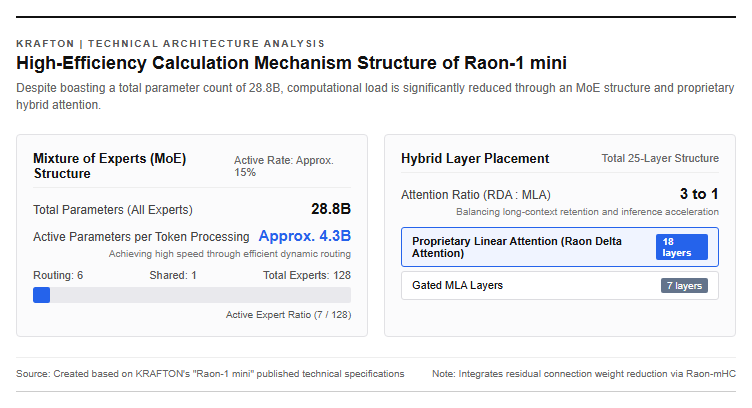
The technical superiority of Raon-1 mini is supported by a proprietary model architecture that dramatically enhances computational efficiency. Out of the total 28.8B parameters, it adopts a Mixture of Experts (MoE) structure that dynamically activates only about 4.3B per token processed. Specifically, out of a total of 128 experts, a total of 7 experts operate—consisting of 6 routed experts and 1 shared expert. Furthermore, within its 25-layer structure, it introduces a hybrid arrangement combining 18 proprietary linear attention layers (Raon Delta Attention) and 7 gated MLA layers in a 3-to-1 ratio. Raon Delta Attention enhances the ability to retain historical information in long contexts by separating the forget gate and the write gate. By simultaneously incorporating residual connection technology (Raon-mHC), which is a lightweight version of DeepSeek’s mHC, it achieves both faster training speeds and accelerated inference processing.
Reduction of KV Cache and Support for Ultra-Long Contexts Exceeding 262,144 Tokens
To suppress memory consumption during inference, Raon-1 mini incorporates sophisticated attention design. While standard LLMs require maintaining a KV cache across all layers, this model is specified so that only the 7 MLA layers hold a KV cache. As a result, the KV cache amount per token at BF16 precision is kept to approximately 8KiB. Thanks to this lightweight design, it is able to support a vast native context window of up to 262,144 tokens while keeping memory consumption during full-context execution down to around 2GB. Even for long-text analysis tasks that typically consume large memory resources, it can operate efficiently on standard hardware environments such as a single 32GB GPU. Furthermore, by utilizing DFlash2—a draft model for speculative decoding—it achieves an output throughput up to 2.18 times higher compared to autoregressive decoding.
Benchmark Evaluation and Prospects for Practical Application
Benchmark Demonstration in Instruction Adherence and Agent Capabilities
The performance of Raon-1 mini has been demonstrated across various public benchmarks. It scored 64.9 points in MultiChallenge, which measures instruction compliance in long-form dialogue, outperforming competing MoE models of the same scale by 5.9 points. It recorded 72.3 points in GDPVal and 55.9 points in BrowseComp Plus—which measure the execution capabilities of autonomous agents—achieving the highest scores among baselines with equivalent architectures. Furthermore, it recorded 84.2 points in IFBench, which assesses complex instruction-following capabilities, taking a significant 17.6-point lead over the competing Qwen3.6-35B-A3B (66.6 points). It also scored 92.9 points in the Korean daily conversation benchmark, demonstrating its practicality in multilingual environments and advanced agent workflows. This model features a total of six thought control modes, including five levels of thinking depth (Low, Medium, High, Ultra-High, and Maximum) as well as a Standard mode, allowing users to freely select response speed and reasoning depth depending on the task.
Local Operation Requirements and Ripple Effects on the AI Industry and Game Development
In terms of operational feasibility in production environments, the use of the NVFP4 quantized model supports inference execution on a single NVIDIA RTX 5090 (32GB VRAM). Although GGUF formats and MLX formats for Apple Silicon are also provided, even the minimum configuration IQ4_XS quantized version results in a file size of 16.07GB, making it difficult to operate entirely in-memory on a 16GB M4 Mac (with a GPU allocation limit of 12.71GB), and a memory environment of 32GB or more is recommended for local execution. KRAFTON plans to leverage the technological foundation gained from this LLM development to advance the creation of an even larger model, Raon-1, and a real-time full-duplex speech model. In addition, through Ludo Robotics—a newly established AI and robotics hub in San Francisco—the company is pursuing a strategic shift to expand simulation technologies cultivated in gaming spaces into the fields of physical AI and humanoid robots. Attention is gathering on the model as a presence that opens up the future of AI agent utilization not only in the gaming industry but across a wide range of industrial sectors.
Reference Pages
- [KRAFTON/Raon-1-mini-preview – Hugging Face] https://huggingface.co/KRAFTON/Raon-1-mini-preview
- [KRAFTON, Inc. Official Press Release] https://www.krafton.com/news/press/
- [KRAFTON AI Official Website] https://www.krafton.ai/
[#LLM #AI #KRAFTON #OpenSource #MoE #MachineLearning #Raon]

コメント