Workday has announced AI agents equipped with autopilot capabilities that autonomously execute practical tasks in HR, finance, and IT. This backdrop is driven by the growing demand to automate routine tasks, such as job posting management and accounting verification, and to enhance support for HR and management decision-making.
- HR Operations Transforming from Waiting for Instructions to “Automatic Execution”
- The Mechanism of the Autopilot Feature Integrated with Sana
- Specific Approaches in Recruitment, Accounting, and IT Environments
- Skill Analysis Breaking Down Jobs into Three Types
- Results of Human Resource Reallocation and Reskilling Support
- Realization of Advanced HR Advisory Functions via Sana
- Utilizing Evidence-Based Data (RAG) to Differentiate from General-Purpose AI
- Cases of Time and Cost Reductions in Leading Companies
- Algorithmic Governance Seen in AI Recruitment Discrimination Lawsuits
- Market Evaluation and Future Focus Toward Monetization
- Acceleration of Human Capital Management and the Evolution from “Administration” to “Business Partner”
- Phased Implementation Processes and Security/Governance Design
HR Operations Transforming from Waiting for Instructions to “Automatic Execution”
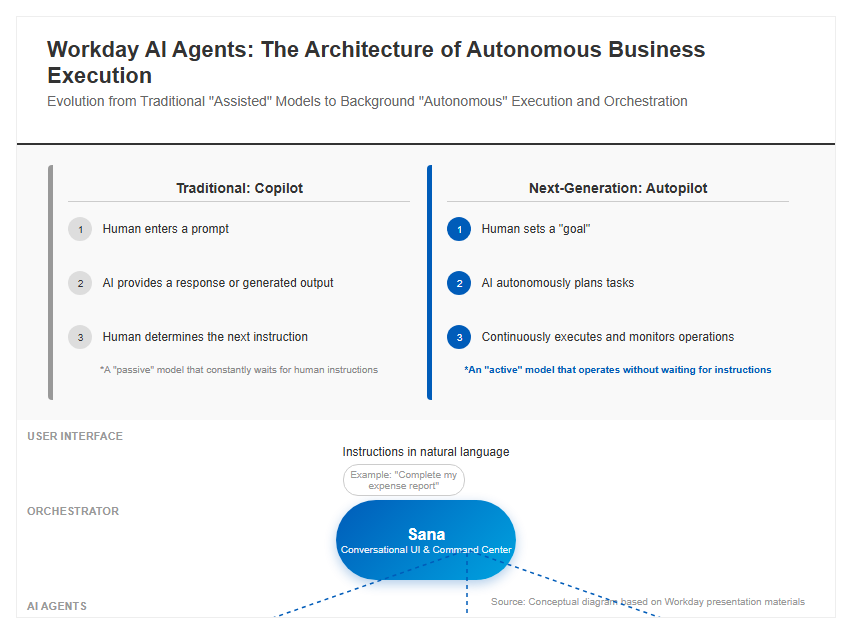
While conventional generative AI has primarily functioned as a supportive tool that generates text and data in response to user prompts, this functional expansion shifts into a realm where AI autonomously sets goals and processes continuous tasks. Unlike “Copilots” that wait for human instructions, Workday’s newly announced AI agents with autopilot capabilities possess the ability to continuously monitor and execute operations in the background. For example, in recruitment operations, instead of a recruiter handling 25 job openings having to check the status of each one individually, the AI assesses job publication statuses and necessary requirements to advance processing automatically. This significantly reduces the time HR personnel spend on checking work progress and sending reminders, creating an environment where they can concentrate on uniquely human decision-making and communication tasks. Behind this lies a structural challenge where routine verification tasks and inquiry responses, which frequently occur in HR operations, squeeze out strategic tasks that should be the primary focus.
The Mechanism of the Autopilot Feature Integrated with Sana
At the core supporting the orchestration of autonomous agents is the conversational user interface “Sana.” When employees or personnel enter instructions in natural language, Sana assigns tasks in the background to multiple appropriate AI agents and automatically executes optimal actions. Depending on work progress and task characteristics, components such as calendars, input forms, approval cards, and graphs are dynamically generated and switched on the screen. Furthermore, Sana flexibly integrates not only with data inside Workday but also with external systems such as Microsoft Outlook, Google Drive, Salesforce, and Jira. This enables the automation of advanced workflows spanning multiple applications, such as automatically creating an expense report from a receipt attached to an incoming email. Please refer to the figure below.
Specific Approaches in Recruitment, Accounting, and IT Environments
The autopilot capabilities will be rolled out sequentially to various functions, starting with the “Talent Acquisition Agent” in the HR domain, followed by payroll management, accounting, and deployment (system operations management). The Talent Acquisition Agent searches for candidates matching the criteria simultaneously with the publication of a new position, analyzes candidate information and job fit, and presents them to the recruiter. It handles everything in the background up to drafting scout emails and scheduling interviews, and after obtaining the personnel’s final approval, sends and processes them. In the accounting agent, it automatically extracts important information from contracts, prepares accounting entries, and proposes revenue recognition schedules, while executing continuous automated verification of financial data for audits. Additionally, the deployment agent analyzes the company’s usage status to propose effective new features that have not yet been activated, helping to shorten the period from planning to verification for new feature implementation—which previously took several months—down to a few weeks.
“Work Intelligence” to Visualize Organizational Tasks
Skill Analysis Breaking Down Jobs into Three Types
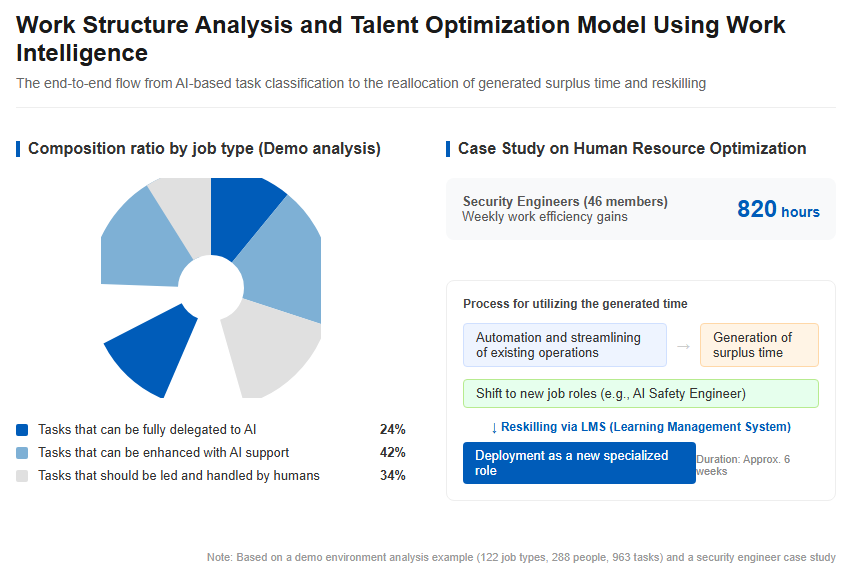
Announced alongside the introduction of AI agents is the “Work Intelligence” feature, which quantitatively visualizes and analyzes business processes within the organization. This feature automatically classifies a company’s jobs and duties into three categories: “tasks that can be completely delegated to AI,” “tasks that can be enhanced through AI support,” and “tasks that should be led and handled by humans.” For the analysis, the “Workday Skills Cloud” data infrastructure—which systematizes over 75,000 standardized skill items and the relationships between skills—is utilized. In an organizational analysis example from a demo environment involving 288 people across 122 job roles and 963 tasks, the resulting proportions were 24% for tasks left to AI, 42% for AI-supported tasks, and 34% for human-led tasks. This enables companies to redesign business processes and prioritize AI implementation based on data rather than relying on intuition and experience.
Results of Human Resource Reallocation and Reskilling Support
The strength of Work Intelligence lies not only in calculating potential task automation but also in its ability to provide a consistent proposal for the reallocation of human resources and reskilling plans to utilize the resulting surplus time. For instance, in one case, an analysis of the tasks performed by 46 security engineers revealed that a total of 820 hours of work per week could be streamlined. By further detailing the breakdown of these 820 streamlined hours, the function proposed a personnel shift toward advanced roles newly required within the organization, such as “AI Safety Engineers.” By integrating with Workday’s Learning Management System (LMS), a scenario is mapped out where necessary training programs are automatically assigned, enabling employees to become effective contributors in new specialized roles within a short period of approximately six weeks. In this way, it achieves portfolio optimization for the entire organization, rather than just improving individual task efficiency. Please refer to the following figure.
Integration of Internal Knowledge and External Expertise (Bersin Galileo Integration)
Realization of Advanced HR Advisory Functions via Sana
Workday has announced a partnership with the leading HR consulting firm The Josh Bersin Company to provide its HR-specialized AI, “Galileo,” to customers through Sana. Users can pose questions based on their own internal HR data (such as performance evaluations, attendance, payroll, and turnover rates) directly from the Workday interface. While the scope of access to company data is controlled according to the logged-in user’s permissions, Galileo generates responses by cross-referencing this data with external industry benchmarks and best practices. For example, it becomes possible to devise improvement measures by comparing a team’s turnover or engagement metrics against industry standards, or to create development roadmaps based on industry-standard skill models for specific professional roles.
Utilizing Evidence-Based Data (RAG) to Differentiate from General-Purpose AI
While it is possible to research other companies’ cases using general-purpose large language models (LLMs) like ChatGPT or Claude, there are concerns that general AI responses may be abstract or include misinformation (hallucinations) that differs from the facts. The greatest feature of Galileo lies not in the uniqueness of the model itself, but in the rigorous “grounding (RAG: Retrieval-Augmented Generation)” mechanism behind its answers. It searches through 25 to 30 years of research reports, industry-specific data, and case databases accumulated by Bersin over more than a quarter-century, extracting only highly reliable evidence to present to the AI. In a 30-question comparative verification conducted by Bersin, it was found that more than 50 errors and exaggerations occurring in general chatbots were completely eliminated through Galileo’s architecture. It is already being adopted by over 1,000 organizations worldwide, including Microsoft.
Proven Implementation Effects and Structural Challenges in Operation
Cases of Time and Cost Reductions in Leading Companies
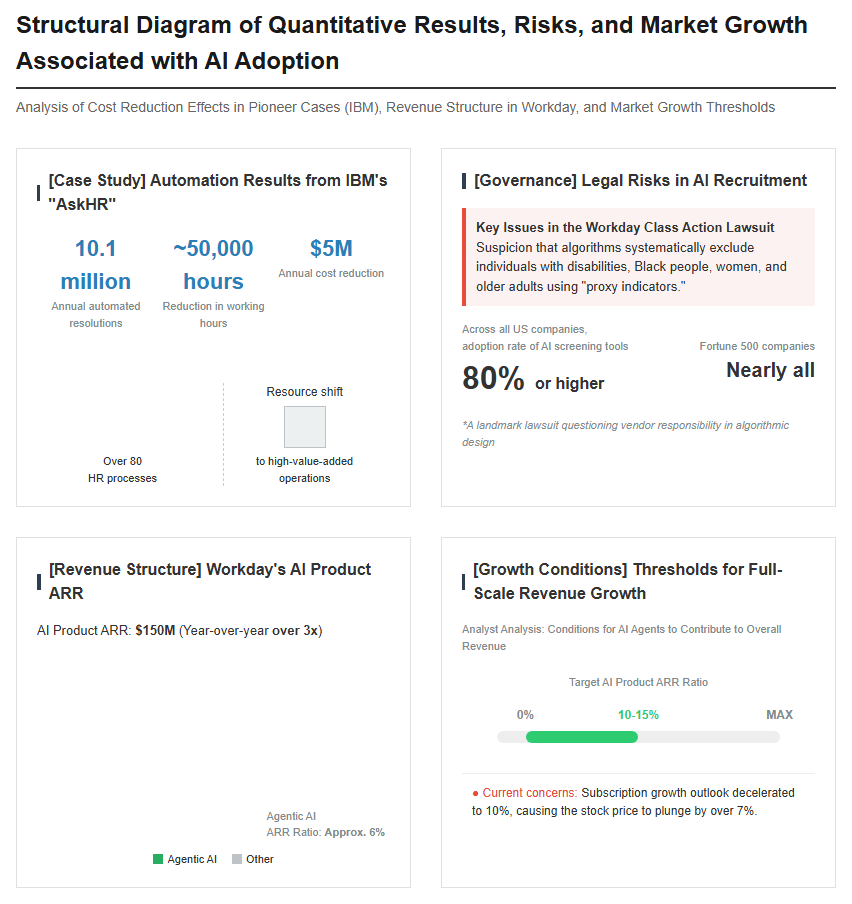
The implementation of autonomous AI agents and AI chatbots is already yielding quantitative results in leading companies. For example, “AskHR,” an internal HR AI agent implemented by IBM, automates the processing of more than 80 common HR processes. It has been announced that this enables the automated resolution of approximately 10.1 million employee inquiries and procedures annually, achieving a reduction of about 50,000 working hours and approximately 5 million USD in costs per year. By having an AI that has learned work rules and manuals serve as the primary contact point to provide immediate answers, employee waiting times are eliminated, creating an environment where HR professionals can focus on high-value-added tasks such as urgent individual consultations and system design.
Algorithmic Governance Seen in AI Recruitment Discrimination Lawsuits
On the other hand, the introduction of AI into HR operations requires strict risk management regarding legal systems and ethics. On June 22, 2026, Judge Rita Lin of the U.S. District Court for the Northern District of California ordered Workday to respond to a trial at its California headquarters regarding the first nationwide class-action lawsuit filed alleging that Workday’s AI recruitment tool is discriminatory. The plaintiffs argue that Workday’s AI selection algorithm uses “proxy indicators,” such as gaps in employment history, to systematically exclude people with disabilities, Black individuals, women, and job seekers over the age of 40, thereby violating the Americans with Disabilities Act (ADA) and other regulations. With more than 80% of all U.S. companies and nearly all Fortune 500 companies having implemented AI selection tools, the outcome of this lawsuit, which questions the responsibility of vendors for their algorithm design, is expected to have a decisive impact on future corporate governance.
Market Evaluation and Future Focus Toward Monetization
In Workday’s third-quarter fiscal year 2027 earnings report, total revenue increased 11.2% year-over-year to $2.705 billion, and non-GAAP earnings per share (EPS) exceeded market expectations at $2.82. Additionally, the Annual Recurring Revenue (ARR) for new AI products expanded to approximately $150 million—more than triple the previous year’s corresponding period—with over 2,200 core customers adopting AI products. However, the total ARR for agentic AI (approximately $600 million) accounts for only about 6% of total ARR, and after-hours share prices temporarily plunged by more than 7% following a slowdown in the subscription revenue growth outlook for the fourth quarter to 10%. Market analysts, including Morgan Stanley, analyze that for AI agent capabilities to have a significant positive impact on enterprise-wide revenue growth, the AI product ARR ratio needs to reach 10% to 15% or higher. Please refer to the following figure.
The Future Vision of HR and Key Focus Areas
Acceleration of Human Capital Management and the Evolution from “Administration” to “Business Partner”
The penetration of AI agents is fundamentally transforming the role of HR departments. Traditionally, HR departments were forced to devote significant resources to “administrative tasks” such as attendance tracking, various application procedures, and policy inquiries. However, as autopilot AI agents automatically execute routine tasks in the background and Work Intelligence visualizes optimal human resource allocation, the primary focus of HR will shift from “processing procedures” to “practicing human capital management that contributes to engagement improvement and business strategy.” While AI reduces the workload, the importance of human dialogue and ethical judgment—such as final evaluations, hiring decisions, and fostering organizational culture—is becoming even greater.
Phased Implementation Processes and Security/Governance Design
To succeed with AI agents within a company, it is important to avoid simultaneous company-wide implementation and instead take a phased approach. A “small start” is recommended, beginning with trial implementations of highly standardized tasks with clear decision criteria, such as internal inquiry handling and schedule coordination. Furthermore, because AI handles sensitive personal information such as payroll and performance evaluation data, it is essential for companies to clearly set and maintain detailed access permissions, log traceability, and control parameters for the scope of AI autonomous operation. Rather than leaving decisions entirely to AI, companies are required to take an approach that continuously verifies response accuracy and operational effectiveness while maintaining a “Human-in-the-Loop” governance structure where humans are involved in the confirmation and approval processes.
Reference Pages
- 【Workday, Inc. Official News Release】https://newsroom.workday.com/2026-10-13-Workday-Launches-Autopilot-Agents-That-Get-Real-Work-Done-Across-HR,-Finance,-and-IT
- 【Workday Japan Official Website】https://www.workday.com/ja-jp/homepage.html
【#Workday #AIAgents #HRDX #AutonomousAI #TalentManagement #HRSystems #HumanCapitalManagement #EnterpriseAI】


コメント