On October 22, 2026, Ricoh Japan Corporation launched a monthly rental plan for rack-mount GPU servers within its “RICOH On-Premises LLM Starter Kit,” which enables the operation of generative AI in on-premise environments. The background to this includes the growing demand for on-premises solutions from the perspectives of confidential information retention and data sovereignty, alongside the prolonged procurement periods for GPU servers and the burden of initial investments.
- Key points of the incident and overview of the service provision
- Facilitating Smooth Deployment Through Pre-kitting and Monthly Rentals
- Growing Demand for On-Premises Solutions Driven by Confidential Information Protection and Data Sovereignty
- the existing barriers of prolonged GPU procurement and rising costs
- Flexible usage period settings and avoidance of equipment obsolescence risk
- Future Outlook and Key Points for Local Generative AI Utilization
Key points of the incident and overview of the service provision
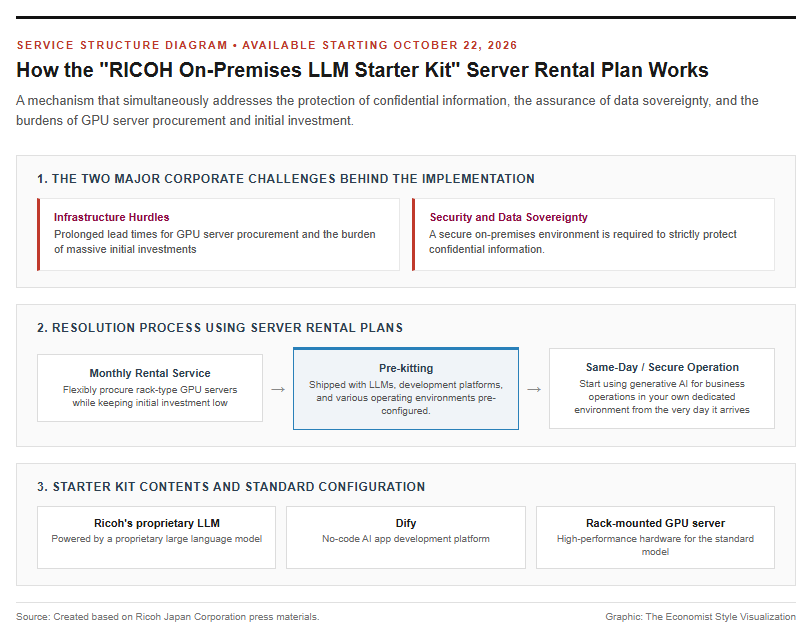
On October 21, 2026, Ricoh Japan Corporation announced a new server rental plan that allows monthly use of rack-type GPU servers as a new service for the “RICOH On-Premises LLM Starter Kit,” a one-stop service supporting the adoption and operation of generative AI in on-premises environments. The service became available on October 22, 2026. This service provides the high-performance rack-type GPU servers used in the starter kit’s standard model on a rental basis. Upon delivery, the servers are shipped pre-kitted (pre-configured) with Ricoh’s proprietary large language model (LLM), “Dify,” a no-code development platform for building AI applications, and various operating environments. This allows adopting companies to begin using generative AI for business in a secure, dedicated in-house environment from the very day the equipment arrives, without the need for complex environment setup tasks. Please refer to the conceptual diagram below for the service configuration and delivery format.
Facilitating Smooth Deployment Through Pre-kitting and Monthly Rentals
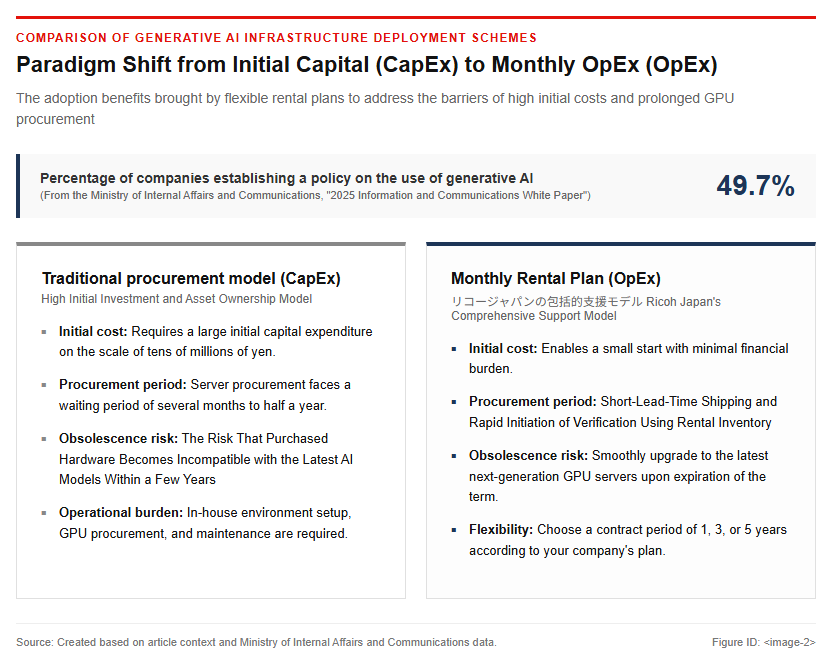
Traditional on-premises AI deployment has required advanced expertise and a massive amount of setup effort, ranging from hardware selection to the configuration of the OS, GPU drivers, inference engines, and security settings. With the new monthly rental plan, various software and operating platforms are pre-configured with optimal combinations, significantly lowering the technical hurdles for enterprises. Furthermore, while the traditional purchase model required a hefty initial capital expenditure (CapEx) on the scale of tens of millions of yen, adopting a monthly rental method (OpEx) makes budget planning easier and enables a small start with minimized financial burdens. In addition, Ricoh Japan goes beyond merely providing hardware; it comprehensively offers support for building business-specific AI applications utilizing “Dify,” employee training at the time of implementation, and operational Q&A support, establishing a system that comprehensively backs the adoption of generative AI and business efficiency improvements across the entire organization.
Background and Market Challenges of the Return to On-Premises AI
Growing Demand for On-Premises Solutions Driven by Confidential Information Protection and Data Sovereignty
In recent years, the adoption of generative AI has been rapidly penetrating corporate business transformations, with a survey in the Ministry of Internal Affairs and Communications’ “2025 White Paper on Information and Communications” showing that the percentage of companies establishing policies for generative AI use has reached nearly half at 49.7%. Meanwhile, in sectors such as finance, healthcare, manufacturing, and public services, deep-rooted security concerns and compliance constraints persist regarding transmitting confidential information—such as design blueprints, customer data, and personal information—to external public clouds. Furthermore, due to economic security risks and the need to ensure data sovereignty (sovereign AI) concerning data routed through and stored on overseas servers, as well as concerns over ballooning costs associated with rapid surges in usage on pay-as-you-go clouds, the trend of a “return to on-premises” to keep data under in-house management is accelerating rapidly.
the existing barriers of prolonged GPU procurement and rising costs
While the need to operate LLMs in on-premises environments is growing, procuring, building, and maintaining in-house GPU infrastructure has presented significant challenges. Amid the soaring global demand for AI, the lead times for procuring high-performance GPU servers have lengthened, frequently resulting in waiting periods ranging from several months to over half a year from the time an AI implementation decision is made until actual operation begins. Furthermore, the pace of GPU evolution is extremely rapid, and the “risk of equipment obsolescence”—where expensive hardware purchased in-house becomes unable to support the latest AI models within just a few years—has also been a factor making companies hesitant to adopt it. Facing the dual barriers of soaring cloud service usage fees and the initial costs of on-premises construction, companies have been strongly yearning for the emergence of a new implementation scheme that achieves both a shortened procurement period and fixed costs.
Benefits for Adopting Companies and Future Prospects
Flexible usage period settings and avoidance of equipment obsolescence risk
A major strength of Ricoh’s rental plan is the ability to choose flexible contract periods such as 1, 3, or 5 years depending on a company’s AI utilization plan and verification phase. Through short-lead-time shipping utilizing rental inventory, companies can launch AI projects without missing the right timing, enabling rapid verification and practical application. Furthermore, upon expiration of the rental period, it is possible to smoothly upgrade and transition to a new server equipped with the latest next-generation GPUs, fundamentally solving the risks of long-term asset ownership and hardware obsolescence associated with owning equipment in-house. Companies can constantly utilize state-of-the-art AI computing infrastructure within a fixed monthly cost, allowing them to expand internal deployment in phases while assessing effectiveness. Please refer to the image below for the relationship between implementation benefits and the operational cycle.
Future Outlook and Key Points for Local Generative AI Utilization
Ricoh Japan has announced plans to expand its lineup of hardware specifications and various rental plans tailored to specific use cases and scales—ranging from PoC (proof of concept) and pre-deployment verification to large-scale, full-scale operations—in order to meet the diversifying AI adoption requirements of enterprises. In addition, the company will strengthen integration with its proprietary LLMs currently under development, such as the “Ricoh LMM_35B-A3B,” as well as cutting-edge AI agent technologies and self-improving models, to support advanced business automation in secure local environments. On-premises solutions that leverage generative AI while keeping confidential information protected within the company are expected to become increasingly important moving forward, serving not merely as a cost-cutting measure, but as a foundational data utilization platform that dictates corporate competitiveness.
Reference page
- 【Server Rental Plan Launched for the “RICOH On-Premises LLM Starter Kit”】https://jp.ricoh.com/release/2026/1021_1
- [RICOH On-Premises LLM Starter Kit Official Information] https://promo.digital.ricoh.com/ai/service/ricoh-on-premises-llm-starter-kit/
[#Ricoh #OnPremiseLLM #GPUServer #GenerativeAI #DataSovereignty #Dify #DX]

コメント