
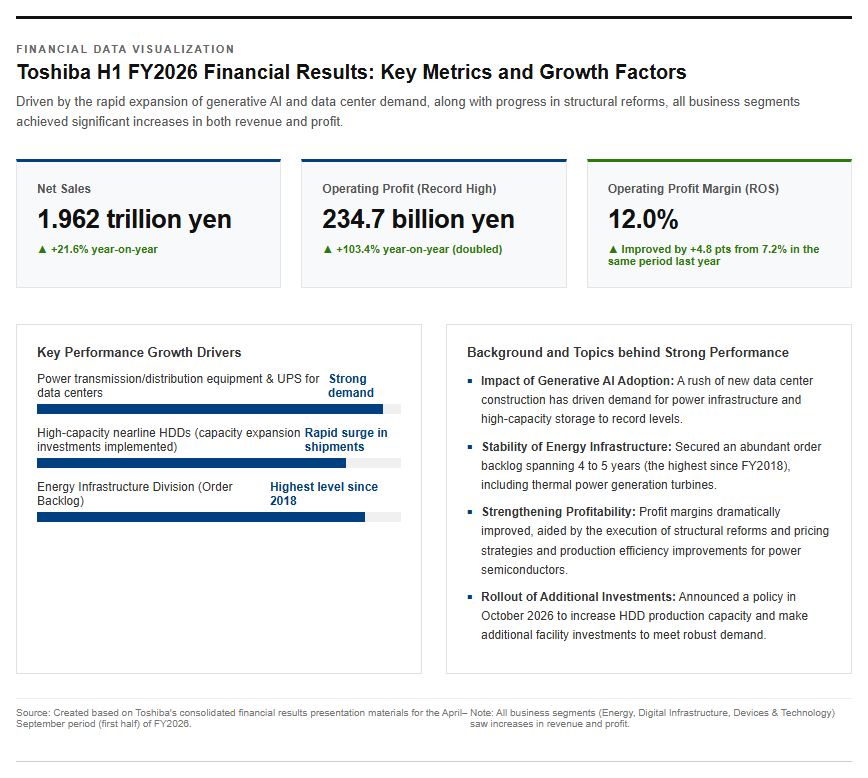
Toshiba’s financial results for the first half of fiscal 2026 reached record highs, with net sales increasing by 21.6% year-on-year to 1.962 trillion yen and operating profit doubling to 234.7 billion yen. The drivers behind this business expansion are strong demand for data center equipment accompanying the spread of generative AI, and enhanced profitability through structural reforms.
- Key Takeaways: Overview of First-Half Results and Background of Record Profits
- Segment-Specific Results and the Ripple Effect of Data Center Demand
- Structure of 2.5 Trillion Yen in Net Income and Fluctuations in Kioxia Share Valuation Gains
- Results of the Toshiba Revival Plan and Reverse Carve-Out Organizational Reforms
- Momentum in US AI Infrastructure Investment and Supply Constraint Risks
- Future Outlook and Key Points: Accelerated Growth from FY2027 Onward and Challenges for Relisting
Key Takeaways: Overview of First-Half Results and Background of Record Profits
Toshiba’s consolidated financial results for the April–September period of 2026 (first half of fiscal 2026), announced on November 13, 2026, showed that operating profit—an indicator of core business earnings—surged 103.4% year-on-year to 234.7 billion yen, marking a record high for an interim period. Net sales reached 1.962 trillion yen, a 21.6% increase year-on-year, with all business segments achieving higher sales and profits. The ratio of operating profit to net sales (ROS), which indicates core profitability, improved significantly by 4.8 percentage points from 7.2% in the same period last year, rising to 12.0%.
The primary driver behind this sharp business expansion was the global spread of generative AI and a rush in data center construction. Shipments of transmission and distribution equipment, uninterruptible power supplies (UPS), and high-capacity nearline hard disk drives (HDDs)—all essential for data centers—performed exceptionally well. Furthermore, order backlogs in the energy infrastructure division, including thermal power turbines, reached their highest level since fiscal 2018, with a rich accumulation of orders spanning 4 to 5 years. To meet this increasing demand, Toshiba announced policies in October 2026 to increase HDD production and make additional capital investments in facilities.
Segment-Specific Results and the Ripple Effect of Data Center Demand
By business segment, all three core areas—Energy, Digital Infrastructure, and Devices & Technology—recorded significant increases in both sales and profits. In the Energy business, the accelerated adoption of renewable energy both domestically and internationally, alongside the development of power infrastructure accompanying the establishment of new data centers, acted as a tailwind, significantly boosting sales of power transmission/distribution equipment and power plant machinery. In the Digital Infrastructure business as well, industrial systems, defense/radio systems, and railway equipment maintained steady orders.
In the Devices sector, in addition to robust demand for nearline HDDs, pricing measures for power semiconductors and improvements in production efficiency contributed to boosting profit margins. As shown in the diagram below, a wide variety of systems are required inside data centers, ranging from power supply to cooling and power receiving/transforming equipment.
The Toshiba Group has established a dedicated organization providing one-stop services from data center design, equipment supply, and construction to operational support, accelerating the realization of group-wide synergies. Through self-help efforts such as a decrease in product warranty provisions and improvements in marginal profit ratios, the business structure—which formerly suffered from a heavy fixed-cost burden—has transformed into a lean, high-profitability entity.
Financial Structure and Progress of Management Reforms
Structure of 2.5 Trillion Yen in Net Income and Fluctuations in Kioxia Share Valuation Gains
Consolidated net income for the first half of fiscal 2026 reached 2.5283 trillion yen, approximately eight times that of the same period last year, marking a record high for an interim period. The main factor behind this massive profit increase was that valuation and gain on sales relating to shares of major semiconductor company Kioxia Holdings held by Toshiba were recorded as non-operating income. Driven by growing demand for AI-related SSDs, Kioxia’s stock price surged from the spring of 2026, temporarily boosting Toshiba’s financial results.
However, the impact of fluctuations in the stock market has also become clear. In the April–June period of 2026 (first quarter), non-operating income of 6.3294 trillion yen—centered mainly on valuation gains from Kioxia shares—was recorded, bringing net income to 4.4673 trillion yen. However, subsequent adjustments in semiconductor stocks halved the valuation gains in the July–September period. As a result, interim net income decreased by nearly 2 trillion yen from the first-quarter figure. Operating cash flow steadily expanded, rising 52% year-on-year to 170.7 billion yen, and market participants are evaluating the fluctuations in valuation gains separately from core earning power.
Results of the Toshiba Revival Plan and Reverse Carve-Out Organizational Reforms
In December 2023, under the umbrella of Japan Industrial Partners (JIP), Toshiba delisted from the Tokyo Stock Exchange and opted to go private. Moving away from the short-term pressures of the stock market, the company announced a new mid-term management plan, the “Toshiba Revival Plan,” in May 2024. In the past, Toshiba had spun off its infrastructure, energy, and digital businesses to speed up decision-making, but this resulted in increased coordination costs (Decision Costs) due to organizational fragmentation.
The Revival Plan “reverse-rotated” these spin-offs, advancing a reverse carve-out type PMI (Post-Merger Integration) that absorbs key subsidiaries back into Toshiba’s parent entity. Toshiba Infrastructure Systems was absorbed and integrated on April 1, 2025, followed by the integration of Toshiba Energy Systems and Toshiba Digital Solutions into the parent company on April 1, 2026. The optimization of up to 4,000 personnel, the consolidation of head office functions into the Kawasaki district, and the introduction of a business segment (BS) system and appointment of Co-COOs starting in November 2025 have significantly streamlined the decision-making hierarchy. As a result, the operating profit margin target of 10% for fiscal 2026 set out in the mid-term management plan is projected to be exceeded.
Macro Environment and Future Outlook
Momentum in US AI Infrastructure Investment and Supply Constraint Risks
Data center demand supporting Toshiba’s core business is driven by explosive AI-related investments by major US tech companies (hyperscalers). Capital expenditures on data centers by the top five companies are projected to surge from $51.2 billion in 2020 to $310.6 billion in 2025. Furthermore, US construction spending on data centers reached $75.2 billion and power infrastructure reached $137.9 billion as of July 2026. North American data center vacancy rates dropped to a historic low of 1.4% by the end of 2025, reflecting an acute market over-demand condition.
On the other hand, multiple supply constraints and risks have been pointed out regarding the mid- to long-term sustainability of investments. Power shortages and delays in grid connections associated with the rapid increase in data centers, the securing of water resources for cooling, and a shortage of specialized construction personnel are factors delaying construction schedules. In addition, the increasing CAPEX burden on hyperscalers and rising data center construction costs ($11.3 million/MW forecasted for 2026) are also notable. Toshiba aims to solve these market challenges by providing high-efficiency power transmission and distribution equipment and power-saving storage technologies that resolve such infrastructure bottlenecks.
Future Outlook and Key Points: Accelerated Growth from FY2027 Onward and Challenges for Relisting
Having achieved record-high profits in the first half of FY2026, Toshiba’s management phase is shifting from “lean restructuring” to the next stage of “strengthening earning power and growth investment.” Toshiba has announced plans to increase capital expenditures and R&D investments in focus areas such as energy, data centers, physical AI, and defense from FY2027 onward. In the defense sector, orders for surveillance radars and guidance equipment are surging, accelerating new investments to expand production capacity.
Key points to watch going forward include remaining challenges in business portfolio reform and future relisting scenarios. The outcome of the reorganization negotiations for the power semiconductor business—which are ongoing with ROHM and Mitsubishi Electric—and the handling of Toshibaテック (Toshiba Tec), which is required to resolve parent-subsidiary listing issues, will be the focus of future management. Whether Toshiba can commercialize differentiated technologies such as next-generation power semiconductors and quantum technology at an early stage while maintaining the swift decision-making system established through privatization will determine whether it can enhance corporate value and achieve a “complete resurgence” in the mid- to long-term.
References
- [Toshiba FY2026 Q2 Financial Results Briefing Materials] https://www.global.toshiba/content/dam/toshiba/jp/ir/corporate/finance/pdf/tpr2026q2.pdf
[#Toshiba #FinancialResults #DataCenter #GenerativeAI #StructuralReform #Kioxia]


コメント