
On November 26, 2026, Sakana AI announced an update introducing new modes, “Twilight 2.0” and “Midnight 2.0,” to its strategic research AI, “Sakana Marlin,” significantly boosting research depth and processing speed. In addition to the existing lightweight mode, advanced verification functions and an automated PowerPoint slide generation feature tailored to specific purposes and time limits have been introduced, driven by the goal of implementing evolving test-time scaling technology in society.
- Key Takeaways: Overview of the New Sakana Marlin Modes
- A Naming Convention Inspired by the Ocean’s Depths and Clear Role Division by Mode
- Comparison of Research Capabilities Between Conventional Sunlight and the New Modes
- Technical Innovations Involving Test-Time Scaling and Iterative Hypothesis Verification
- A dedicated harness that automates everything from data integration to slide generation
- Future developments and key points to watch in business utilization
Key Takeaways: Overview of the New Sakana Marlin Modes
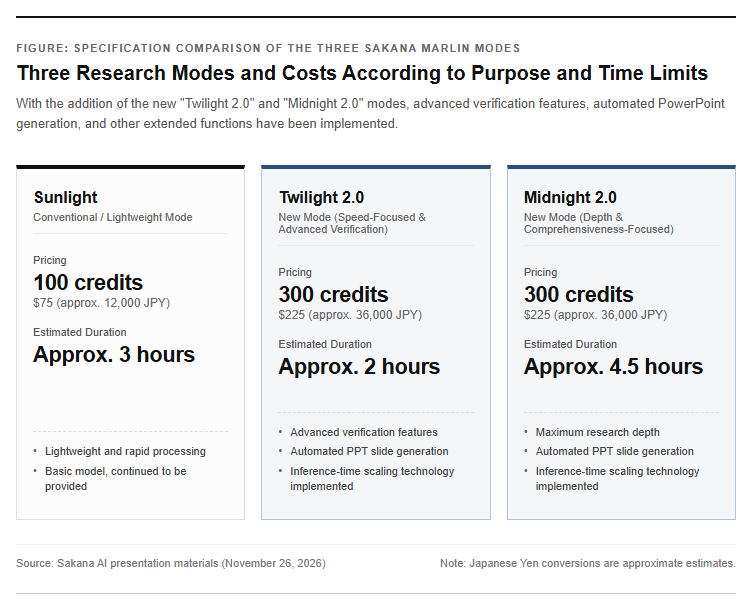
On November 26, 2026, Tokyo-based AI company Sakana AI announced a major feature update to its autonomous research AI, “Sakana Marlin.” The highlight of this update is the official introduction of two new modes, “Twilight 2.0” and “Midnight 2.0,” which respectively evolve research speed and depth. The conventional Sakana Marlin will continue to be offered as the lightweight “Sunlight” mode, allowing users to choose from three different modes depending on their research objectives and time constraints. In terms of pricing, while the conventional Sunlight mode is available at 100 credits per run ($75, approx. 12,000 JPY), both new modes, Twilight 2.0 and Midnight 2.0, are set at 300 credits per run ($225, approx. 36,000 JPY). The estimated processing times are about 3 hours for Sunlight, about 2 hours for Twilight 2.0, and about 4.5 hours for Midnight 2.0, establishing a system capable of meeting diverse business requirements such as quick reporting and specialized analytical depth. The chart below shows the relationship between the pricing and expected processing time for each mode.
A Naming Convention Inspired by the Ocean’s Depths and Clear Role Division by Mode
The names of the newly added modes originate from the structure of the “ocean layers,” ranging from the shallow sea reached by sunlight to the lightless deep sea. Sunlight, symbolizing the shallow layer, is suitable for keeping costs down while grasping general overviews, making it ideal for the initial stage of quickly surveying the landscape of an unfamiliar domain. In contrast, “Twilight 2.0,” named after the twilight zone where light dimly reaches, is a mode designed to quickly and broadly capture the overall structure and key arguments of a target theme. It demonstrates high efficacy when you need to urgently organize points before your next meeting or when you want to rapidly get an overview of an unknown market during the launch of a new project. Meanwhile, “Midnight 2.0,” named after the bathypelagic zone where no light reaches at all, is the deepest-tier mode combining thorough comprehensiveness of arguments, deep exploration, and advanced verification capabilities. It is the optimal choice when you want to extract new insights from specialized fields where you already possess a certain level of knowledge, or when robust backing and multifaceted analysis are required for creating external reporting materials.
Comparison of Research Capabilities Between Conventional Sunlight and the New Modes
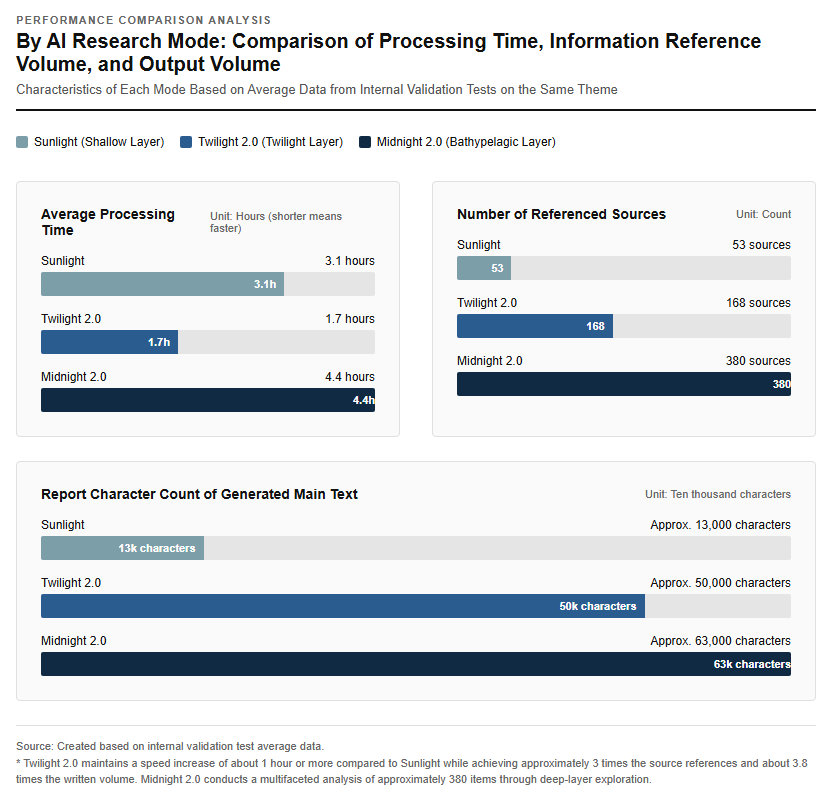
According to average data from internal validation tests conducted on the same theme, clear performance differences in processing time, volume of referenced information, and report length are demonstrated among the three modes. The average processing time in the conventional Sunlight mode was 3.1 hours, with 53 cited sources referenced and a generated body text length of approximately 13,000 characters. In contrast, the speed-focused Twilight 2.0 mode significantly shortens the processing time to 1.7 hours—finishing over an hour faster than Sunlight—while referencing 168 sources (about three times as many) and outputting a detailed report spanning approximately 50,000 characters. Furthermore, the Midnight 2.0 mode, which performs the deepest exploration, takes an average processing time of 4.4 hours to analyze 380 sources from multiple angles—equivalent to about seven times that of Sunlight—and produces a report of approximately 63,000 characters, boasting about five times the volume. The dramatic increase in the number of referenced information sources makes it less susceptible to specific primary sources or biased opinions, offering the advantage of facilitating the comparative verification of conflicting claims and the identification of logical contradictions.
Technical Approach and Impact on Business Society
Technical Innovations Involving Test-Time Scaling and Iterative Hypothesis Verification
Behind this technological innovation lies research findings that fuse “inference-time scaling”—a major trend in recent AI development—with methodologies for evaluating complex intellectual output. Inference-time scaling is an approach that dramatically improves the quality of output by allocating more of a model’s computational resources to the inference process during response generation. However, in real-world strategic research where there is no single predetermined correct answer, simply extending computation time or inference steps has posed the challenge of not leading to stable quality improvements. The development team at Sakana AI constructed an autonomous research process in which the AI reconstructs questions on its own based on information obtained during the investigation, repeatedly revising and verifying hypotheses. By incorporating an evaluation model that forces the AI to self-requestion—asking “Is the presented conclusion really correct?” or “Are there other conflicting possibilities?”—they have succeeded in simultaneously enhancing the volume and quality of inference. The figure below illustrates the processing process in which the autonomous agent repeats hypothesis verification.
A dedicated harness that automates everything from data integration to slide generation
In response to the dramatic increase in the volume of report text resulting from the deepened research enabled by the new mode, this update also implemented a fundamental overhaul of the slide output function in Microsoft PowerPoint format. The generation algorithm has been enhanced so that executives and frontline personnel who lack the time to read long, full-length reports can instantly grasp the overall picture of the survey and key decision-making elements by referring only to the slide materials. To realize this function, the company newly developed a dedicated harness that enables AI agents to assemble professional-grade presentation materials. After reading the entire report, the agent designs the story structure and consistently handles everything from the automatic generation of the cover, table of contents, and executive summary, to writing lead sentences that clearly state the conclusion for each slide, diagramming the logical structure, graphing quantitative data, and appending supporting reference URLs. The function to output to individual slide templates specified by the company or clients is also maintained, drastically reducing the practical man-hours required for document creation.
Future developments and key points to watch in business utilization
The emergence of Sakana Marlin’s new mode holds the potential to significantly transform the nature of intellectual production activities such as corporate market research, competitor analysis, and the understanding of regulatory trends. In particular, its high practicality is evidenced by the provision of flexible contract formats tailored for corporate use, such as the “Team Plan,” which allows 20 uses of the new mode per month for $3,125 (approx. 500,000 yen) in addition to a pay-as-you-go plan (approx. 36,000 yen per use). On the other hand, it has been explicitly stated that the tool is currently unsuitable for investigations in ultra-niche areas with extremely scarce publicly available information, applications requiring second-by-second immediacy, or analyses closed exclusively within internal sequestered data. Furthermore, confirming the opt-out design regarding the reuse of input data for retraining and ensuring compliance with laws, regulations, and security governance will be important steps when corporations implement the system. As the importance of AI sovereignty is championed for a Japan-origin frontier AI company, all eyes will be on how the technological approach of achieving high-efficiency research and inference without excessive reliance on computational resources is received in domestic and international business markets moving forward.
Reference Pages
- [Sakana AI Official Announcement: Sakana Marlin Update] https://sakana.ai/marlin-update-2/
- [Sakana Marlin Official Product Page] https://sakana.ai/marlin/
[#SakanaAI #SakanaMarlin #GenerativeAI #AIAgents #ResearchAI #InferenceTimeScaling #DocumentCreation]
コメント