In October 2026, Japan’s imports from the Middle East reached 1.2338 trillion yen, a 27.9% increase compared to the same month of the previous year. Although the actual volume of crude oil imports decreased, soaring crude oil prices and the depreciation of the yen are significantly pushing up energy procurement costs.
- Key points of October trade statistics and data on the surge in imports from the Middle East
- The shadow of high crude oil prices and a weak yen pushing up values amidst a slight decline in import volumes
- Sharp increases in the UAE and Oman and notable differences in import trends by major country
- The ripple effects of corporate prices and passing on costs, spreading from petrochemicals to daily necessities
- Trade Deficit for the Sixth Consecutive Month and the Substantial Burden on Public Livelihoods and Corporate Earnings
- Development of Alternative Procurement and Security Systems, and the Mid- to Long-Term Outlook for Reducing Dependence on the Middle East
Key points of October trade statistics and data on the surge in imports from the Middle East
According to the preliminary trade statistics for October released by the Ministry of Finance on November 18, 2026, Japan’s imports from the Middle East expanded by 27.9% year-on-year to 1.2338 trillion yen. Meanwhile, exports from Japan to the Middle East remained at 3878 billion yen, a 15.0% decrease year-on-year, widening the trade deficit with the Middle East to 8461 billion yen. In global trade as a whole, exports increased by 20.5% year-on-year to 11.7688 trillion yen, and imports rose by 21.6% to 12.2453 trillion yen. Although both exports and imports set record highs for a single month, the resulting trade balance showed a deficit of 4765 billion yen, marking the sixth consecutive month of deficits. The surge in imports from the Middle East has become a major factor exerting strong pressure on Japan’s overall trade balance. Of the total import value from the Middle East, crude and heavy oil imports reached 1.0362 trillion yen, accounting for an extremely high proportion of 84.0% of the total. In Japan’s energy procurement structure, which relies heavily on the Middle East, this sharp increase in import value is having a profound impact on the domestic economy. Please refer to the figure below.
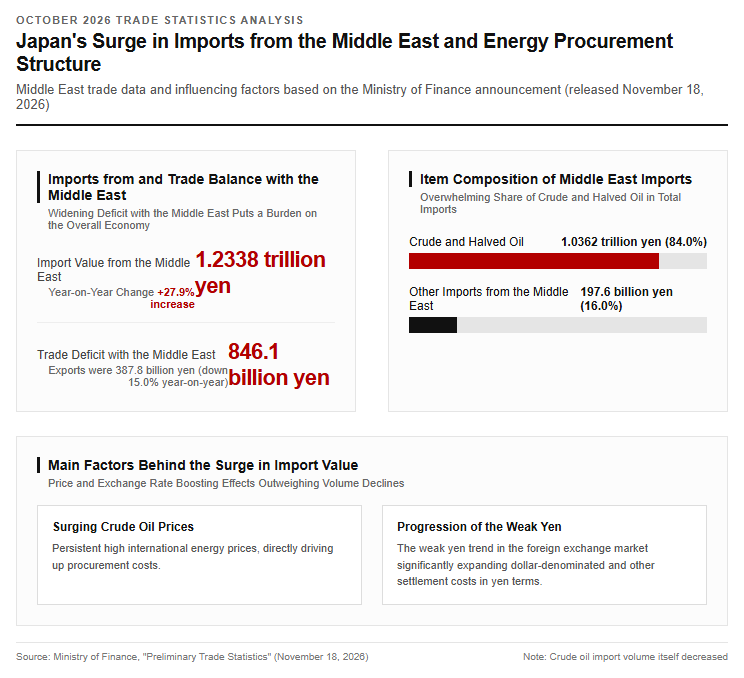
Behind this rapid increase in value is not an increase in local procurement volume, but rather soaring procurement unit prices driven by international market conditions and exchange rate fluctuations.
The shadow of high crude oil prices and a weak yen pushing up values amidst a slight decline in import volumes
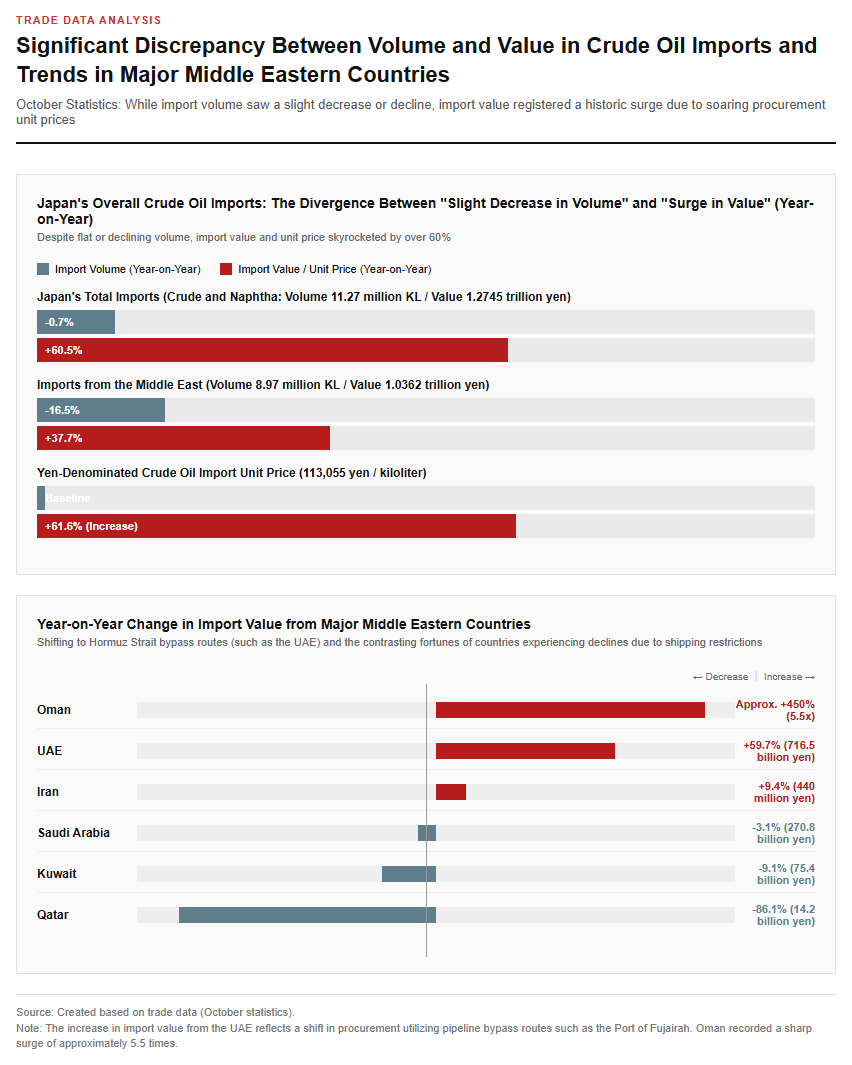
The most notable point in the October trade data is the striking divergence between import volume and import value. While Japan’s total import volume of “crude and heavy oil” in October was 11.27 million kiloliters—virtually flat to a slight decrease of 0.7% year-on-year—the import value surged by 60.5% year-on-year to 1.2745 trillion yen. Furthermore, limiting the figures to import volumes from the Middle East, despite a significant drop of 16.5% year-on-year to 8.97 million kiloliters, the value-based figure jumped 37.7% to 1.0362 trillion yen. The direct reason for the increase in value despite falling volume is the rise in import unit prices caused by soaring international crude oil prices and the depreciation of the yen. The yen-denominated crude oil import unit price in October reached 113,055 yen per kiloliter, marking a record year-on-year increase of 61.6%. Due to restrictions on passage through the Strait of Hormuz accompanying the US-Israel-Iran conflict that broke out at the end of February 2026, tanker freight rates and marine insurance premiums have skyrocketed in addition to rising international crude oil market conditions. This sharp surge in transportation costs is passed on directly to Japan’s import unit prices, creating a structure that drives up overall energy procurement expenses.
Sharp increases in the UAE and Oman and notable differences in import trends by major country
Analyzing October import values from major Middle Eastern countries by nation reveals notable differences stemming from responses to geopolitical risks and changes in transportation routes. Imports from the United Arab Emirates (UAE), the largest import partner, expanded significantly by 59.7% year-on-year to 7165 billion yen. Imports from Oman also expanded to 1252 billion yen, recording a sharp surge of about 5.5 times the amount from the same month last year. This background is driven by a shift in procurement utilizing facilities such as the UAE’s Fujairah port, which serves as a pipeline detour route avoiding the Strait of Hormuz. In contrast, imports from Saudi Arabia decreased by 3.1% year-on-year to 2708 billion yen, those from Kuwait dropped by 9.1% to 754 billion yen, and those from Qatar plunged by 86.1% to 142 billion yen. The drastic drop in imports from Qatar is largely due to a combination of navigation restrictions in the Strait of Hormuz, scheduled maintenance, and switches to alternative routes. Meanwhile, imports from Iran stood at 444 million yen, up 9.4% year-on-year. As Japanese companies adjusted their procurement sources in response to each country’s geographical location and the status of maritime transport route safety, contrasting fortunes in import values emerged within the Middle East region.
Multifaceted impacts on the domestic economy and industrial structure and future prospects
The ripple effects of corporate prices and passing on costs, spreading from petrochemicals to daily necessities
The soaring costs of energy and naphtha imports from the Middle East are having a serious impact on domestic industry and the price system. Naphtha, refined from crude oil, is a foundational raw material for a wide variety of chemical products such as plastics, synthetic rubber, paints, and synthetic fibers, but its import price has risen sharply compared to before the crisis. Facing this surge in raw material costs, petrochemical companies and intermediate goods manufacturers have been forced to raise selling prices for ethylene-based products and synthetic resins. In the Domestic Corporate Goods Price Index, petroleum/coal products and chemical products have risen ahead of others, and these impacts are sequentially spreading to downstream products such as metal products, electronic components, and packaging materials with a time lag of about several months to a year. Please refer to the figure below.
Going forward, the passing on of costs to final consumer goods such as food packaging, daily necessities, and various automotive components is expected to progress sequentially. While companies are trying to avoid a sudden deterioration in earnings by passing on rising purchase prices to product prices, concerns over squeezed profits due to delayed price pass-through and suppressed demand are spreading across both manufacturing and non-manufacturing industries.
Trade Deficit for the Sixth Consecutive Month and the Substantial Burden on Public Livelihoods and Corporate Earnings
The persistently high cost of energy procurement is imposing a heavy burden on the macroeconomic aspects of the Japanese economy as well as on household and corporate finances. The October trade deficit of 476.5 billion yen—marking the sixth consecutive month of trade deficits—occurred despite strong exports of semiconductor-related products driven by AI demand, because the scale of energy imports expanded even further. The entrenchment of a massive trade deficit tends to create real-demand selling pressure on the yen in the foreign exchange market, forming a vicious cycle that triggers further depreciation of the currency. In addition, electricity and city gas rates are highly likely to rise again from autumn into winter, as the rising import prices of raw materials such as LNG and coal are automatically reflected with a delay of several months through the fuel cost adjustment system. Although the government has sought to directly curb prices through drastic fuel oil mitigation measures and electricity and gas rate support policies, a huge amount of fiscal funds has been poured into subsidizing these measures, making the expansion of the fiscal burden another issue. The rise in energy costs pushes up corporate production costs and reduces real disposable incomes for households, carrying the risk of dragging down the economic recovery.
Development of Alternative Procurement and Security Systems, and the Mid- to Long-Term Outlook for Reducing Dependence on the Middle East
The focus moving forward is on structural efforts to reduce dependence on the Middle East and the establishment of an energy security framework. In the Energy White Paper 2026, approved by the Cabinet in October 2026, the government expressed a sense of crisis, stating that situations are now occurring which cannot be addressed solely by conventional reserve releases or temporary alternative procurements. In response, it has submitted three bills to the Diet to strengthen the institutional foundation: a bill to diversify crude oil and other procurement to support diversification during normal times, a bill for crude oil and other transportation insurance in which the government supplements wartime maritime transport insurance, and an amendment bill to the JOGMEC Act to provide investment and financing for alternative transport routes and next-generation resource development. Japanese companies are proceeding with the expansion of procurement from sources such as U.S. crude oil and Algerian naphtha, and there is a movement toward seeing dependence on the Middle East drop from a temporary high of over 90% to under 70%. However, there are no small challenges, including the permanent increase in freight costs associated with transportation from distant locations such as North America, and the burden of investment to remodel domestic refinery facilities optimized for Middle Eastern crude oil. Over the medium to long term, it will be extremely important to accelerate the electrification of automobiles, the transition to bio-feedstocks, and the development of plastic-saving technologies, thereby breaking away from the excessive reliance structure on fossil fuels as a whole.
References
- [Ministry of Finance: October 2026 Trade Statistics (Preliminary Figures)] https://www.customs.go.jp/toukei/shinbun/trade-st/2026/2026104.xml
- [Japan External Trade Organization (JETRO) Business News] https://www.jetro.go.jp/biznews/2026/11/8aa1a86dba5660e5.html
[#TradeStatistics #MiddleEastSituation #HighCrudeOilPrices #EnergySecurity #JapaneseEconomy #HighPrices #AlternativeProcurement]


コメント