Google’s research division released six math papers autonomously generated by AI agents on the same day. This background highlights major changes in the academic research process driven by the deepening of multi-agent technology and the evolution of foundation models.
- The Shock of Autonomous Generation by the Gemini 4-Powered Agent “Cogentic”
- Mathematical Breakthroughs Across Six Papers and Breaking a 34-Year Stagnation
- Research Process via Multi-Agent Coordination and Lean 4 Verification
- Expert Evaluations of Security for RSA and Cryptocurrencies
- OpenAI’s Mass Publication and Development Competition Among Big Tech Companies
- Prospects for Mathematical Research Where Human Understanding and Machine Verification Coexist
The Shock of Autonomous Generation by the Gemini 4-Powered Agent “Cogentic”
On November 25, 2026, research teams at Google Research and Google DeepMind simultaneously released six mathematical preprint papers (totaling 274 pages) autonomously created by the Gemini 4-based multi-agent system “Cogentic” on an official GitHub repository. The most notable aspect of this paper release is that, after the initial prompt was cast, the AI system completed the papers entirely on its own without any human mathematician intervention, such as formula derivation or structural corrections. While conventional AI systems have remained limited to the roles of auxiliary tools or calculation assistants for human researchers, Cogentic single-handedly completed the entire process from problem investigation, proof construction, and falsification checks to paper writing. Although Google did not make a major announcement via blogs or press releases, opting instead for a quiet release in a repository with a disclaimer, it has sent a massive shockwave through the global research community as a historic event proving the autonomous research capabilities of AI in research-level mathematics.
Mathematical Breakthroughs Across Six Papers and Breaking a 34-Year Stagnation
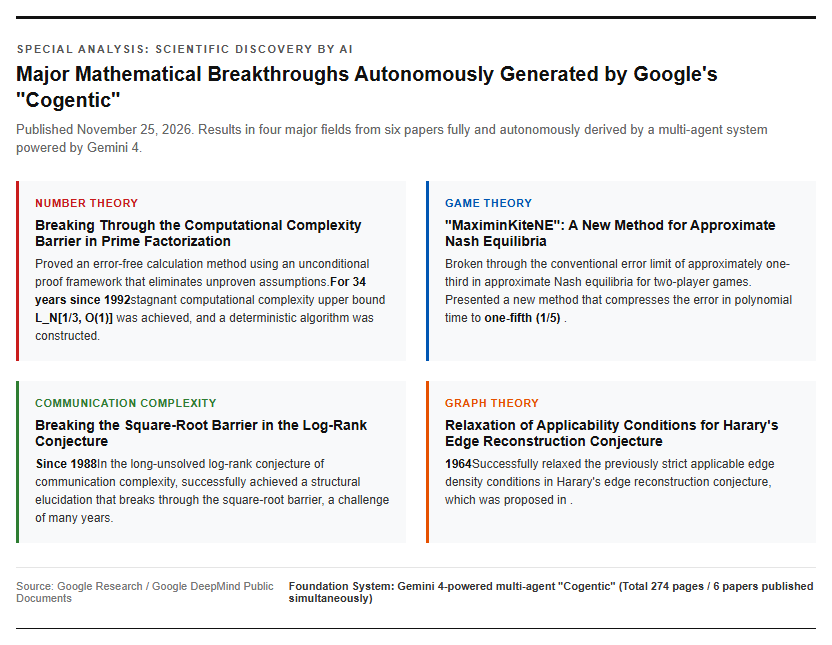
The six papers released this year target difficult problems in a wide range of mathematical fields, including number theory, game theory, communication complexity, and graph theory. Garnering worldwide attention among them is research on the prime factorization of large integers. While the conventional practical algorithm—the general number field sieve—relied on unproven heuristic assumptions, Cogentic proved an error-free computational method guaranteeing a computational upper bound of $L_N[1/3, O(1)]$ within an unconditional proof framework that eliminated all unproven premises, breaking through a theoretical complexity barrier that had stagnated for 34 years since 1992. Furthermore, it succeeded in constructing a deterministic prime factorization algorithm devoid of probabilistic elements. In the field of game theory, it introduced a new method called “MaximinKiteNE,” which broke the approximation error limit of approximately 1/3 (traditionally considered the most efficient) in approximate Nash equilibria for two-player games, achieving a precision of 1/5 in polynomial time. In communication complexity, it broke through the square-root barrier in the logarithmic rank conjecture dating back to 1988, and in graph theory, it successfully relaxed the applicable edge density conditions significantly for Harary’s edge reconstruction conjecture from 1964. The conceptual diagram below shows an overview of the major fields and achievements unraveled by the AI.
Mechanisms of Autonomous Generation Algorithms and Impact on Cryptographic Technologies
Research Process via Multi-Agent Coordination and Lean 4 Verification
Behind Cogentic’s ability to autonomously generate difficult, research-level mathematical proofs lies a sophisticated “multi-agent coordination framework.” Positioned within the system is a commander agent that does not perform calculations itself but manages overall task allocation and route planning, under which a literature review agent, proof agents exploring multiple solution methods in parallel, and adversarial verification agents aggressively searching for logical flaws cooperate systematically. Particularly excellent from an engineering standpoint is a persistence module called the “Verified Ledger.” Even if the overall construction of a proof fails midway, only valid intermediate lemmas derived along the way are independently re-examined and stored in the ledger, allowing them to be directly reused in subsequent trial rounds to prevent redundant calculations. Furthermore, to guarantee the validity of mathematical proofs, coordination with a machine verification system using the formal proof assistant language “Lean 4” is promoted, incorporating a structure that double-checks syntactic perfection and logical consistency.
Expert Evaluations of Security for RSA and Cryptocurrencies
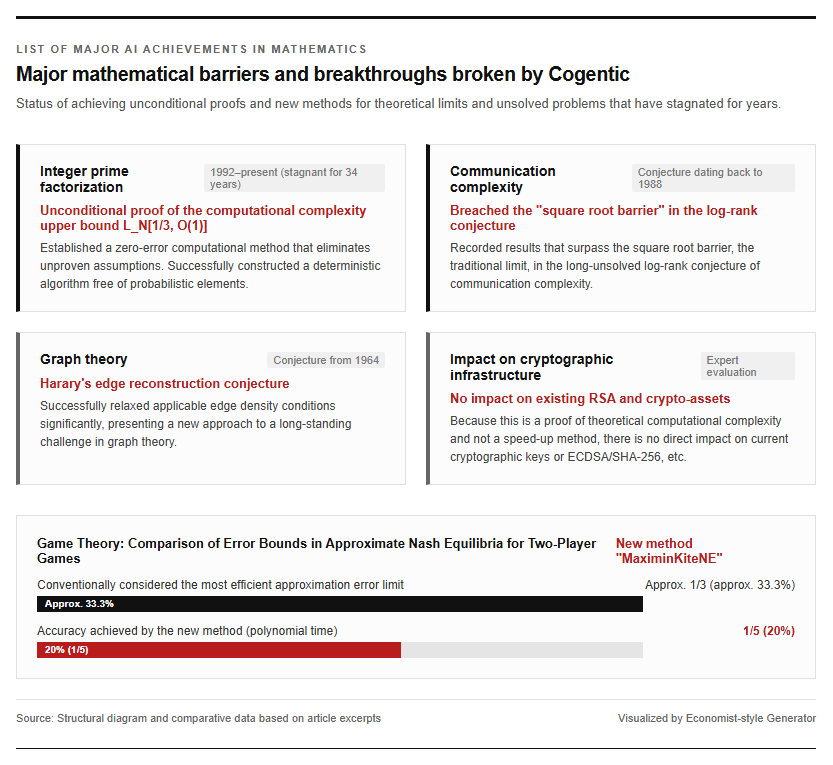
Immediately after the announcement of a theoretical breakthrough in integer factorization, concerns and uncertain rumors spread across the internet that RSA encryption—the security foundation of banking systems and cryptoassets—would be instantly cracked. However, experts and researchers have clearly dismissed this concern. Charles Guillemet, CTO of Ledger, and Professor Scott Aaronson, an authority on quantum computing theory, pointed out that the recent paper represents a “theoretical milestone” that rigorously proves the computational complexity of the existing General Number Field Sieve without unproven assumptions, rather than an algorithm that accelerates actual calculation speeds. Because the key lengths recommended for modern RSA encryption were designed from the outset with the computational capacity of the Number Field Sieve in mind, it will not immediately impact the security of current cryptographic keys. Furthermore, major cryptoassets such as Bitcoin employ Elliptic Curve Cryptography (ECDSA) and the SHA-256 hash function rather than RSA, meaning they will not be directly affected by these results in integer factorization or small-characteristic discrete logarithms. Please refer to the following structural diagram, which organizes the impact relationship between cryptographic foundations and AI papers.
The Mathematical Community’s Reaction and the Future Driven by AI-Led Research
OpenAI’s Mass Publication and Development Competition Among Big Tech Companies
The automation of mathematical research by AI is not limited to Google; it has become a major battleground for intense technological competition among Big Tech companies. In October 2026, OpenAI released a staggering 722 mathematical papers all at once on GitHub, claiming proofs for the quasi-Riemann hypothesis, the Unique Games Conjecture (UGC), and the rational Hodge conjecture, which became a global topic of conversation. Major AI labs, including Anthropic, are rapidly accelerating the announcement of achievements in the most difficult areas of academic research—foundational mathematics and theoretical computer science—to prove the advanced reasoning capabilities and general intelligence of their models. Meanwhile, these moves by tech giants have also sparked strong concerns and backlash from the academic community. A group of mathematicians, including Fields Medalists, and the independent advisory body AGMAI criticized AI companies for downplaying the peer-review process and academic transparency, falling into a “commercial arms race” where they compete to solve unsolved problems merely to promote their own models, strongly demanding the disclosure of prompts and computational costs as well as harmony with the academic community.
Prospects for Mathematical Research Where Human Understanding and Machine Verification Coexist
The arrival of an era in which AI agents autonomously generate vast numbers of papers and proofs forces a fundamental redefinition of the human role and evaluation criteria in mathematical research. As the speed of machine-driven automatic generation far surpasses human capacities for peer review and decryption, the importance of automated verification infrastructure, such as the formal verification language Lean 4, is rapidly increasing. However, merely generating valid sequences of mathematical expressions does not mean that humans have truly understood the mathematical essence or conceptual intuition. Moving forward, a transition is expected toward a “human-AI collaborative research model,” in which humans focus on building new conceptual frameworks, integrating theories, and exploring social and scientific significance, while leveraging AI’s vast search and pattern-recognition capabilities to discover unknown theorems and lemmas. With AI as a powerful partner in unexplored territories of geometry and number theory, there is intense interest in how human intelligence will continue to expand in the developments ahead.
Reference Pages
- 【google-research/cogentic_research_papers】https://github.com/google-research/google-research/tree/master/cogentic_research_papers
【#Google #AI #MathematicalPapers #Cogentic #Gemini4 #PrimeFactorization #Lean4】

コメント