
The European Union (EU) Court of Justice recognized Google’s abuse of its dominant position in the search market and mobile OS, and imposed substantial fines. Behind this is the strong regulatory stance of European authorities seeking to strictly limit the monopolistic practices of large IT companies.
- Record-high fines for Android finalized
- In-house favoritism and repeated sanctions against ad technology
- Losing the case in the United States and scalpels into the business structure
- Market Evaluation and Criticism from President Trump
- Paradigm shift from post-regulation to ex-pre rules
- The launch of a new antitrust investigation in the AI era
Record-high fines for Android finalized
On July 2, 2026, the Court of Justice of the European Union (CJEU), the highest court of the European Union (EU), dismissed the final appeal by Google and its parent company Alphabet. This brought an end to the long-standing antitrust lawsuit over the mobile operating system “Android,” finalizing a record-high fine—4.1 billion euros (about 660 billion yen). In 2018, the European Commission determined that Google forced device manufacturers to pre-install its apps to strengthen its search engine market dominance, initially imposing a fine of 4.34 billion euros. In 2022, the lower court reduced the amount to 4.1 billion euros due to insufficient evidence in some charges, but this ruling completely exhausts Google’s legal remedies, marking a historic victory for Brussels (European authorities). The following image shows the spread of the lawsuit surrounding Android.
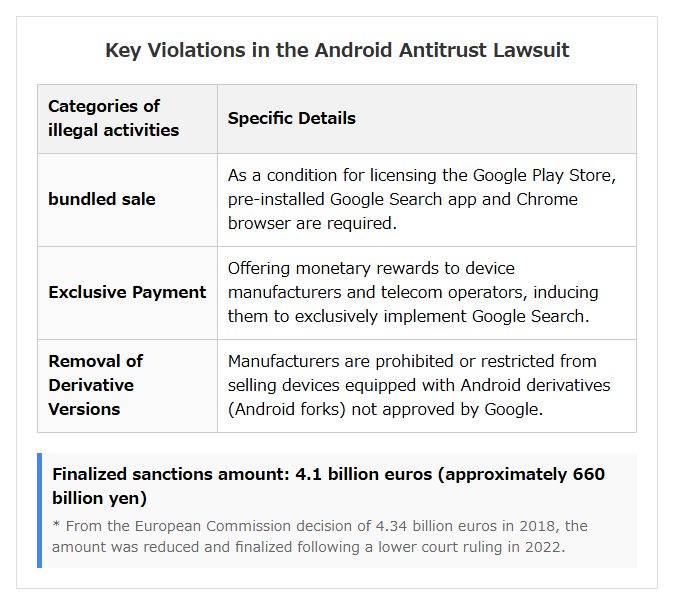
The three specific anti-competitive practices identified as problematic are as follows.
-
As an access condition for the Google Play app store, the search app and the Chrome browser are pre-installed
-
Offered monetary rewards to specific manufacturers on the condition that they would exclusively implement search services
-
Actively blocked the sale of devices equipped with unauthorized Android derivatives (forks)
Google countered that Android’s openness has fueled competition, but the court upheld the European Commission’s finding of abuse of dominant position.
In-house favoritism and repeated sanctions against ad technology
EU authorities’ pursuit of Google is not limited to Android. On September 10, 2024, Google was fined €2.42 billion over “self-priorning,” which allowed Google to display its comparison shopping service more favorably than competitors in search results. Furthermore, on September 5, 2025, a new fine of 2.95 billion euros (approximately 510 billion yen) was imposed for abusing its dominant position in the display advertising technology market. Regarding this advertising technology issue, the European Commission has suggested not only a fine but also the possibility that a “partial sale of the advertising business” may be necessary as a structural remedy to resolve conflicts of interest.
As a result of these incidents, the total amount of antitrust penalties imposed by Google in the EU over the past decade has reached nearly 11 billion euros (over 1.7 trillion yen). Google argues that these decisions are unjust and deprive European companies of revenue opportunities, but judicial rulings have consistently moved toward harshly condemning ‘exclusion by leveraging advantages’ rather than ‘improvement through competition’ by major IT companies.
[Multifaceted Impact] Market Reactions and Political Tensions Between the US and Europe
Losing the case in the United States and scalpels into the business structure
Google’s legal troubles are worsening not only in Europe but also in its home country, the United States. In August 2024, a U.S. federal district court issued a historic ruling that Google violated antitrust laws to maintain its monopoly in the internet search and advertising market. In this ruling, Google was found to have paid tens of billions of dollars annually to Apple and others to set up its search engine initially, which was deemed an “illegal means to eliminate competitors.” In September 2025, the court presented corrective measures. Although the worst-case scenarios initially feared—such as forced sales of Chrome browser and Android OS (business splits)—have been avoided, exclusive search contracts and data sharing with competitors have been prohibited.
The current state of U.S. trials is explained in the following diagram.
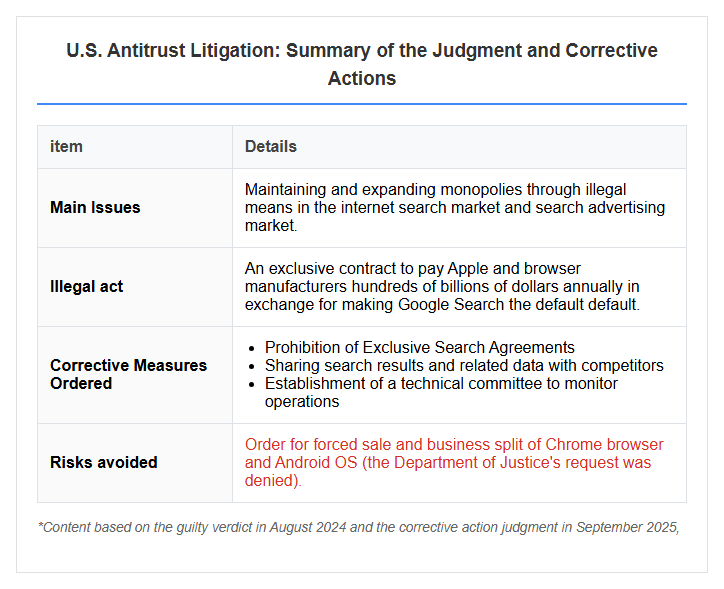
This ruling is the largest since the Microsoft lawsuit in 1998 and is seen as paving the way for next-generation innovation. Riding this victory, the U.S. Department of Justice and the Federal Trade Commission (FTC) have increased regulatory pressure on other major tech companies such as Amazon and Apple.
Market Evaluation and Criticism from President Trump
The market’s reaction to the judicial ruling has been calm in the long term, though there have been temporary fluctuations. Following the confirmed loss in the Android lawsuit, Alphabet’s stock price fell about 1% in premarket trading. However, when the company avoided the worst outcome of a business split in a U.S. trial, there were moments when the stock price rose more than 8% in response to the resolution of uncertainty. Analysts appreciate Google’s efforts to restructure its business to become a winner in the AI field, and are moving up their target price.
On the other hand, this issue has also become a source of conflict in international politics. U.S. President Donald Trump strongly criticized on his social media, calling Europe’s fines on Google “extremely unfair.” Trump argues that these sanctions are discriminatory acts that hinder U.S. investment and employment, and suggests the possibility of retaliatory measures such as investigations into European companies and the imposition of tariffs. The conflict over regulations against major IT companies carries the risk of escalating beyond mere legal disputes into economic friction between the US and Europe.
[Future Outlook] Digital Markets Act (DMA) and Regulation in the New Era of AI
Paradigm shift from post-regulation to ex-pre rules
The conclusion of this Android lawsuit symbolizes the end of an era when the EU mainly used traditional competition law to deal with major tech companies. Until now, antitrust lawsuits often took more than ten years from the emergence of the issue to the result of a verdict, posing challenges of not keeping pace with the pace of technological innovation. As a result, the EU has shifted toward a new regulatory strategy under the Digital Markets Act (DMA), which came into effect in 2023.
A DMA prohibits or requires pre-designated “gatekeeper” companies to perform the following actions in advance.
-
Prohibition of priority display for your own services
-
Prohibition of actions that hinder the presentation of alternative purchase options in app stores
-
Maintaining a fair competitive environment across eight key sectors, including operating systems and advertising services.
Under this new law, authorities will be able to intervene more quickly, and violations may result in extremely high fines of up to 10% of global turnover (or up to 20% for repeated violations). Google is already under a new investigation under the DMA, with search results and app store practices being scrutinized once again.
The launch of a new antitrust investigation in the AI era
The regulatory focus is now rapidly shifting toward the field of artificial intelligence (AI). In December 2025, the European Commission launched a formal investigation into suspicions that Google is using web publisher content and YouTube videos to train generative AI models without proper compensation for creators. As many media outlets rely on Google Search for user traffic, concerns are growing that displaying AI-generated answers (AI overviews) in search results has significantly reduced traffic to publishers.
Google has been pointed out to take a firm stance, such as not allowing content uploads unless data usage is permitted, raising the issue of whether this constitutes an abuse of its dominant position.
Here are the key points to watch going forward.
-
Establishing legitimate compensation rules for the use of AI-generated content
-
Pros and Cons of the Policy Prohibiting Use by Other Companies’ AI on YouTube Content
-
Securing market competition during the transition from traditional search markets to “AI-first search”
The authorities’ determination to not allow a new “data monopoly” by major IT companies is firm, and the regulatory battle over Google has entered its second stage.
[#Google #独占禁止法 #EU #デジタル市場法 #Android #AI規制 #経済ニュース]

コメント