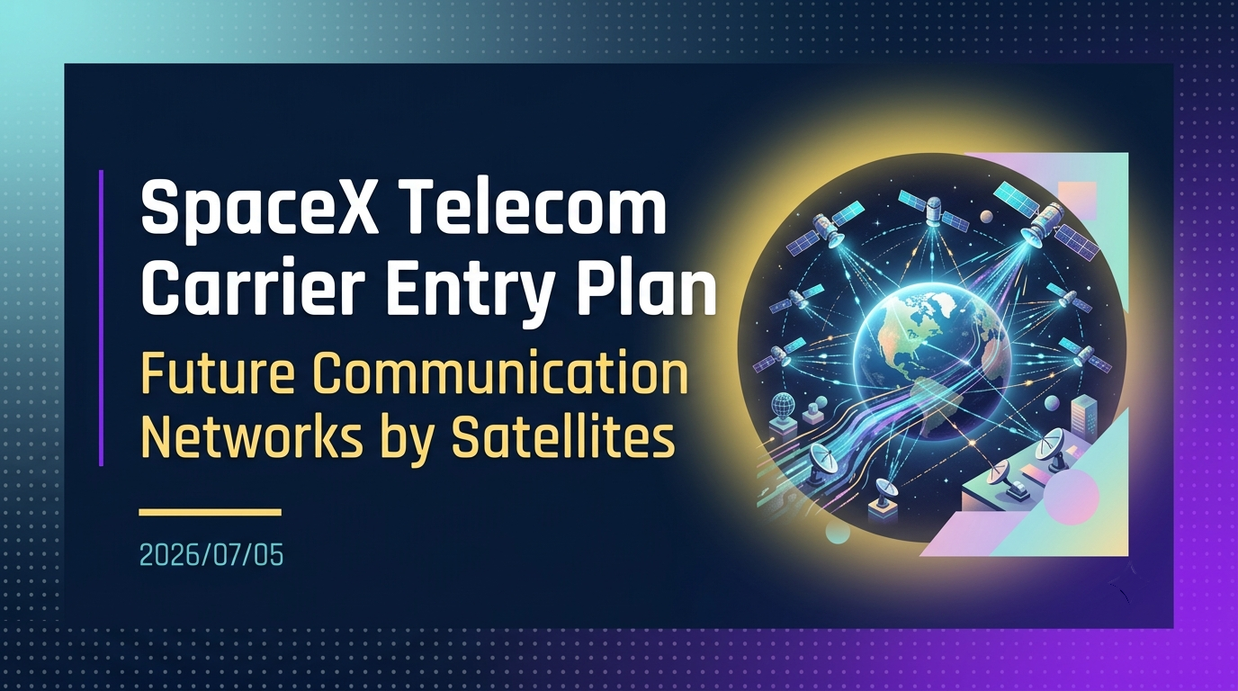
SpaceX in the US is planning to deploy its own telecommunications service that uses technology that directly connects smartphones and satellites without relying on existing carriers. Behind this move is a strategy to evolve the satellite internet ‘Starlink’ into a cash engine generating massive profits, using it as the source for grand visions such as Mars migration and AI infrastructure development.
- Starlink Mobile is changing the everyday life of “zero out-of-reach”
- Innovative technology that connects existing smartphones directly to satellites
- Ripple effects on the Japanese market and the strategies of the four mobile phone companies
- The profitability of the telecommunications business, which supports 60% of total sales
- Overwhelming cost competitiveness created by the vertically integrated model
- A reinvestment cycle that uses Starlink’s profits to invest in Starship and AI
- Inclusion in the Nasdaq 100 Index and Market Expectations
- Interference with Terrestrial Networks and International Debate
- Autonomous Driving, Drones, IoT: Becoming the Foundation for Next-Generation Industries
- Orbital Data Centers and Future Space Infrastructure Concepts
Starlink Mobile is changing the everyday life of “zero out-of-reach”
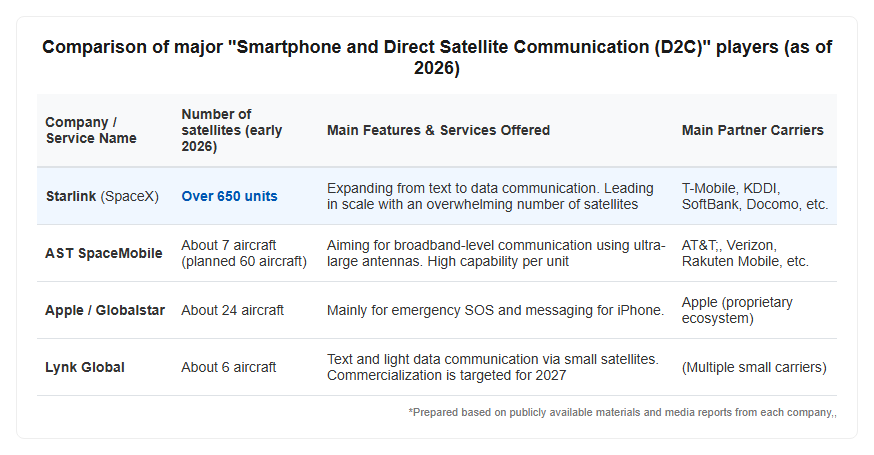
SpaceX’s “Starlink Mobile (Direct to Cell)” is a groundbreaking service that enables communication anywhere on Earth with visible skies, without modifying existing smartphones. As of September 2025, the company has launched over 650 dedicated satellites into low Earth orbit in just 18 months, completing the first generation of Constellation deployments. To date, more than 12 million users worldwide have connected at least once through this service, and it has proven effective as a life-saving communication method in emergencies.
Although SpaceX is already partnering with 35 telecommunications carriers in 32 countries worldwide, its ambitions go beyond supplementing existing carriers as a “countermeasure against being out of reach.” According to the latest analysis, the company has begun pursuing its own carrier model that contracts directly with users, aiming to reshape the global mobile communications market landscape estimated at about 120 trillion yen. In particular, investment banks have discussed the possibility of entering as MVNO (Mobile Virtual Communication Operator) by renting lines from existing carriers, and even the possibility of acquiring major carriers themselves, clearly signaling the transformation from a space company to a comprehensive telecommunications infrastructure company. Please refer to the diagram below.
Innovative technology that connects existing smartphones directly to satellites
The biggest feature of Starlink Mobile is that users do not need to install special hardware or apps, allowing them to use their current LTE-compatible smartphones in their pockets as is. This is achieved by equipping the satellite side with its function as a ‘space mobile phone base station’ (eNodeB payload) and an ultra-large phased array antenna.
Technically, the satellite is operated in an extremely low orbit of about 360 km altitude to optimize the communication link between terminals and satellites. Furthermore, the introduction of next-generation satellites utilizing the dedicated 50MHz frequency band (S-band) acquired from Ecosters is also planned. This next-generation system is expected to increase communication capacity by approximately 100 times compared to the first generation by introducing SpaceX’s in-house designed silicon and advanced 5G protocols. This will enable a communication experience close to current terrestrial LTE even via satellite, aiming to enter the uncharted realm of full 5G connectivity everywhere, including mountainous and offshore areas.
Ripple effects on the Japanese market and the strategies of the four mobile phone companies
SpaceX’s plan to enter the carrier market is sending significant ripples through Japan’s domestic telecommunications market. In Japan, KDDI took the lead and began offering “au Starlink Direct” in April 2025. The service is scheduled to expand from text message sending to data communication after summer 2025, and has already gained over 4 million users.
In 2026, this trend accelerated further, with NTT Docomo launching “docomo Starlink Direct” on April 27 and SoftBank launching “SoftBank Starlink Direct” on April 10. Meanwhile, Rakuten Mobile is pursuing its own path by partnering with US-based AST Space Mobile, aiming for commercialization in the fourth quarter of 2026. While Japan’s four mobile carriers are each working on direct satellite communication with different partners and methods, if SpaceX goes beyond its partnership model and steps into carrier services under its own brand, the long-standing “business model that controls the line” that Japanese carriers have built could be fundamentally transformed by the Black Ship from space.
The Revenue Structure of Giant Infrastructure Companies Disguised as Space Firms
The profitability of the telecommunications business, which supports 60% of total sales
SpaceX’s true identity is no longer just a “company that launches rockets.” Looking at the revenue structure for fiscal year 2025, of the company’s total sales of approximately $18.67 billion, the Connectivity division centered on Starlink will account for about $11.39 billion, making it the largest pillar that generates about 60% of total sales.
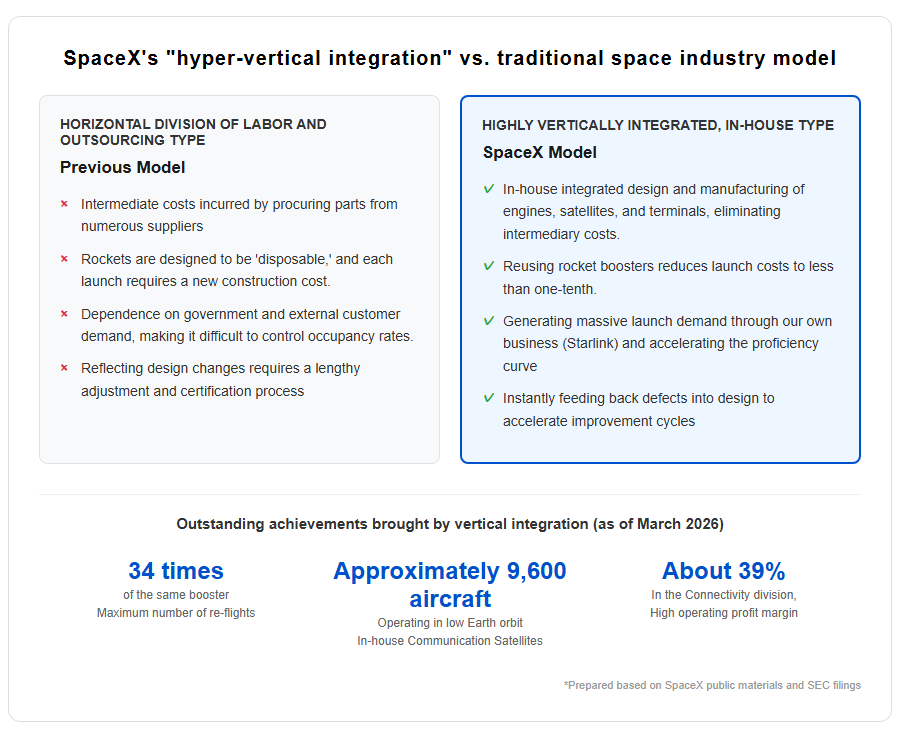
Notably, its high profit margin is particularly noteworthy. The telecommunications segment’s operating profit for 2025 is projected to reach approximately $4.42 billion, with an exceptionally high operating margin of about 39%. In contrast, the rocket launch business (Space division) posted an operating loss of $660 million due to investments aimed at future market acquisition, and the AI division also posted a $6.36 billion deficit, in contrast to Starlink, which functions as a powerful “cash engine” supporting the growth and loss-making businesses across the SpaceX Group. The number of subscribers has exploded from 2.3 million in 2023 to 10.3 million by the end of March 2026, and this steady subscription revenue is the lifeblood supporting the company’s ambitious projects.
Overwhelming cost competitiveness created by the vertically integrated model
The reason SpaceX dominates other space and telecommunications companies lies in its “ultra-vertical integration” system, where everything from design and manufacturing to launch and operation is handled in-house. The technology for reusing the main Falcon 9 rocket for broadband satellite launches has succeeded in reducing launch costs to less than one-tenth of conventional ones. As of March 2026, the company has re-flown the same booster 34 times, and owning this high-frequency, low-cost transportation method is driving the rapid construction of a satellite network of thousands of satellites in a short period.
Additionally, in the manufacturing of satellite bodies, the space industry has overturned the conventional ‘one-piece production’ convention and introduced a mass production model similar to that of automobile factories. As of March 2026, it will have about 9,600 operational satellites, all designed under a system that standardizes design and enables continuous mass production. By building satellites in-house, launching them with their own rockets, and providing them as their own communication services, they minimize external payment costs and accelerate improvement cycles to the extreme. This overwhelming cost competitiveness and speed are precisely the biggest barriers that competitors cannot match. Please refer to the diagram below.
A reinvestment cycle that uses Starlink’s profits to invest in Starship and AI
SpaceX’s management strategy is based on a cycle of boldly reinvesting the massive cash earned from its telecommunications business into next-generation rockets like Starship and AI infrastructure that bring further cost reductions. In 2025 alone, more than $3 billion will be invested in research and development related to Starship, and once this new rocket becomes operational, the payload it can carry per launch will exceed 100 tons, dramatically reducing the cost of space transportation.
Furthermore, the company is accelerating its expansion into the AI field, having acquired and integrated xAI led by Elon Musk in 2026. This aims to build an unprecedented infrastructure platform that vertically integrates hardware (rockets and satellites), infrastructure (communication networks), and intelligence (AI). This circular model, which seeks to simultaneously grasp the future of space development and information processing fueled by profits generated by the communications sector, is no longer merely a single corporate strategy but an attempt to update the very infrastructure of human civilization.
The ambitions of a $2 trillion market capitalization company and international friction
Inclusion in the Nasdaq 100 Index and Market Expectations
Following its IPO in June 2026, SpaceX made a historic debut by surpassing $2 trillion (approximately 324.7 trillion yen) in market capitalization. Immediately after listing, there was some volatile price swings due to profit-taking sales, but prominent analysts described it as a “once-in-a-generation buying opportunity” and highly valued the rarity of the company’s vertically integrated platform, which integrates telecommunications, rockets, and AI.
A major upcoming highlight is its inclusion in the Nasdaq 100 index scheduled for July 7, 2026. This will generate massive forced buying demand from passive management funds linked to the index, further supporting stock prices and increasing volatility. Additionally, the linkage with Tesla stock, which shares the same CEO, has become a market concern, and Musk’s “two empires,” centered on AI and next-generation infrastructure, share a base of individual investors and exert increasing influence on global financial markets day by day.
Interference with Terrestrial Networks and International Debate
Starlink’s rapidly expanding new service has raised strong concerns from existing terrestrial carriers. On September 30, 2024, seven major European telecommunications carriers (including Orange, Telefonica, Vodafone, etc.) jointly submitted a statement to the U.S. Federal Communications Commission (FCC), stating that Starlink’s direct satellite communications pose a risk of interfering with existing terrestrial networks and degrading communication quality.
The focal point of controversy is a phenomenon called “Out-of-Band Emission (OOBE),” in which radio waves from satellites leak beyond permitted ranges into adjacent frequency bands, potentially disrupting ground base station communications. SpaceX is seeking to ease these regulations, but major U.S. carriers AT&T and Verizon have also voiced opposition, leading to international disputes including legal claims for damages. How space infrastructure and ground infrastructure share and coexist with limited frequency resources, as regulatory authorities in each country will establish rules that will be a major key factor shaping future business development.
Outlook for Global Communication Networks Supporting the AI Era
Autonomous Driving, Drones, IoT: Becoming the Foundation for Next-Generation Industries
The true value of direct communication between satellites and smartphones lies in keeping every device in the AI era always-connected beyond merely ensuring “human calls.” Next-generation infrastructure such as autonomous vehicles, logistics drones, and remotely operated robots is fundamentally based on maintaining uninterrupted data communication wherever on Earth. Starlink Mobile is playing a foundational role for next-generation industries by covering the entire surface of the Earth—including mountainous, offshore, and disaster-affected areas—areas that traditional ground base stations alone could not cover.
Additionally, expansion into the IoT (Internet of Things) field is accelerating, and in Japan, KDDI launched Japan’s first direct satellite communication service for IoT networks in April 2026. It is expected to streamline remote infrastructure monitoring and weather data collection, which had previously been difficult to inspect manually, and contribute to solving the challenges of severe labor shortages in depopulated areas. In a society where everything is connected to AI through space, SpaceX’s communication network is evolving into an indispensable part of blood flow.
Orbital Data Centers and Future Space Infrastructure Concepts
SpaceX’s vision is heading toward the “space deployment of computing resources” beyond communications. The company has indicated plans to begin building an “on-orbit AI data center” deploying satellites for AI computing as early as 2028. Terrestrial data centers face serious challenges such as massive electricity consumption, securing cooling water, and land use regulations, but the idea is that they can directly utilize the powerful solar energy available almost constantly in outer space, freeing them from terrestrial constraints and limiting infinite scalability.
To realize this grand plan, the next-generation rocket “Starship” will have the capability to transport supplies in the million-ton range. In the future, there is even a concept called “Terafab,” which procures resources on the lunar surface, manufactures satellites, and deploys them into deep space. SpaceX is now beginning to build an extraterrestrial civilization infrastructure that integrates communications, AI, and energy into orbit, aiming for Elon Musk’s ultimate mission to “multi-planetary species.”
[#SpaceX #Starlink #通信キャリア #垂直統合 #IPO #イーロンマスク #AIインフラ #宇宙ビジネス]
」_en.png)

コメント