Citing its acquisition by SpaceX, OpenAI has proposed terminating its direct AI model supply agreement with the AI coding tool “Cursor” on November 12, 2026. This move is driven by the invocation of a change-in-control clause associated with the change in parent company, as well as distrust toward the company led by Elon Musk.
- OpenAI’s announcement of the end of the partnership
- Application of the transition period and contract clauses proposed on November 12, 2026
- Trust concerns regarding companies led by Elon Musk
- Ensuring the Safety of the Next-Generation AI Model “Astra” and the Preparedness Framework
- Impact of 5% User Traffic and 3 Technical Migration Paths
- AI Model Dependency Risks as a Supply Chain and Competitor Trends
OpenAI’s announcement of the end of the partnership
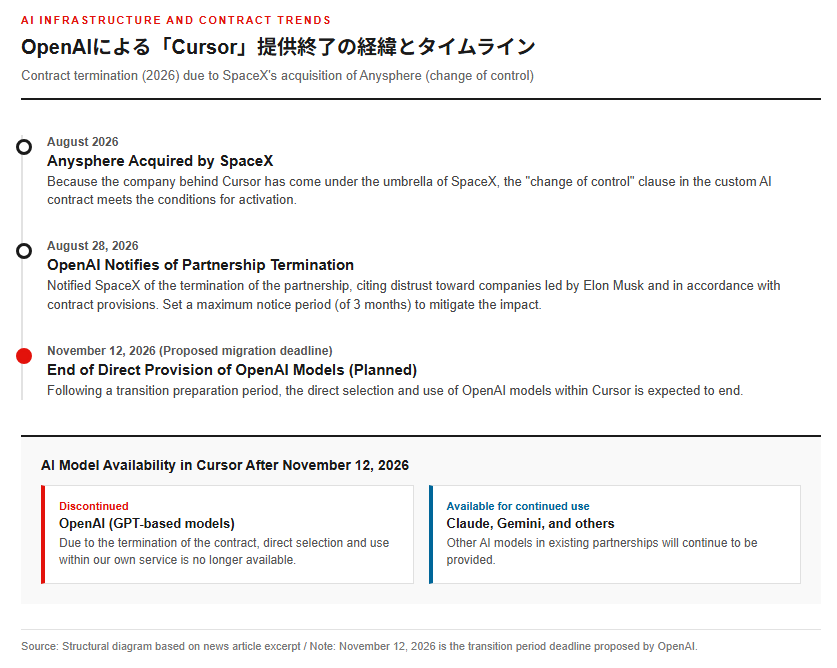
On August 28, 2026, OpenAI announced that it had notified its parent company, SpaceX, of its intention to terminate its partnership and AI model provision agreement with Anysphere, the developer of the popular AI coding tool “Cursor.” OpenAI also stated on its official social media channels that it plans to dissolve the partnership following the acquisition by SpaceX. As a result, starting in mid-November 2026, Cursor users are expected to no longer be able to directly select and use OpenAI’s models within the service. Until now, Cursor has been praised by developers for allowing them to use multiple top-tier AI models—such as the GPT series, Claude, and Gemini—in parallel without having to switch working environments. However, this decision will result in the loss of one of those crucial options. Even so, this does not mean that Cursor itself will become unusable, and other AI models with which partnerships are maintained will continue to be provided.
Application of the transition period and contract clauses proposed on November 12, 2026
The specific termination date proposed by OpenAI to SpaceX and Anysphere is November 12, 2026. This date is not a finalized shutdown date, but was proposed by OpenAI as a preparation period for developers to transition to alternative solutions. OpenAI cited the acquisition of Anysphere, the company behind Cursor, by SpaceX in August 2026 as the reason for the contract termination. The custom AI agreement concluded between the companies includes a change-in-control clause allowing either party to unilaterally terminate the contract within a certain period if a change in the company’s parent company or voting power owner occurs, and OpenAI has lawfully exercised its rights under this clause this time. The company explained that it intentionally set a three-month notice period—the longest permitted under the contract—to minimize the blow to the affected developer community.
Please refer to the diagram below to see how developers are responding as the discontinuation approaches.
The Background of the Conflict That Led to the Termination of Technology Provision
Trust concerns regarding companies led by Elon Musk
The primary factor behind OpenAI’s decision to terminate this contract is a deep distrust of SpaceX, Cursor’s new parent company, and its CEO, Elon Musk. OpenAI cited past instances where companies led by Musk have repeatedly violated multiple contracts and terms of service as the basis for its decision. Specifically, the company pointed to the breach of contract terms by Twitter (now X) following Musk’s acquisition, as well as the fact that Musk himself admitted during deposition testimony in a 2026 lawsuit that xAI had violated terms of service through the unauthorized use of OpenAI data. With xAI now operating as part of SpaceX, OpenAI concluded that it could not be confident that SpaceX would properly use advanced technology within the bounds of the terms of service, triggering the end of their nearly four-year collaboration.
Ensuring the Safety of the Next-Generation AI Model “Astra” and the Preparedness Framework
Another factor in this decision is the existence of Astra, which OpenAI is developing as its next-generation flagship model. On August 7, 2026, OpenAI announced that it cannot rule out the possibility that Astra’s cybersecurity capabilities have reached “Critical,” the highest level defined in its internal Preparedness Framework. “Critical” refers to a level that brings unprecedented, qualitatively new threats and cyber capabilities, and models that reach this standard require extremely careful management. Determining that providing a new-generation model with such advanced and powerful cyber capabilities to a company that has come under control without guaranteed trust would pose a major safety risk, the decision was firmly made to adopt a policy of not providing any future new models to Cursor at all.
Specific Impact on Developers and the Market
Impact of 5% User Traffic and 3 Technical Migration Paths
Through a social media post, Michael Truell, co-founder of Cursor, revealed that OpenAI models account for only about 5% of all user traffic within Cursor, expressing his view that the overall impact is limited. However, for users leveraging AI in practical business settings, sudden model changes or supply interruptions impose a heavy burden, as they require revisions to operational manuals and retraining. To avoid this impact, OpenAI and the community have proposed the following three migration paths. The first is a method where users set their own individual OpenAI API keys obtained by themselves in the Cursor desktop app to connect directly. The second is a method of running the Codex IDE extension separately within Cursor; since this does not depend on Cursor’s native model selection feature, it continues to operate unaffected by the termination of the contract. The third is a route to connect to OpenAI models via external cloud gateways such as Azure or Amazon Bedrock.
AI Model Dependency Risks as a Supply Chain and Competitor Trends
This incident has highlighted the fact that AI models, which have served as the foundation of productivity enjoyed by developers worldwide, are actually a supply chain that can easily fluctuate depending on the business relationships and terms of service of the provider companies. For systems or editors that rely completely on the AI of a single specific company, the blow dealt in the event of a similar situation would be even more catastrophic. In that regard, because Cursor adopted a multi-model design, transitioning to another cutting-edge model was easy, avoiding the worst-case scenario. Additionally, activity among competing AI companies is heating up. Tom Brown, co-founder and CCO of competitor Anthropic in the US, praised Cursor as a trusted partner since Claude 3.5 Sonnet and announced that he will continue to preferentially allocate computational resources to further strengthen the provision of Claude models on Cursor. Moving forward, this will serve as a turning point to determine whether the editor’s flexibility in switching between multiple models will be appreciated, or whether users looking for a specific, powerful model will leave.
Reference Page
- 【Our decision on Cursor following its acquisition by SpaceX】https://openai.com/index/our-decision-on-cursor-following-its-acquisition-by-spacex/
【#AICoding #Cursor #OpenAI #SpaceX #AISafety #ElonMusk #DevelopmentEnvironment】

コメント