Saitama City has decided to increase the total continuous expenditure to approximately 30.5 billion yen for the construction project of a planned compulsory education school around JR Musashi-Urawa Station, following three consecutive failed biddings, and aims to re-tender the project with the goal of starting construction in July 2027. The background involves surging material prices and a concentration of ongoing projects among construction contractors due to a severe labor shortage, highlighting structural challenges that are common to public facility development nationwide.
- Key Points of the Events and Policy for the Fourth Re-bidding
- Project costs ballooning from 22 billion yen to 30.5 billion yen and the background behind the poor performance
- The Dilemma of the City’s First 9-Year Integrated School Plan and the Overcrowded School Problem
- Voices of Anxiety and Criticism Erupt at the Residents’ and Parents’ Briefing Session
- The Reality of Soaring Construction Costs Revealed by a Nationwide Survey of Local Governments
- Challenges Toward Re-bidding and Future Points of Focus
Key Points of the Events and Policy for the Fourth Re-bidding
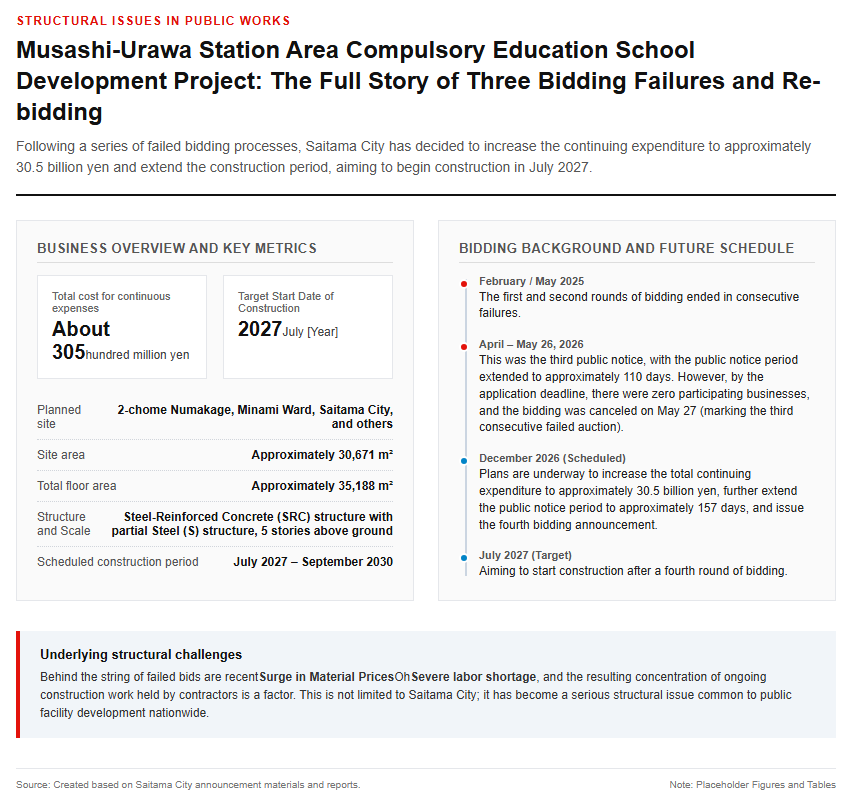
At a regular press conference on October 14, 2026, Hayato Shimizu, Mayor of Saitama City, Saitama Prefecture, announced his intention to hold a fourth round of bidding for the construction work of the “(Tentative Name) Saitama Municipal Musashi-Urawa Station Surrounding Area Compulsory Education School Development (Construction) Project,” for which bidding has failed for three consecutive times, aiming to start construction in July 2027. To cope with the rapid increase in the number of children and students due to redevelopment around Musashi-Urawa Station, the project plans to construct a five-story school building with a steel-framed reinforced concrete (and partially steel-framed) structure and a total floor area of approximately 35,188 square meters on the former site of Numakage Park and part of the site of Numakage Municipal Elementary School (2-7-35 Numakage, Minami-ku, Saitama City, and other locations, with a site area of approximately 30,671 square meters).
After experiencing two failed bidding processes in February and May 2025, the Saitama City Board of Education significantly extended the public notice period from the previous 44 days to approximately 110 days and implemented countermeasures such as relaxing participation qualifications, before issuing a public notice for a third bidding process in April 2026. However, since zero businesses submitted an application for confirmation of participation qualifications by the application deadline of May 26, 2026, it announced the cancellation of the bidding on May 27. Saitama City plans to issue a public notice for a fourth bidding process by December 2026, and in addition to further extending the public notice period from the previous 142 days to approximately 157 days, it has set a construction period from July 2027 to September 2030, placing the highest priority on successfully completing the construction work.
The following image shows an overview of the planned construction site.
Project costs ballooning from 22 billion yen to 30.5 billion yen and the background behind the poor performance
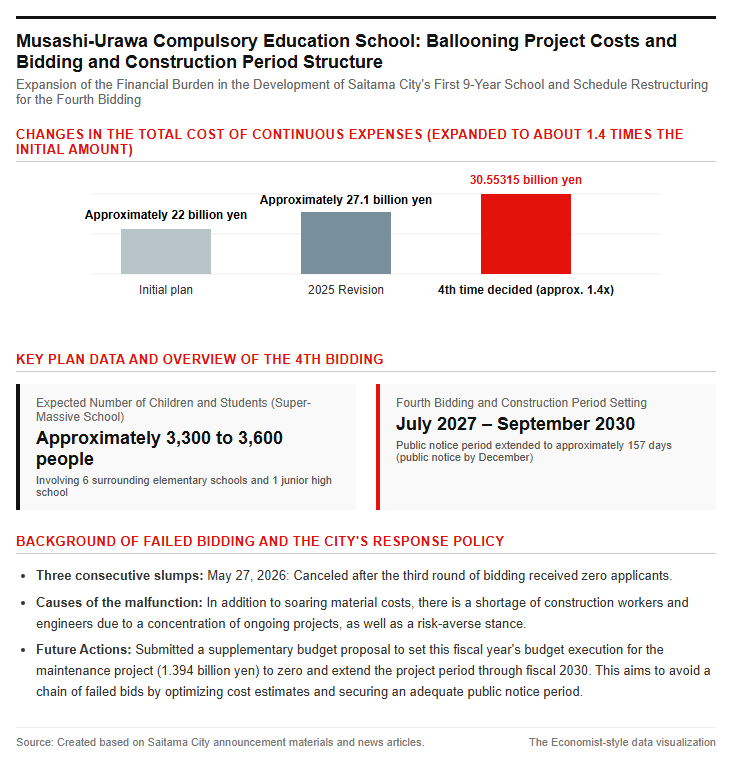
Under the new school development project spearheaded by the City of Saitama, project costs have continued to swell due to recent surges in material prices and rising labor costs. While the total ongoing expenditure at the initial planning stage was estimated at approximately ¥22 billion, it was increased to about ¥27.1 billion in the 2025 review, and with the decision on this fourth round of bidding, an additional ¥3.4 billion was added, bringing the total ongoing expenditure to ¥30,553,150,000. This represents an expansion to approximately 1.4 times the scale compared to the initial budget. The City of Saitama has submitted a supplementary budget proposal to the city council to zero out the ¥1.394 billion in development project execution planned for this fiscal year and to change the project implementation period from fiscal 2027 to fiscal 2030.
Regarding the background of the bidding falling through three times in a row, interviews and questionnaire surveys conducted by the City of Saitama targeting 44 construction companies revealed that the primary factor was the concentration of ongoing projects, such as private construction work and other large-scale public works, during the construction period, which made it impossible to secure the necessary construction personnel and engineers. As contractors increasingly showed a tendency to avoid bidding out of fear of risks, the “estimate-utilization method” introduced by the city also proved ineffective. However, regarding the new estimated construction period proposed by the city (July 2027 to September 2030), responses indicating “we will consider participating” have been received from multiple contractors, and the city intends to break the chain of failed bids by optimizing estimated costs and securing adequate public notice periods.
The Musashi-Urawa Compulsory Education School Development Plan and the Depths of the Confusion
The Dilemma of the City’s First 9-Year Integrated School Plan and the Overcrowded School Problem
The planned “Musashi-Urawa Station Vicinity Compulsory Education School” will be Saitama City’s first compulsory education school, offering a unified nine-year curriculum from the first grade of elementary school to the third grade of junior high school. It is designed to be an ultra-massive school with an estimated 3,300 to 3,600 students, and has been positioned as a flagship policy to address the increase in children accompanying the rush of high-rise condominium construction around Musashi-Urawa Station. This is a large-scale reorganization plan involving six surrounding schools: Numakage Elementary School, Urawa Oizato Elementary School, Urawa Bessho Elementary School, Nishi-Urawa Elementary School, Tsuji Elementary School, and Uchiya Junior High School.
However, even among ordinance-designated cities, Saitama City has a high proportion of large and overcrowded schools (with 31 or more classes), and the deterioration of the educational environment has been pointed out for years. There are also strong doubts regarding the current plan, with many questioning whether consolidating a facility for roughly 3,600 students into a single location might instead lead to difficulties in school administration. A petition submitted to Saitama City by a civic group points out that the plan itself—cramming a combined elementary and junior high school onto the limited site of the former Numakage Citizens’ Pool—is a factor driving up costs, and argues that flexible, decentralized measures such as adding classrooms to surrounding junior high schools and adjusting school districts should be considered. In response, the city has stated that establishing a compulsory education school is the best option due to constraints in securing land and to avoid the fragmentation of communities across a wide area.
The figure below shows the school district concept associated with school reorganization.
Voices of Anxiety and Criticism Erupt at the Residents’ and Parents’ Briefing Session
Following three failed rounds of bidding, the Saitama City Board of Education held explanatory meetings on July 12 and 13, 2026, at the Municipal Utiya Junior High School gymnasium for parents and local residents. Approximately 50 people, including parents from the six affected schools, attended the sessions. Hideko Takei, Superintendent of Education, offered an apology and reported the current situation, stating that the originally planned opening in April 2028 is now practically impossible and that the city now aims to complete construction during 2030.
Severe criticisms poured in from the venue, such as “Three failed bids is a major blunder by the city administration” and “It is causing immense stress because we don’t know when our children’s future schools or school districts will be decided.” Particularly from parents with older children in upper grades, concerns were raised about confusion caused by construction delays—such as siblings ending up attending different schools, or families being forced to consider enrolling their children in private schools. Furthermore, there was a succession of voices expressing dissatisfaction over the abolition of the Numakage Municipal Pool, which was chosen as the construction site, as well as demands for securing safe play areas during the period until construction begins, and calls for improving the educational environment during the postponement period, such as upgrading existing school restrooms to Western-style ones and installing air conditioning in gymnasiums.
Public Works Slumps Spreading Nationwide and Future Outlook
The Reality of Soaring Construction Costs Revealed by a Nationwide Survey of Local Governments
The three failed bidding processes in Saitama City are by no means an isolated incident unique to a single municipality. According to a questionnaire survey conducted by The Japan Research Institute, Limited targeting 557 basic municipalities nationwide (conducted in January–February 2026, with 155 municipalities responding), nearly all municipalities recognize that “construction costs are soaring,” with about 80% of them reporting that they have felt this surge over the past five years. Moreover, a mere three municipalities answered that construction cost increases will subside and “plateau” going forward, leaving local governments with no choice but to take action on the assumption that costs will remain high or rise even further.
According to the same survey, more than 70% of all local governments have experienced failed or aborted bids for construction work over the past three years. The primary reasons cited were “the planned price does not match market prices” (approx. 77%) and “tight construction schedules” (approx. 23%). As for responses after a failed bid, more than half of the municipalities “re-advertised the project with an increased planned price without changing the scope of work,” creating a nationwide vicious cycle of further increases in construction costs due to budget re-resolutions and project delays. The soaring project costs and delays in the construction of the new school in Saitama City can be said to be a prime example of this structural crisis brought about by the nationwide construction boom and labor shortage.
Challenges Toward Re-bidding and Future Points of Focus
To achieve Saitama City’s goal of issuing the fourth bidding public notice by December 2026 and starting construction in July 2027, many challenges still lie ahead. First is the question of whether the estimated price, increased to 30.5 billion yen, will be sufficient in light of material price and labor cost trends from 2027 onward. Amid the ongoing impacts of global resource price hikes, the depreciation of the yen, and overtime regulations in the construction industry (the “2024 problem”), the risk remains that if further cost increases occur, the city will be forced to choose between increasing project costs once again or scaling back the plan.
Second, while the opening timeframe has not been indicated, questions are being raised about how swiftly concrete measures to maintain the local educational environment—such as adding prefabricated school buildings and repairing existing facilities—will be implemented. Although Mayor Shimizu emphasizes that “completing the construction without fail is the primary goal,” careful explanations and highly transparent information disclosure are essential to regaining the trust of parents and local residents. Attention is focused on the future moves of the city administration and the city council as to whether a business operator will be successfully selected in the fourth bidding round so that construction can begin, or whether they will be forced into a fundamental reassessment of the plan itself.
Reference page
- [Saitama City: (Announced on May 27, 2026) Regarding the failed bidding for the (tentative name) Saitama Municipal Musashi-Urawa Station Surrounding Area Compulsory Education School Construction (Architectural) Project] https://www.city.saitama.lg.jp/006/014/008/003/015/002/p130982.html
- 【Saitama City: Written Request for Reconsideration Regarding the Construction of a New City Hall, Construction of Compulsory Education Schools, Abolition of the Meat Market, etc.】https://www.city.saitama.lg.jp/006/002/016/004/p131780.html
- 【Japan Research Institute Conducts Questionnaire Survey of Local Governments on “Public Facility Development in the Era of Surging Construction Costs”】[suspicious link removed]
[#SaitamaCity #MusashiUrawa #CompulsoryEducationSchool #BiddingFailure #RisingConstructionCosts]


コメント